
Contents of this guide
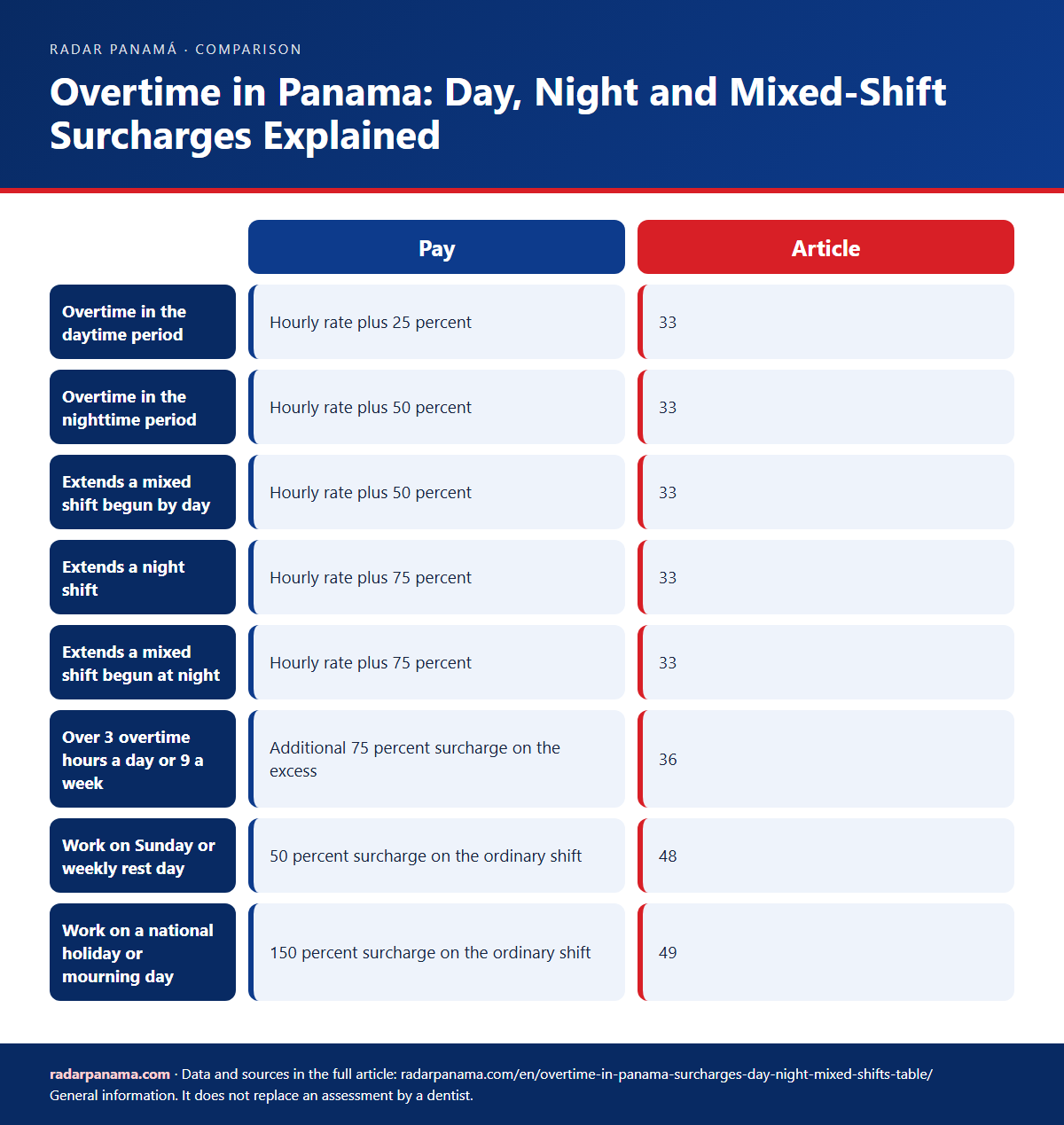
| Situation | Pay | Article |
|---|---|---|
| Overtime in the daytime period | Hourly rate plus 25 percent | 33 |
| Overtime in the nighttime period | Hourly rate plus 50 percent | 33 |
| Extends a mixed shift begun by day | Hourly rate plus 50 percent | 33 |
| Extends a night shift | Hourly rate plus 75 percent | 33 |
| Extends a mixed shift begun at night | Hourly rate plus 75 percent | 33 |
| Over 3 overtime hours a day or 9 a week | Additional 75 percent surcharge on the excess | 36 |
| Work on Sunday or weekly rest day | 50 percent surcharge on the ordinary shift | 48 |
| Work on a national holiday or mourning day | 150 percent surcharge on the ordinary shift | 49 |
Summary of articles 33, 36, 48 and 49 of the Labor Code, in the version with the amendments of Law 44 of 1995 published by Panama’s Judicial Branch. How surcharges combine is covered by article 50.
The three surcharges in article 33
Article 33 of the Labor Code defines the working day as all the time the worker cannot freely use because of being at the employer’s disposal. Time beyond the limits of the ordinary shift, or beyond lower limits set by contract or internal rules, is overtime. It is paid with a surcharge on the wage, and the percentage depends on the period in which the work is done:
| When the overtime hour is worked | Surcharge on the wage |
|---|---|
| In the daytime period | 25 percent |
| In the nighttime period, or when it extends a mixed shift that began in the daytime period | 50 percent |
| When it extends the night shift or a mixed shift that began in the nighttime period | 75 percent |
Put simply, each overtime hour is paid as an ordinary hour plus the corresponding percentage. A daytime overtime hour is worth 1.25 times the ordinary hour, a 50 percent hour is worth 1.5 times and a 75 percent hour is worth 1.75 times.
Day, night and mixed shifts
To know which surcharge applies, it is necessary to know which shift the person works. Article 30 splits the day into two periods: daytime, from 6 a.m. to 6 p.m., and nighttime, from 6 p.m. to 6 a.m. A shift is a night shift when more than three of its hours fall in the nighttime period, and it is mixed when it spans hours from both periods without going over three nighttime hours.
Article 31 sets the ordinary maximum for each:
| Shift | Daily maximum | Weekly maximum |
|---|---|---|
| Day | 8 hours | 48 hours |
| Night | 7 hours | 42 hours |
| Mixed | 7 and a half hours | 45 hours |
Anything beyond those maximums, or beyond a lower limit the company has agreed to, is overtime. A person who completes 8 daytime hours and stays 2 more generates 2 daytime overtime hours. One who works a 7 hour night shift and stays 1 more generates one overtime hour with a 75 percent surcharge. The same article 31 says that 7 nighttime hours and 7 and a half hours of a mixed shift are paid as 8 hours of daytime work.
How many overtime hours are allowed
Article 36 limits overtime. No more than three overtime hours can be worked in a day or more than nine in a week. When for any reason the worker goes past that cap, the excess is paid with an additional 75 percent surcharge, without prejudice to the penalties that may apply to the employer. The same article bans overtime in dangerous or unhealthy work and for workers under sixteen.
Article 35 clarifies that workers are not required to work overtime, except in two cases: when an accident or imminent risk endangers lives or the existence of the business, or when a collective agreement provides for it and the person accepted that obligation in an individual contract. The text also contemplates exceptions for agricultural operations, small businesses and fully export-oriented industries, always within legal limits.
How pay is calculated, with an example
There is a single formula: overtime hours times the ordinary hourly rate times one plus the surcharge. These articles do not set a divisor for converting a monthly salary into an hourly rate, so that figure comes from the contract and from how the company pays wages. With an ordinary hourly rate of 10.00 balboas (an illustrative figure, not any real salary), the calculation looks like this:
| Overtime in the pay period | Surcharge | Rate per hour | Total |
|---|---|---|---|
| 2 hours in the daytime period | 25 percent | 12.50 balboas | 25.00 balboas |
| 2 hours in the nighttime period | 50 percent | 15.00 balboas | 30.00 balboas |
| 1 hour extending the night shift | 75 percent | 17.50 balboas | 17.50 balboas |
| Total overtime | 72.50 balboas |
Example with an invented ordinary hourly rate to show the mechanics. Each company starts from the person’s actual salary and schedule.
- Identify the shift. Day, night or mixed, depending on how many hours fall in each period (article 30).
- Separate ordinary from overtime. Whatever goes past the daily maximum or the agreed limit is overtime (articles 31 and 33).
- Check the caps. Three hours a day and nine a week; the excess carries the additional 75 percent surcharge (article 36).
- Assign each hour’s surcharge. The 25, 50 or 75 percent rate applies depending on the period and type of shift (article 33).
- Close the payroll cutoff. Article 37 says wages must include overtime worked up to five working days before payday.
According to Panama Outsourcing’s website, its payroll calculation service processes biweekly or monthly payroll with overtime, holidays, commissions, vacations and sick leave, and issues pay slips that break down each employee’s shifts. That traceability is what lets anyone check where each surcharge comes from.
Panama Outsourcing, a Panamanian human resources company, calculates biweekly or monthly payroll that includes overtime, holidays and individual pay slips, according to its website. The service page explains what it covers.
Sundays, rest days and holidays
Article 48 establishes that work on a Sunday or another mandatory weekly rest day is paid with a 50 percent surcharge on the ordinary shift, without prejudice to the person’s right to another rest day. Article 49 sets the surcharge for work on a national holiday or mourning day at 150 percent and states that this surcharge includes pay for the rest day. Days off that arise from workweeks shorter than six days are paid at 50 percent if worked in a day shift and at 75 percent if worked in a mixed or night shift.
When several surcharges coincide, article 50 sets the order: the Sunday, holiday or mourning day surcharge is applied to the wage first, and the surcharge for the excess hours is added to that result. The same principle governs any other case with several surcharges. Holiday details are covered in the client’s entry on how to calculate holiday pay, which is in Spanish.
The base amounts of the minimum wage, which change by decree, are explained in Radar’s guide to the minimum wage in Panama.
Common payroll mistakes
- Applying 25 percent to every overtime hour without checking whether it was worked at night or extends a night or mixed shift.
- Forgetting that 7 nighttime hours or 7 and a half hours of a mixed shift already count as a full day, so overtime starts earlier than on a day shift.
- Not counting hours beyond three a day or nine a week with their additional surcharge.
- Paying a Sunday or holiday as a normal day, without the surcharges in articles 48 and 49.
- Leaving out of the pay period the overtime worked up to five working days before payday (article 37).
- Calculating overtime without a daily record of clock-ins and clock-outs to back each surcharge.
Companies with questions about contracts, internal rules or shift records can review Panama Outsourcing’s labor legal advisory service. The contributions deducted from what is paid are covered in the guide to social security contributions.
This content is informational and does not replace the advice of a labor lawyer or an accountant. The articles were read in the version of the Labor Code with the amendments of Law 44 of 1995; it is worth confirming in the Gaceta Oficial whether later reforms exist before applying any calculation.
Frequently asked questions
How much is overtime paid in Panama?
The ordinary hourly rate plus a 25, 50 or 75 percent surcharge, depending on the period worked and the type of shift, under article 33 of the Labor Code. Daytime overtime is worth 1.25 times the ordinary hour.
How many overtime hours can be worked per day and per week?
Up to three overtime hours a day and nine a week, under article 36. Anything beyond that cap is paid with an additional 75 percent surcharge, without prejudice to penalties on the employer.
How is night overtime paid?
With a 50 percent surcharge when worked in the nighttime period, and 75 percent when it extends the night shift or a mixed shift begun at night. The nighttime period runs from 6 p.m. to 6 a.m.
How much is work on a Sunday paid?
Work on a Sunday or another mandatory weekly rest day carries a 50 percent surcharge on the ordinary shift under article 48, without prejudice to the right to another rest day. If overtime is worked on a Sunday, article 50 orders applying the Sunday surcharge first and then the surcharge for the excess hours.
Is a worker required to work overtime?
As a general rule, no. Article 35 provides for it only in an accident or imminent risk, or when a collective agreement provided for it and the person accepted that obligation in an individual contract, plus some exceptions for certain activities.
Related articles
- Minimum wage in Panama: how it is set, regions, sectors and how it is calculated
- Social security contributions in Panama: what the employee pays and what the employer pays
- Taxes a company pays in Panama
Sources
- Labor Code of Panama (Cabinet Decree 252 of 1971, with the amendments of Law 44 of 1995), Judicial Branch: articles 30 to 35, PDF page 16 (in Spanish).
- Labor Code, articles 36 and 37: overtime limits and pay cutoff, page 17.
- Labor Code, articles 48 and 49: Sundays, rest days and holidays, page 18.
- Labor Code, article 50: concurrence of surcharges, page 19.
- Panama Outsourcing, payroll calculation and labor legal advisory: description of the services according to its website.
- Panama Outsourcing, how to calculate holiday pay in Panama.
- Radar Panamá, minimum wage, social security contributions and taxes a company pays.
Ask about this article
Type your question and we will show you the answer inside this article or in other Radar Panamá publications.