
Contents of this interview
- Who answers and why it matters
- What happens behind the scenes when AI recommends a clinic
- The figure that does not exist for Panama
- Simple website and active Instagram: the bad news
- What others say weighs more
- A Spanish-only website: it depends on who the customer is
- The costliest mistake: solving the wrong problem
- Google reviews: they read them, but not all systems alike
- Three things in ninety days
- What a Panamanian SME can do this week
- Frequently asked questions
- Sources consulted
Who answers and why it matters
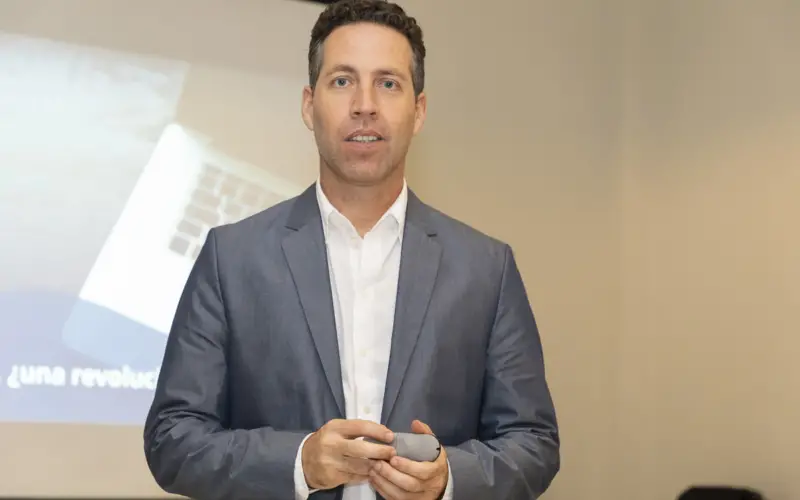
Néstor Romero is an engineer from the University of Córdoba (Spain) and holds a doctorate from the University of Málaga. He is president of the European Digital Marketing Association and vice-president of the European Neuromarketing Association. He teaches artificial intelligence and digital marketing at Quality Leadership University (Panama) and has been a guest lecturer at the University of Louisville, the University of Málaga, the University of Chile and UNED, with more than 20 years of digital projects in more than 30 countries. On 23 September he spoke at the LiderIA Summit, in the auditorium of the Torre de las Américas in Panama City, with the lecture “Communicating in the age of AI: brands, audiences and reputation in the new digital economy”.
Deilys Romero, economy and business writer at Radar Panamá, spoke with him by telephone on 26 September, days after his talk at the LiderIA Summit, with the professor in Panama City. The sentences in quotation marks are verbatim from that conversation. He set one caveat at the outset: where a figure does not exist, he says so rather than estimating it.
What happens behind the scenes when AI recommends a clinic
Néstor Romero, professor at Quality Leadership University
1. It searches
It retrieves around a dozen pages that look relevant.
2. It chooses
It keeps three or four. It no longer asks whether they deal with the subject, but whether they are reliable and clear.
3. It writes
It writes in its own words and decides whom to name. A business can drop out at any of the three phases.
Romero explains that the name that appears “usually comes from what third parties say about that clinic (reviews, directories, articles), not from what the clinic says about itself”. And he adds a prerequisite that almost nobody meets: the website must state, in readable text, what it does, where and at what cost.
Néstor Romero
The figure that does not exist for Panama
Radar Panamá asked him what percentage of commercial searches in Panama are already resolved in an AI answer. The reply was, in his words, uncomfortable.
Néstor Romero
According to Romero, the phenomenon “moves faster where the decision is comparative: professional services, health, education, banking and hospitality”. Those are the sectors Radar Panamá has put to the test in its Radar AI series, with studies on which dental clinics AI recommends in Panama and which immigration lawyers AI recommends.
Simple website and active Instagram: the bad news
Does an SME with a simple website and an active Instagram account stand a chance? Romero says yes, “every chance”, but first puts forward a finding from his own research.
Néstor Romero
From there, he proposes a specific order.
- Check that the website can be read. That it is not blocked and that the text really exists, not inside images.
- Publish on the business’s own domain what is currently somewhere else. Prices, services, opening hours, who it is for and who it is not for.
- The reviews. In his words, “they are the only thing a third party writes on your behalf”.
What others say weighs more
Néstor Romero
The example that best illustrates it, he says, he saw in industrial air conditioning: the market leader had a worse website than much smaller rivals and, even so, artificial intelligence recognised it without hesitation as first in the sector. The reason lay outside its website: dozens of locations with business listings full of real reviews.
Néstor Romero
| What counts for an AI to cite a business | What Romero says | Who controls it |
|---|---|---|
| Readable text on the business’s own website | Prerequisite: what it does, where and at what cost, in text rather than images | The business |
| Reviews on business listings | What weighs most; the only thing a third party writes on the business’s behalf | Customers |
| Directories and articles | Where the name the machine cites usually comes from | Third parties |
| Social networks | Zero citations across more than 3,000 references; they block crawling | Does not count for AI |
A Spanish-only website: it depends on who the customer is
Néstor Romero
And he offers a fact that, he says, almost nobody knows. In a systematic review he published with several colleagues, of thirty studies on this subject not one evaluates whether what works in English works the same in another language.
Néstor Romero
The costliest mistake: solving the wrong problem
Néstor Romero
Romero recounts the case of a company that called him convinced that its drop in traffic was due to artificial intelligence: “the fashionable explanation, and it fitted everything”. On reviewing nine months of data, impressions had fallen by around 40% and clicks by 75%. That disproportion was the diagnosis: they had not stopped appearing, they had stopped appearing at the top.
Néstor Romero
Google reviews: they read them, but not all systems alike
Néstor Romero
On whether the text matters or only the rating, Romero holds that a detailed review hands the machine something it can use: what was done, how much it cost, how it went. “Ten stars without words only provide an average,” he sums up, with a caveat he asked to keep: “I have no measurement of my own that quantifies it, so take it as professional judgement and not as data.”
Three things in ninety days
The first, according to Romero, comes before anything else.
Néstor Romero
The second is to create one page for every service sold, with the price or range, the timeframe, the coverage and who it is not the right option for. “That last part looks commercially suicidal and it is exactly what allows the machine to recommend you to those who do fit,” he explains. The third: claim the business listings and ask ten satisfied customers for reviews with text.
| The three 90-day actions | What it involves | Why it matters |
|---|---|---|
| 1. Check the robots.txt | Open domain/robots.txt and check that no line forbids entry to all search engines | If it is blocked, nothing else works; it is fixed in a minute |
| 2. One page per service | Price or range, timeframe, coverage and who it is not the right option for | Saying who it is not for lets the machine recommend the business to those who do fit |
| 3. Listings and reviews with text | Claim the business listings and ask ten satisfied customers for written reviews | It is the only thing a third party writes on the business’s behalf, and what weighs most |
What a Panamanian SME can do this week
The conversation yields tasks with no budget that, according to Romero, decide whether a business can even be evaluated by an assistant. First, check the domain’s robots.txt file; Google’s official documentation explains what each line means. Second, check that services, opening hours and coverage areas are written on the website as text, not only in images or on Instagram. Third, locate and claim the Google Business Profile listing, including any that customers themselves may have created. And no new investment before confirming, with data, that the drop in traffic does not come “from the old”. For those registering a new company, Radar Panamá’s guide to opening a company in Panama covers the preliminary steps.
More Radar Panamá interviews: Néstor Romero answers: which jobs AI changes first in Panama and what universities are missing · Kathia Rivera answers: incorporating a company in Panama as a foreigner, without travelling and in a week
Frequently asked questions
How does an AI decide which business to recommend?
According to Néstor Romero, in three steps: it searches a dozen relevant pages, it chooses three or four depending on whether they strike it as reliable and clear, and it writes, deciding whom to name. That name usually comes from what third parties say about the business (reviews, directories, articles), not from what the business says about itself.
What percentage of searches in Panama is already resolved by AI?
That figure does not exist for Panama, and Romero warns that anyone offering it is making it up. What he has measured: in one entire sector of a Latin American country, 46 out of 46 commercial searches returned an AI answer before the links, and in the United States clicks fall by almost half.
Does Instagram help AI recommend a business?
No. In Romero’s study of more than 3,000 references cited by assistants, the four big social networks contributed not a single citation, because they block automated crawling. For artificial intelligence, an Instagram page does not exist; whatever is there must be published on the business’s own domain.
Which weighs more, the business’s own website or what third parties say?
What others say weighs more, because nobody speaks ill of their own business and the machine knows it. Romero cites an industrial air-conditioning leader with a worse website than its rivals, which AI recognised as first in the sector thanks to its dozens of listings with real reviews, some unclaimed.
Do Google reviews influence what AI recommends?
Yes, but not in all systems nor in the same way. In Romero’s measurement of businesses in a single neighbourhood, one assistant relied on listings and their reviews and another read editorial lists. Reviews with text contribute more than wordless stars, although Romero offers that as professional judgement, not data.
What three things should an SME do in ninety days?
First, check the domain’s robots.txt and, if it blocks all search engines, call whoever runs the website. Second, create one page per service with price or range, timeframe, coverage and who it is not the right option for. Third, claim the business listings and ask ten satisfied customers for reviews with text.
Sources consulted
- Radar Panamá telephone interview with Néstor Romero, 26 September.
- Néstor Romero, the interviewee’s website.
- LiderIA Summit programme, Torre de las Américas, Panama City.
- Introduction to robots.txt, Google Search Central official documentation.
- Add or claim a Business Profile, Google Business Profile Help.
Who does artificial intelligence already recommend in Panama?
Radar Panamá put AI assistants to the test with real questions from home buyers and measured which names appear and why.
Read the Radar AI study on developers and residential projects
Ask about this article
Type your question and we will show you the answer inside this article or in other Radar Panamá publications.