
Which taxes a company or an individual pays, how to open a bank account as a foreigner, what role credit and factoring play: finance in Panama has its own rules. This page organises the Radar Panamá guides on the subject, with the rule and the official source behind each fact.
Start here
Essential guides on this topic
 8 Oct 2026Documents to Open a Bank Account in Panama as a Foreigner: Checklist by ProfileA practical checklist of documents to open a bank account in Panama as a foreigner: resident, non-resident and visitor, what Agreement 1-2026 sets, what each bank publishes and how apostille…
 8 Oct 2026Panama Bank Account Without Residency: Limits and OptionsWhether a foreigner without residency can open an account in Panama, which limits apply, why the simplified account is for residents, remote opening and what changes with residency.
 19 Oct 2026Open a Bank Account in Panama from Mexico: Documents, Apostille and Source of FundsA Mexican can open an account in Panama without residency. Documents under the rule, apostille from Mexico, source of funds, individual or company and what to ask the bank.
All articles on this topic
 14 Oct 2026Credit Transfer at Panama Universities: Limits, Grades, ProcessThe 60% credit cap, the equivalence required, minimum grades for bachelor and graduate programs and the external and internal transfer…
 8 Oct 2026Why a Panama Bank Rejects a Foreigner’s Account and What to DoDocumented reasons a Panama bank rejects a foreigner's account, what prepares each point, how to apply again and how to…
 30 Sep 2026Opening a bank account in Panama as a foreigner: what the rule requires and what each bank requiresAgreement 1-2026 of the Superintendency of Banks sets what a bank must ask a foreigner for; the minimum deposit and…
 26 Sep 2026Opening a bank account in Panama from abroad: the firms that handle the opening, comparedWhat a Panamanian bank asks of a non-resident and eight law firms that handle account opening, ranked by Google reviews,…
 26 Sep 2026The Panama Canal as an economic engine: how much it earns, how much it hands the State and what it depends onHow the Panama Canal makes money, how much it contributes to the National Treasury, the cluster that lives off the…
 26 Sep 2026Taxes a company pays in Panama: income tax, ITBMS, dividends, Notice of Operation and payrollEvery tax a company pays in Panama with its rate, base and deadline: income tax, ITBMS, dividends, Notice of Operation,…
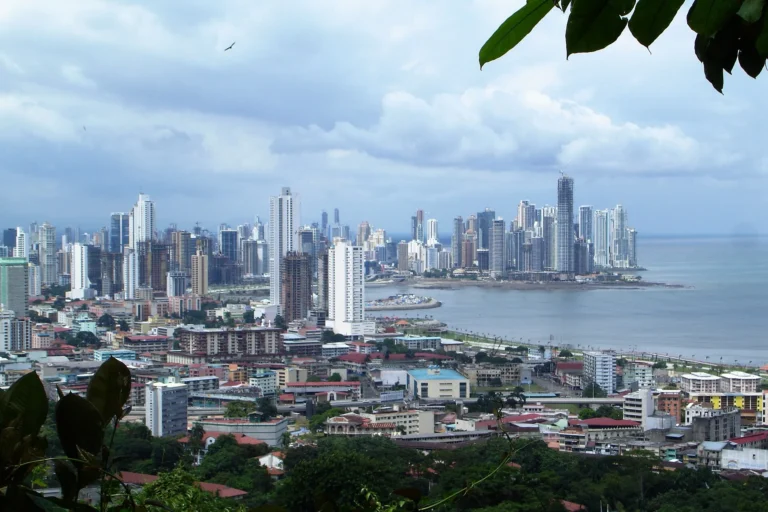 26 Sep 2026How Panama’s economy works: dollar, Canal, banking, logistics and territorial taxationThe five pillars of Panama's economy, the key figures for GDP, the Canal, banking and employment, and the structural weaknesses…
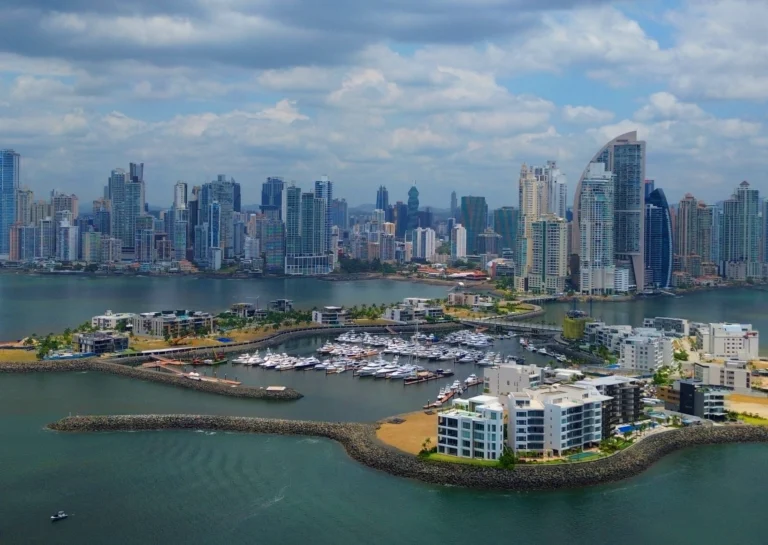 26 Sep 2026Investing from Puerto Rico in Panama: the dollar advantage and the shopping centres of Grupo Los PueblosWhy Panama suits the Puerto Rican investor: same currency, territorial taxation and the commercial projects of Grupo Los Pueblos, from…
Other topics
Last verified: 19 October 2026. Every figure links to its official source.
- Which taxes a company pays and why income is territorial
- Income tax: rate, alternative calculation and individuals
- ITBMS, dividends, Notice of Operation, single fee and social security
- E-invoicing, accounting records and the order of procedures
- Bank accounts for foreigners and companies
- The dollar and the financial system
- Myths and reality
- Frequently asked questions
- Sources
Which taxes a company pays and why income is territorial
A company operating in Panama pays income tax on what it earns inside the national territory, ITBMS on its sales, the Notice of Operation tax, the annual single fee that keeps its registration in force and Social Security contributions if it has employees. The foundation of the whole system is article 694 of the Fiscal Code: the object of the tax is taxable income produced, from any source, within the territory of the Republic, wherever it is received.
In practice, where the income arises matters more than where the company is incorporated. Paragraph 2 of the same article states that income is not considered produced in Panama when it comes from directing, from an office in Panama, transactions that are completed, consumed or take effect abroad, or from distributing dividends that come from income generated outside the country. How this principle fits with the dollar, the Canal and banking is covered in the guide to how Panama’s economy works.
Territoriality is not a blanket exemption: a company that sells in the local market pays tax on those sales. The tax-by-tax detail appears in the article on taxes a company pays in Panama.
Income tax: rate, alternative calculation and individuals
The general rate for legal entities is 25% of net taxable income, under article 699 of the Fiscal Code as worded in the law published in Official Gazette 26489-A of 15 March 2010. The same article sets its own rates, phased down to 25% by 2014, for banking, insurance, telecommunications and power generation.
Legal entities with taxable income above 1,500,000 balboas a year pay the larger of two figures: ordinary net taxable income, or the result of applying 4.67% to total taxable income. If paying under that method causes losses, the entity may ask the tax authority (DGI) not to apply the second calculation, according to paragraph 1 of the same article.
| Taxpayer | Rate or rule | Legal basis |
|---|---|---|
| Legal entity, general rate | 25% of net taxable income | Fiscal Code, article 699 |
| Legal entity with taxable income above 1,500,000 balboas | The larger of net income and 4.67% of taxable income | Article 699, alternative calculation |
| Individual, up to B/.11,000 | 0% | Fiscal Code, article 700 |
| Individual, above B/.11,000 up to B/.50,000 | 15% on the excess over B/.11,000 | Article 700 |
| Individual, above B/.50,000 | B/.5,850 on the first B/.50,000 plus 25% on the excess | Article 700 |
The deadlines for filing the income tax return and paying the estimated tax are published by the DGI. Its website did not open during this verification, so this guide gives no filing dates. They can be confirmed in the institution’s current calendar or with the company’s accountant.
ITBMS, dividends, Notice of Operation, single fee and social security
Besides income tax, five other charges need to be mapped from the start. The table lists each one with the rule behind it.
| Charge | What the rule says | Source |
|---|---|---|
| ITBMS | General rate of 7% from 1 July 2010; 10% for alcoholic drinks and lodging; 15% for tobacco products. Producers, traders and service providers with annual gross income below B/.36,000 are not taxpayers. | Fiscal Code, article 1057-V, as worded in Gazette 26489-A |
| Dividends | Withholding of 10% on profits of Panamanian source and 5% on exempt, foreign-source or export profits; 20% for bearer shares. If less than 40% of net profit is distributed, 10% is paid on the difference. | Fiscal Code, article 733, as worded in Gazette 26489-A |
| Notice of Operation | Annual tax of 2% of the company’s capital, with a minimum of B/.100 and a maximum of B/.60,000; persons with invested capital below B/.10,000 are exempt. | Fiscal Code, article 1004, as worded in Gazette 26489-A |
| Single fee | B/.300 a year for corporations and limited liability companies; for private interest foundations, B/.350 in the first year and B/.400 afterwards. Payable by 15 July or 15 January, depending on the registration month. | Fiscal Code, article 318-A, under Law 52 of 2016 |
| Social Security (CSS) | Employee contribution of 9.75%; employer contribution of 13.25% until 28 February 2027, 14.25% from 1 March 2027 and 15.25% from 1 March 2029. | Article 96 of the consolidated text of Law 51 of 2005 |
Anyone hiring staff for the first time will find the full payroll picture, including the thirteenth month and holidays, in the note on payroll and the other taxes a company pays. For investors based abroad, the case of investing from Puerto Rico shows how the dollar and territorial taxation combine.
E-invoicing, accounting records and the order of procedures
An invoice or equivalent document is mandatory to document every sale of goods and provision of services, issued through authorized fiscal equipment or the Panama Electronic Invoicing System, except where the DGI authorizes an exception. This is recorded in Executive Decree 3 of 2023, which cites article 11 of Law 76 of 1976 as amended by Law 256 of 2021. The qualified electronic signature the system requires is obtained through the Public Registry’s electronic signature portal. Radar’s Spanish-language guide to electronic invoicing in Panama covers who is obliged, the free invoicing tool and how to choose an authorized provider.
Legal entities that carry out no operations that are completed, consumed or take effect inside Panama must keep accounting records and their supporting documents for at least five years, either at their resident agent’s offices or elsewhere, under article 1 of Law 52 of 2016. Law 254 of 2021 amended that law, as acknowledged in DGI Resolution 201-1754 of 2024, which in turn extended the deadline for resident agents to file the sworn declaration on accounting records. Non-compliance carries a fine of B/.1,000 plus B/.100 for each day the cause remains unremedied (article 7 of Law 52).
The usual order of procedures for a company that will operate locally is as follows.
- Incorporate the company and register it with the Public Registry, paying the first single fee together with the registration rights (article 318-A).
- Obtain the Notice of Operation if the commercial or industrial activity requires it, with its annual tax calculated on capital.
- Obtain the qualified electronic signature and register in the DGI’s electronic invoicing system.
- Register for ITBMS once annual gross income exceeds B/.36,000, and keep the books with the accountant.
- Open the company’s bank account with the documents the bank requires, including identification of the beneficial owner.
- Enrol employees with the Social Security Fund and pay the payroll contributions.
Bank accounts for foreigners and companies
A foreigner can open an account at a Panamanian bank, and the governing rule is Agreement 1-2026 of the Superintendency of Banks, dated 16 January 2026, on preventing misuse of banking and trust services. Its article 18 sets the passport as the suitable identity document for a foreigner, with a copy of the page showing photograph, signature and details and the page carrying the entry stamp. The entry-stamp copy is not required for clients recruited during visits abroad or onboarded by international license banks. Foreigners with residence may identify themselves with the Electoral Tribunal identity card or the permanent resident card from Immigration.
Due diligence includes a client profile with 14 data points, among them the activity that generates income, the origin and destination of funds, the country of domicile, and the amount and frequency of transactions. Article 52 provides that the agreement takes effect six months after its promulgation, and article 53 gives banks until 30 June 2027 to adapt digital onboarding. In practice each institution adds its own conditions, such as a bank reference letter or an opening deposit; the guide to opening a bank account in Panama as a foreigner separates what the rule requires from what each bank asks.
The simplified opening in article 15 can only be used by individuals who are nationals or resident foreigners, with accounts whose balance never exceeds B/.5,000. A non-resident falls outside that scheme, a topic developed in the note on a bank account without residency. The papers required for each applicant profile are listed in the article on documents to open a bank account, and the most frequent reasons for refusal, with ways forward, in the one explaining why a bank rejects a foreigner’s account. There is also a comparison of the firms that handle account opening from abroad.
For companies, Agreement 1-2026 provides specific due diligence for legal entities (article 19), which includes certifications of the company’s existence and standing and information on beneficial owners. That is why companies tend to arrive at the bank with the articles of incorporation, registry certificate and beneficial owner details already organized.
The dollar and the financial system
Panama has no central bank and recognized the US dollar as legal tender shortly after its independence in 1903, according to a World Bank technical note hosted by the Superintendency of Banks. For a foreign investor this removes exchange-rate risk against the dollar. The cost is that the country issues no currency of its own and does not set its interest rate, a trade-off analyzed in the note on how the Panamanian economy works. The Panama Canal as an economic engine completes that picture.
Supervision rests with the Superintendency of Banks. Its website lists 40 banks with a general license, which operate inside and outside the country, and 13 with an international license, which operate only with effect abroad, in its listings of general license and international license banks. The Banking Activity Report for April 2026 records total deposits of 120,742.5 million dollars, of which external deposits grew 13.33% and represent 41.3% of the total.
Myths and reality
- Myth: Panama levies no taxes. The rule sets income tax at 25% for legal entities and 7% as the general ITBMS rate; what is not taxed is income produced outside the territory.
- Myth: a company is exempt simply because it is registered in Panama. The test is where the income arises, not where the company is domiciled (Fiscal Code, article 694).
- Myth: a company with no operations has no duties. It must pay the annual single fee and, under Law 52 of 2016, keep accounting records with support for at least five years.
- Myth: a bank may reject any non-resident without criteria. Agreement 1-2026 calls for risk-based due diligence, and banks keep their own commercial matrix within that framework.
- Myth: the simplified account is available to everyone. Article 15 limits it to individuals who are nationals or resident foreigners, with a balance never above B/.5,000.
- Myth: using the dollar means Panama prints banknotes. The country has no central bank and uses the US dollar as legal tender.
Frequently asked questions
How much income tax does a company pay in Panama?
The general rate is 25% of net taxable income of Panamanian source. Legal entities with taxable income above 1,500,000 balboas pay the larger of that figure and 4.67% of their taxable income, under article 699 of the Fiscal Code.
What is the territorial taxation principle?
It is the rule that only income produced inside Panama’s territory is taxed, wherever it is received. Article 694 of the Fiscal Code establishes it.
What is the ITBMS rate?
The general rate is 7%, with 10% for alcoholic drinks and lodging and 15% for tobacco products. Those with annual gross income below B/.36,000 are not taxpayers, under article 1057-V of the Fiscal Code.
Can a foreigner open a bank account in Panama?
Yes, with a passport and the documents the bank’s due diligence requires. Agreement 1-2026 of the Superintendency of Banks sets identification, tax residence and financial profile, and each bank adds its own conditions. This text is informational and does not replace the advice of an accountant, a lawyer or a tax adviser.
What does it cost to keep a corporation in good standing?
The annual single fee is B/.300 for corporations, under article 318-A of the Fiscal Code. It is payable by 15 July or 15 January, depending on the month the company was registered.
Sources
All sources were consulted on 19 October 2026. The DGI website did not open during verification.
- Official Gazette 26489-A of 15 March 2010: amendments to articles 699, 700, 733, 1004 and 1057-V of the Fiscal Code.
- Fiscal Code of the Republic of Panama, article 694.
- Law 52 of 27 October 2016, Official Gazette 28149-B (accounting records and single fee).
- DGI Resolution 201-1754 of 26 March 2024, Official Gazette 29999.
- Executive Decree 3 of 2023, Official Gazette 29706-B (electronic invoicing).
- Social Security Fund, consolidated text of Law 51 of 2005, Official Gazette 30284-B.
- Superintendency of Banks, Agreement 1-2026 of 16 January 2026.
- Superintendency of Banks, Banking Activity Report, April 2026.
- Superintendency of Banks, general license banks and international license banks.
- World Bank, technical note on Panama’s payment system (hosted by the Superintendency of Banks).
- Public Registry of Panama, qualified electronic signature.