
Contents of this guide
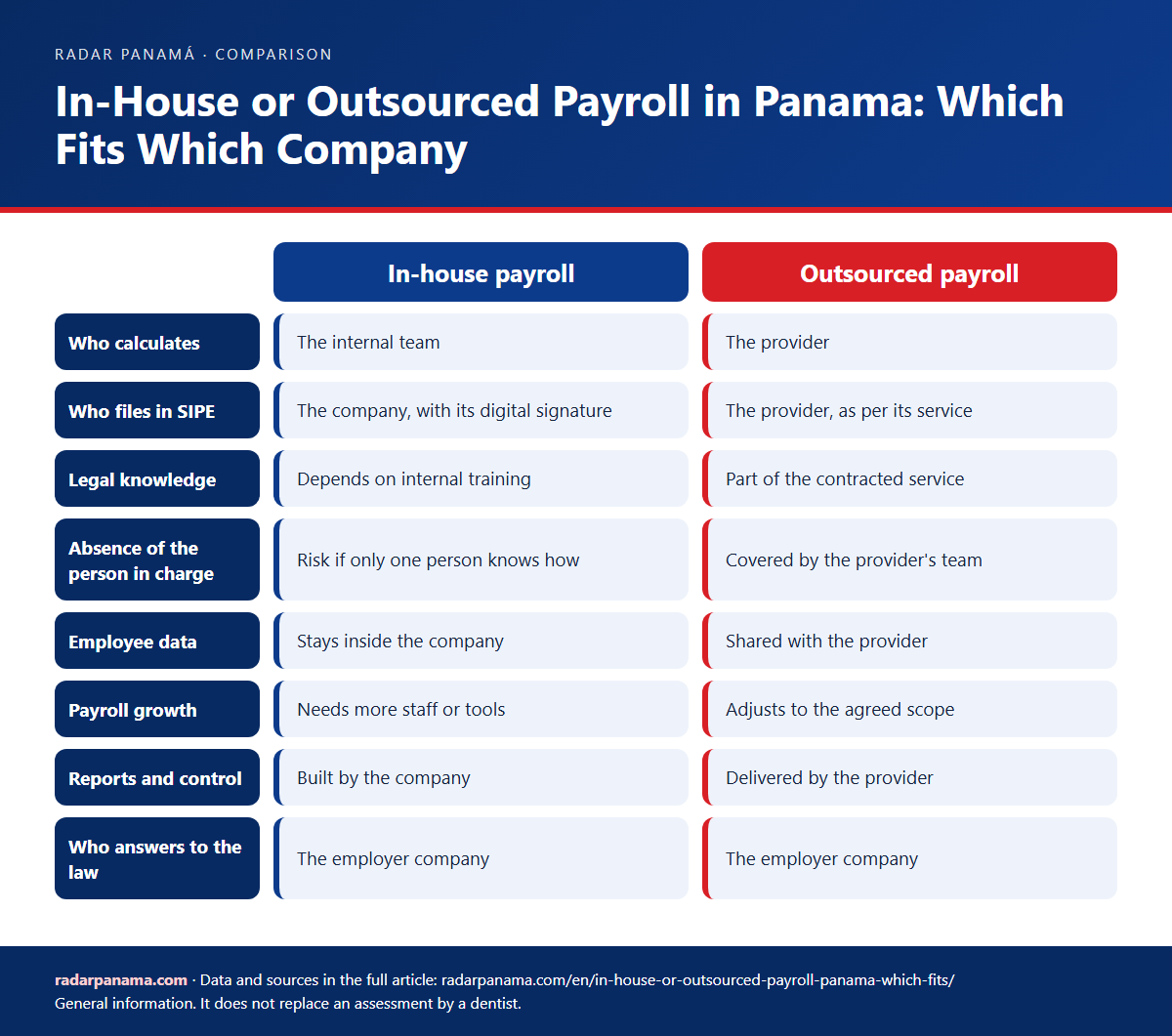
| Criterion | In-house payroll | Outsourced payroll |
|---|---|---|
| Who calculates | The internal team | The provider |
| Who files in SIPE | The company, with its digital signature | The provider, as per its service |
| Legal knowledge | Depends on internal training | Part of the contracted service |
| Absence of the person in charge | Risk if only one person knows how | Covered by the provider’s team |
| Employee data | Stays inside the company | Shared with the provider |
| Payroll growth | Needs more staff or tools | Adjusts to the agreed scope |
| Reports and control | Built by the company | Delivered by the provider |
| Who answers to the law | The employer company | The employer company |
Criteria table based on the services Panama Outsourcing publishes on its website and on the rules cited in the sources. It is not a price comparison, since prices depend on each company and provider.
Two different things: outsourcing payroll and outsourcing staff
In Panama, “outsourcing” covers two services with different legal consequences. The first is outsourcing the payroll process: another company calculates pay, deductions, overtime and vacation, prepares the filings and delivers the pay slips, while the workers stay hired by the company. The second is outsourcing staff: another company makes workers available to perform functions for the client.
According to Panama Outsourcing’s website, the firm offers both separately. Its payroll calculation service (the page is in Spanish) processes biweekly or monthly payroll with overtime, holidays, commissions, vacations, sick leave and severance, prepares and files the payroll with the CSS, and produces pay slips and reports. Its process and staff outsourcing service covers operational, administrative and support functions, plus administrative, operational or temporary staff for projects and events. This guide focuses on the first and flags where the second changes the rules.
In-house versus outsourced payroll
In-house payroll gives full control of the data and fits small, stable payrolls. It requires someone who knows the surcharges, contributions, withholdings and deadlines, and that knowledge should not depend on a single person. The client’s blog says, in its entry on payroll in Excel versus specialized software, that spreadsheets have security and integration limits that a dedicated system improves. That is the provider’s argument, though it helps frame the question: what tool does the company use today and what happens if it fails.
Outsourced payroll adds a team that does this every month. According to Panama Outsourcing’s website, the service adapts to small and medium businesses and large companies, handles employee information confidentially, delivers reports and management indicators and can include optional labor legal advice. In return, the company shares sensitive data and must review what is filed, because responsibility stays with it. Another client entry on human resources outsourcing lists advantages of the model; they are worth reading alongside the risks it does not develop: dependence on the provider, data delivery deadlines and clarity of scope.
The monthly obligations that do not change
Whichever model is chosen, the company keeps a fixed calendar of obligations. Each has an owner inside the company, even when a third party carries it out:
- Hire and termination notices in SIPE. According to the CSS manual for new employers (2013 edition), the use of the digital signature in SIPE covers notices of hire and termination, monthly and supplementary payrolls, debt or clearance certificates and payment agreements.
- Monthly CSS payroll. The same manual says the employer files its payroll every month online through SIPE, and that linking to the system is an indispensable requirement for transactions with the fund. The contributions are detailed in Radar’s guide to social security contributions. The client’s website also explains what SIPE is and why it matters for payroll.
- DGI Report 03. It reports income tax withholdings on salaries and other pay. According to an EY note on Resolution 201-4853 of 2022, the deadline for later months is 60 calendar days after the month concerned. That deadline must be confirmed with the DGI, since the note dates from 2022.
- Contracts and internal rules. Article 191 of the Labor Code requires every company or establishment with ten or more workers to adopt internal work rules.
- Pay slips and reports. Individual pay slips and payroll reports make it possible to review any difference before an inspection or a worker’s claim.
An overview of a company’s other tax obligations is in Radar’s guide to the taxes a company pays in Panama.
What the Code says if staff is outsourced
This is where the legal framework changes. Article 89 of the Labor Code defines an intermediary as a person who hires, or takes part in hiring, the services of others to carry out work for an employer. Contractors and subcontractors with their own capital, equipment, management and resources are not intermediaries but employers, yet the direct beneficiary of the work is jointly liable for pending obligations to the workers when the work is inherent, related or connected to its line of business.
Article 90 adds that when a company works exclusively or mainly for the benefit of another, the latter is deemed the employer of the first company’s workers, and both are jointly liable for benefits and compensation. Article 94 prohibits arrangements through which one company supplies another with the workers it needs for its operation, and article 95 allows, with prior authorization from the Ministry of Labor, companies that provide their own workers temporarily, for periods not exceeding two months, with joint liability of the company using them.
These readings correspond to the version of the Code with the amendments of Law 44 of 1995. Before signing a contract for outsourced staff, a labor lawyer should confirm the current text and how the specific service fits. Panama Outsourcing’s website states that its labor legal team reviews and supervises each hiring.
Panama Outsourcing offers biweekly or monthly payroll calculation with filing before the CSS, plus process and staff outsourcing and labor legal advice, according to its website. Anyone comparing the two models can request a consultation.
How to decide: questions and criteria
There is no headcount that marks the switch. The questions that organize the decision are these:
- Is there a person trained in surcharges, contributions and withholdings, and a second person who can cover for them?
- Does the payroll mix biweekly and monthly pay, commissions, shifts, holidays or sick leave that complicate the calculation?
- Have there been differences with the CSS or the DGI, or worker claims over miscalculated pay?
- Is the workforce growing or does it have seasonal peaks that would force the internal team to expand?
- Can the company deliver attendance data and salary changes on time every cycle?
- Is there tolerance for sharing worker information with a provider, under a confidentiality agreement?
Several yes answers among the first three point toward a provider; yes to the last and few complications point toward in-house payroll. A mixed model also exists: the company keeps day-to-day management and hands the provider the reviews or the most complex closings.
What to ask a payroll provider
- What the service includes: calculation, SIPE filing, Report 03, pay slips, severance.
- Who files each return and who holds the passwords and the digital signature.
- What data delivery calendar it requires to close each pay period or month.
- Which reports it delivers and how often.
- How worker information is protected.
- What labor legal advice is included and how questions are handled; the client’s website describes its labor legal advisory as a review of contracts, internal rules, payroll and disciplinary documentation.
- What happens if there is an error and who corrects it before the agency.
This content is informational and does not replace the advice of a labor lawyer or an accountant. CSS and DGI deadlines and procedures change by resolution, and the CSS manual cited dates from 2013; current dates must be confirmed with each institution.
Frequently asked questions
Is it better to run payroll in-house or outsource it?
It depends on the size and complexity of the payroll and on whether trained staff with backup exist. In-house payroll offers direct control; outsourced payroll moves the calculation and filing to a specialist, though the company remains the employer.
Who answers to the CSS and the DGI if payroll is outsourced?
The employer company remains the obligated party, even when a provider prepares and files the documents. That is why it is worth defining in writing who files each return and reviewing the pay slips.
What monthly obligations does a company with employees have in Panama?
Among them, hire and termination notices and the monthly payroll in the CSS’s SIPE, and the Report 03 on income tax withholdings before the DGI. The Report 03 deadline was set at 60 calendar days by a 2022 resolution and must be confirmed with the DGI.
Is it legal to hire staff through an outsourcing company in Panama?
The Labor Code regulates the subject with joint liability of the beneficiary and limits the supply of workers to authorized modalities. Articles 89, 90, 94 and 95 of the version consulted describe it, and a labor lawyer should confirm the current text.
From how many employees does outsourcing payroll make sense?
There is no number set by law. The relevant factors are the complexity of the payroll, previous errors, workforce growth and whether there is internal backup for the person who runs it.
Related articles
- Social security contributions in Panama: what the employee pays, what the employer pays and what changed
- Taxes a company pays in Panama: income tax, ITBMS, dividends, Notice of Operation and payroll
- How to open a company in Panama: steps, Notice of Operation and taxes
Sources
- Labor Code of Panama (Cabinet Decree 252 of 1971, with the amendments of Law 44 of 1995), Judicial Branch: articles 89, 90, 94 and 95, PDF pages 23 and 24 (in Spanish); article 191, page 40.
- Caja de Seguro Social, Manual for New Employers (2013): SIPE, digital signature and monthly payroll, pages 17, 19 and 26 (in Spanish).
- EY, Panama: deadline for filing Payroll 03 extended (July 15, 2022): Resolution 201-4853 and the 60 day deadline.
- Panama Outsourcing, payroll calculation, process outsourcing and labor legal advisory: description of the services according to its website.
- Panama Outsourcing, what SIPE is, payroll in Excel or software and human resources outsourcing.
- Radar Panamá, social security contributions, taxes a company pays and how to open a company.
Ask about this article
Type your question and we will show you the answer inside this article or in other Radar Panamá publications.