Contents of this guide
- What happened: magnitude, time and place
- Official tally of damage and affected people
- Health: closed facilities and service changes
- Where to ask for help and official numbers
- How to help and donate through official channels
- Aftershocks and SINAPROC recommendations
- Frequently asked questions
- Sources and what will be updated
What happened: magnitude, time and place
The main quake was recorded on Friday, October 9, 2026 at 12:56 p.m. Panama time. The USGS places it 12 kilometers west-southwest of Pitaloza Arriba, at a depth of about 12.6 kilometers and a moment magnitude of 7.7. The hardest-hit areas are on the Azuero Peninsula and nearby: Tonosí, in Los Santos, and communities in Herrera, Veraguas and Coclé.
Magnitude figures differ by source, so each is best read with its attribution. The Institute of Geosciences of the University of Panama appeared in media with two values: 7.5 in TVN’s first reports and 7.2 in Bloomberg Línea, with an epicenter 39 kilometers northwest of Tonosí. Statements by MINSA and the CSS relayed by the press use 7.5. UN News published 7.7 on October 10 and 7.5 on October 12.
Official tally of damage and affected people
The latest tally SINAPROC, Panama’s civil protection system, released to the press is cut off at 10:00 p.m. on Monday, October 12, according to La Prensa: 2,164 affected families, equal to 7,480 people, in nine provinces. Of those families, 506 lost their homes entirely, 507 had moderate damage, 776 partial damage and 375 minor damage.
SINAPROC’s official statement number 8, with figures through 11:30 a.m. on October 12, reports 14 shelters activated with 598 people and 240 tons of water delivered to communities and hospitals. SINAPROC says the figures are preliminary and no one is reported missing.
The UN, in its October 12 report, said there are no deaths or missing persons and that about 30 people were injured. UNICEF estimates that 38,000 people, including 8,300 children, need humanitarian assistance.
The government declared a national state of emergency and authorized up to 100 million dollars for the response, according to Infobae. In education, the Minister of Education reported that 35 schools collapsed and another 619 were affected. Public school classes resume gradually from October 14, per the same report.
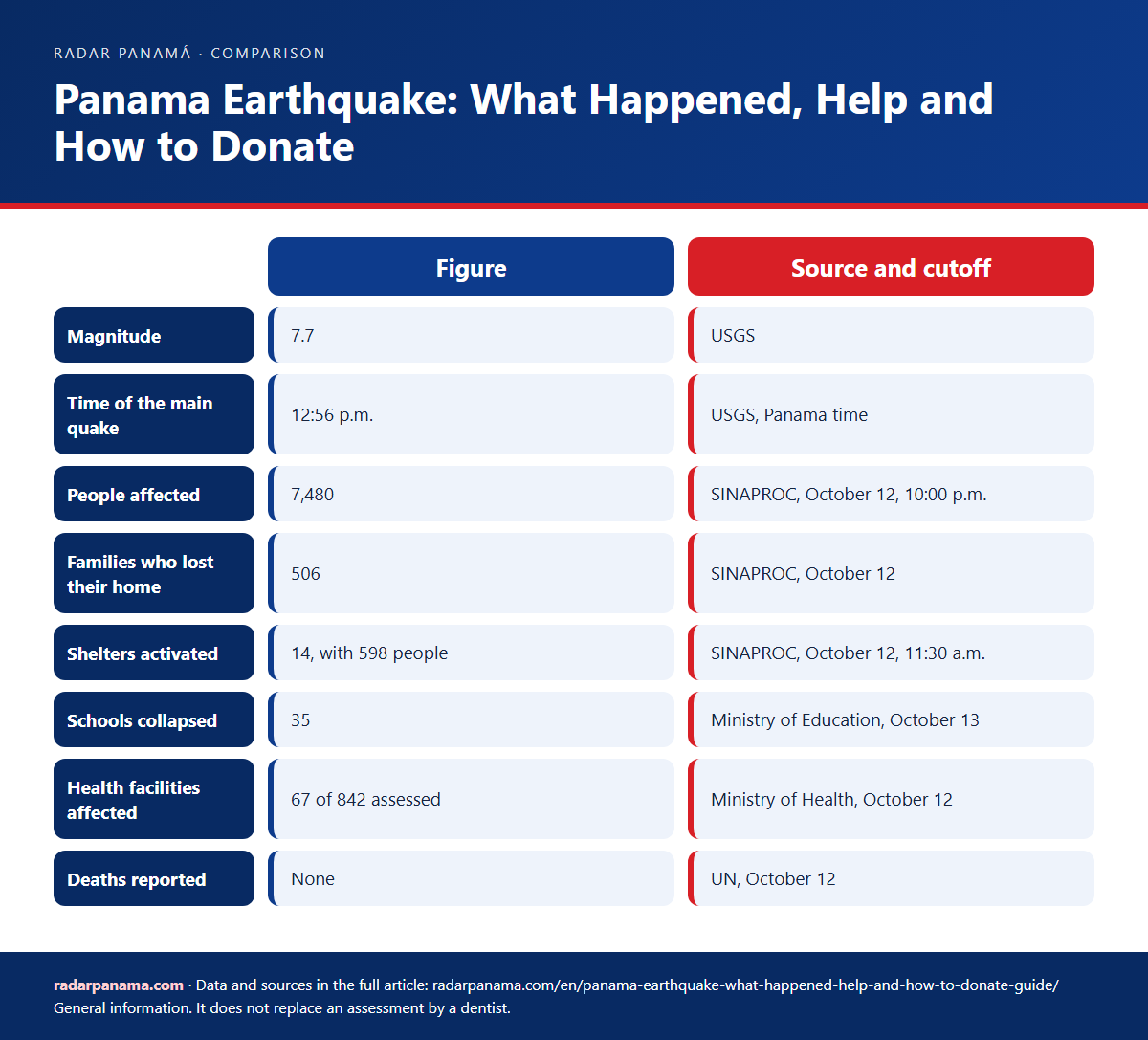
| Item | Figure | Source and cutoff |
|---|---|---|
| Magnitude | 7.7 | USGS |
| Time of the main quake | 12:56 p.m. | USGS, Panama time |
| People affected | 7,480 | SINAPROC, October 12, 10:00 p.m. |
| Families who lost their home | 506 | SINAPROC, October 12 |
| Shelters activated | 14, with 598 people | SINAPROC, October 12, 11:30 a.m. |
| Schools collapsed | 35 | Ministry of Education, October 13 |
| Health facilities affected | 67 of 842 assessed | Ministry of Health, October 12 |
| Deaths reported | None | UN, October 12 |
Preliminary figures consulted on October 13, 2026; they change with each report.
Health: closed facilities and service changes
The Ministry of Health (MINSA) reported on October 12, according to Telemetro, that it assessed all 842 health facilities in the country and that 67 were affected: 66 with minor damage and the Tonosí Rural Hospital, seriously compromised and taken out of service. Aquilino Tejeira Hospital, in Coclé, was evacuated and is operating with a modular hospital. MINSA reports more than 6,000 medical consultations since the quake.
The Social Security Fund (CSS) published its temporary closures on October 11. According to the list reproduced by La Prensa, the Presidente Remón Polyclinic in Panama City, the Los Pozos CAPPS, the Tonosí ULAPS and the Dr. Roberto Ramírez de Diego Polyclinic in Chitré remain closed. Outpatient consultations in Herrera and Los Santos were suspended on Monday and Tuesday. The CSS says emergency care continues and suspended appointments will be rescheduled. As of this writing there is no confirmed reopening date for the closed facilities.
For how these institutions normally work, see the guide to the Social Security Fund and the explainer on the health system in Panama.
MINSA maintains psychological care at hospitals and health centers in Herrera, Coclé, Veraguas and Los Santos. Hours by site are in La Prensa, which also mentions the Mides line 147.
Where to ask for help and official numbers
The SINAPROC website lists its contact lines, which operate around the clock from any phone. The table summarizes them with the function the institution itself gives.
| Channel | Number | Used for |
|---|---|---|
| Emergency line | 911 | Emergencies |
| SINAPROC and COEN | 520-4426, 520-4427 and 520-4429 | SINAPROC and COEN lines |
| SINAPROC WhatsApp | 6998-4809 | Reports, 24 hours |
| Ministry of Social Development | 147 | Guidance and emotional support, per La Prensa |
To report affected communities, SINAPROC’s deputy director, Malitzie Rivera, asked that information be sent to 520-4427 or the institution’s official channels, according to Infobae. Activated shelters are listed in statement number 8.
SINAPROC publishes its official statements on its website, with the damage tally, shelters and contact lines.
How to help and donate through official channels
The Panamanian Red Cross accepts monetary donations. Its official donation page offers card payment, Yappy, Paguelo Fácil and bank transfer; that page is general and not dedicated to the earthquake. According to TVN, the organization says its accounts for cash donations are on its official website and social media. The organization plans to accompany communities for nine months, per TVN.
For in-kind donations, the situation changes quickly. Infobae reported that Parque Omar, in San Francisco, works as a collection center and that provincial governorships receive food, water and basic necessities. Telemetro detailed on October 11 that bottled water, mattresses, blankets, new sheets, powdered milk, diapers and tents were being requested, with provisional hours that must be confirmed.
- Check the channel on the official site. The account or link should appear on the institution’s own page, such as cruzroja.org.pa, and not only in a forwarded post.
- Prefer a monetary donation to the institution when the organization asks for it, since it allows buying according to each community’s needs.
- Confirm the hours and the list of items at the collection center before bringing in-kind donations.
The searches run for this guide turned up no statement from a Panamanian institution about earthquake donation scams, so no attributed warning is included.
Aftershocks and SINAPROC recommendations
The Institute of Geosciences had counted more than 350 aftershocks through October 12, according to Infobae. SINAPROC’s deputy director cited 96 aftershocks between Sunday night, October 11, and early Monday, October 12, with a decrease in the magnitude of the movements according to the Institute’s records. The Colombian Geological Survey also reported a magnitude 6.1 quake in Río Grande on October 12, according to El Heraldo. SINAPROC asks people to stay alert, because aftershocks can worsen existing damage or bring objects down.
The recommendations SINAPROC released for returning to a building and acting during aftershocks, as reported by La Estrella de Panamá and Infobae, are these:
- Inspect the structure from the outside for major cracks, leaning walls, damaged columns or falling debris. If the damage is considerable, no one should enter until qualified personnel evaluate the building.
- If there is a smell of gas, do not enter, light flames or flip switches. In an apartment, close the gas valve and notify the Fire Department.
- Enter only if the authorities allow it, wearing sturdy footwear and, if possible, gloves, eye protection and a mask. SINAPROC says there is no fixed waiting time before re-entry.
- Prepare a 72-hour bag with clothing, documents, medication and food, and report new cracks to the building administration.
The Panamanian Red Cross also asks people not to enter damaged buildings. This content is informational and does not replace the instructions of SINAPROC, firefighters or health professionals.
Frequently asked questions
What happened in the Panama earthquake?
A main quake struck on October 9, 2026 at 12:56 p.m., with magnitude 7.7 according to the USGS and 7.5 according to several statements and media. Tonosí, in Azuero, was near the epicenter. SINAPROC counts 7,480 affected people as of October 12.
Are aftershocks still happening today?
Yes. The Institute of Geosciences had counted more than 350 aftershocks through October 12 and SINAPROC says their magnitude has decreased, though it asks people to stay alert.
Where can people ask for help after the Panama earthquake?
In an emergency, at 911. To report needs, SINAPROC publishes 520-4426, 520-4427 and 520-4429 and the WhatsApp line 6998-4809, around the clock.
How can people donate for the Panama earthquake?
Through the channels the institutions publish. The Panamanian Red Cross accepts donations by card, Yappy, Paguelo Fácil and bank transfer at cruzroja.org.pa/donar.
Is the CSS providing care after the earthquake?
Yes, with changes. Four facilities are temporarily closed and outpatient consultations are suspended at several sites; emergency care continues and appointments will be rescheduled. As of this writing there is no confirmed reopening date.
Related articles
- Social Security Fund in Panama: payments, contributions and appointments
- How Panama’s health system works: Social Security Fund, MINSA and the private sector
Sources and what will be updated
Information consulted on October 13, 2026. This article will be updated with new SINAPROC tallies, changes in CSS and MINSA services, and the donation channels the institutions confirm. Most sources are in Spanish.
- USGS, magnitude 7.7 event of October 9, 2026.
- SINAPROC, official statement number 8 and number 7.
- La Prensa, SINAPROC tally and Ministry of Education figures.
- UN News, October 12 and October 10.
- TVN, Institute of Geosciences and Bloomberg Línea.
- Telemetro, MINSA, La Prensa, CSS and La Prensa, psychological care.
- Infobae, emergency, Infobae, aftershocks and El Heraldo.
- Panamanian Red Cross, donate, TVN, Red Cross, TVN, collection and Telemetro, collection.
- La Estrella de Panamá, SINAPROC recommendations.
Ask about this article
Type your question and we will show you the answer inside this article or in other Radar Panamá publications.