
Contents of this guide
Submarine cables: the invisible infrastructure
More than 95% of international internet traffic travels over fibre-optic cables laid on the seabed, and the geography that made Panama a maritime route also makes it a digital one: it is the shortest point between the Atlantic and the Pacific and the natural link between the United States and South America. According to the Panama Maritime Authority, seven submarine cable systems cross the country’s jurisdictional waters today, with landing stations on both coasts. ProPanamá, the investment promotion agency, estimates that this infrastructure carries 100% of regional internet traffic, 97% of international telephone traffic and 90% of the region’s data transmission.
7 active systems
Cables in service landing in Panama, on the Pacific and on the Caribbean.
9 concessions
Contracts in force to operate and maintain cables after the two awards of October 2025.
14 data centres
Facilities that take advantage of the country’s connectivity and stable power supply.
Two authorities
The Ministry of Economy and Finance grants the concession; the Maritime Authority assesses and protects the installation.
What is coming: TAM-1, Google and the new concessions
In early 2026 the TAM-1 system reached Panama, a cable of some 7,000 kilometres and up to 650 terabits per second connecting the country with the United States, Central America and the Caribbean. In October 2025 the Cabinet Council had authorised two new 20-year concessions, to TelcoSub and to Trans Caribbean Fiber Systems, for routes to the United States and Ecuador. And on 11 August 2026 Google announced the Americas Connect project: the Alisios cable will link the Dominican Republic, Panama and Chile via the Pacific, with a new branch of the Firmina system, opening up for Panama an alternative connection to the south and direct access to Google’s cloud infrastructure in the United States. The MANTA system, which will link Panama with the United States, Mexico and Colombia, is also planned.
Data centres and cloud
The country’s 14 data centres, concentrated in Panama City, Panamá Pacífico and Colón, serve banks, telecommunications operators, Free Zone companies and regional firms seeking a neutral location outside their home countries. Three factors explain the choice: cable connectivity, a power grid with hydroelectric and natural gas generation, and a legal framework in dollars with personal data protection regulated by Law 81 of 2019. The big cloud providers do not yet operate their own regions in Panama, though they do have direct connection zones and content distribution nodes; the arrival of Alisios and TAM-1 is the condition the industry sets for taking that step.
The ecosystem: SEM, Ciudad del Saber and Panamá Pacífico
- Multinational Headquarters (SEM). The regime under Law 41 of 2007 hosts more than 180 multinationals with shared service centres, technology and regional operations, with their own visas for staff and reduced taxation. It is compared with EMMA, Panamá Pacífico and the Free Zone in Radar Panamá’s guide to special regimes.
- Ciudad del Saber. The former Fort Clayton, next to the Canal, brings together more than 200 companies, international organisations and entrepreneurship programmes with tax and immigration incentives for innovation.
- Panamá Pacífico. A special economic area on the former Howard base, with its own airport, data centres and logistics and technology operations of global companies.
- Hub of the Americas. Tocumen airport and Copa Airlines connect more than 80 cities across the continent, allowing a regional team to meet in Panama on a direct flight.
- Talent and remote work. The short-stay visa for remote workers and the residency programmes attract technology professionals; the routes are described in the guide to residency in Panama.
Advantages and gaps in one table
| Aspect | Advantage | Gap or risk |
|---|---|---|
| Connectivity | Seven active cables, TAM-1 and Alisios on the way, two coasts | Dependence on a few landing stations; damage from ships’ anchors |
| Energy | Mix of hydroelectric and gas, priced in dollars | Cost above the regional average for industrial consumption |
| Legal framework | Law 81 on data protection, electronic signature, SEM and Ciudad del Saber | Slow procedures outside the special regimes |
| Talent | Bilingualism in the sector, technical universities, attraction of foreigners | Shortage of senior profiles in development and cybersecurity |
| Market | Regional base for Central America, the Caribbean and northern South America | Small domestic market: 4.5 million inhabitants |
How a technology company sets up its operation in Panama
- Choose the vehicle: an ordinary corporation, an SEM licence if it is a multinational with regional operations, or a base in Ciudad del Saber or Panamá Pacífico depending on the activity. The general procedure is in the guide to opening a company in Panama.
- Define where income is taxed: services provided to clients outside Panama pay no income tax under the territorial principle; those consumed in the country do. The specific taxes are detailed in the guide to corporate taxes.
- Contract connectivity and hosting: compare data centres by certification, power redundancy and direct access to the cables.
- Comply with Law 81 of 2019 on personal data protection and register databases where required.
- Bring in the team: SEM visas, work permits or residency for foreign staff, and electronic invoicing from day one, mandatory for every new taxpayer, as explained in the guide to electronic invoicing in Panama.
Frequently asked questions
How many submarine cables reach Panama?
Seven systems are in service and there are nine concessions in force after the two awarded in October 2025. TAM-1 arrived in 2026 and Google announced the Alisios cable.
What is Google’s Americas Connect project?
A set of cables announced on 11 August 2026: Alisios will link the Dominican Republic, Panama and Chile; Canoa and OlaLuz connect the Dominican Republic with Bermuda and Florida; and a new branch of the Firmina system is integrated.
How many data centres are there in Panama?
Fourteen, according to ProPanamá, concentrated in Panama City, Panamá Pacífico and Colón, serving banking, telecommunications and regional companies.
Why is Panama called a digital hub?
Because its cable infrastructure carries most of the region’s internet and data traffic, and because it combines connectivity, the dollar, stable energy and regimes such as SEM and Ciudad del Saber for technology companies.
Which law regulates data protection in Panama?
Law 81 of 2019, regulated in 2021, which sets principles of consent, purpose and security and creates a database registry before the National Transparency Authority.
Does a software company that invoices abroad pay income tax in Panama?
Not for services provided and consumed outside the country, under the territoriality principle; it does for those provided to clients inside Panama.
What are the weaknesses of Panama’s digital hub?
A shortage of senior talent, the cost of energy, a small domestic market and dependence on a few landing stations exposed to anchor damage.
Sources
- Panamá fortalece su posición como hub digital ante el auge mundial de la inversión en cables submarinos, Panama Maritime Authority.
- Mulino destaca avance de Panamá como hub digital tras anuncio de nuevos cables submarinos de Google, La Estrella de Panamá.
- Telconet y Trans Caribbean Fiber Systems consiguen la concesión para cables submarinos en Panamá, Data Center Dynamics.
- Panamá 2030: de hub de conectividad a plataforma digital regional, TeleSemana.
- TeleGeography, submarine cable investment projections.
- National Authority for Transparency and Access to Information, Law 81 of 2019 on data protection.
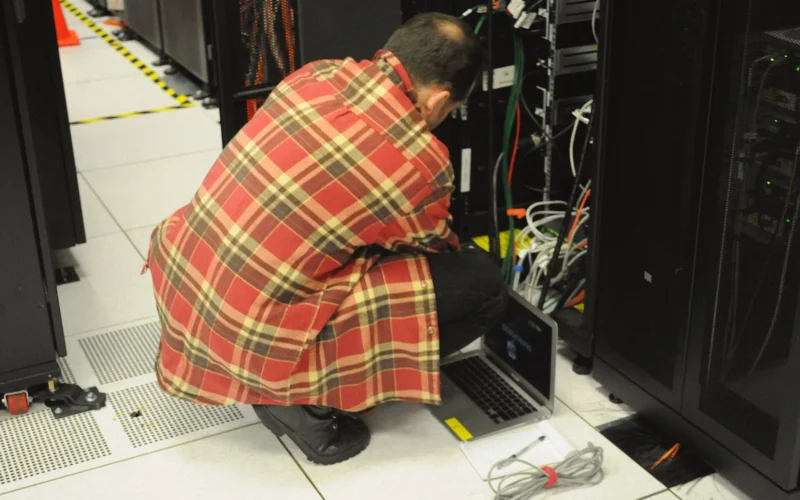
- Image: technician in a data centre, CC0 (public domain), via Wikimedia Commons.
Ask about this article
Type your question and we will show you the answer inside this article or in other Radar Panamá publications.