
Contents of this analysis
- The four regimes in one table
- Colón Free Zone: trade and re-export
- Panamá Pacífico: logistics, industry and services
- SEM: regional headquarters of multinationals
- EMMA: manufacturing and production services
- Which regime suits each company
- The context: international lists and the global minimum tax
- Frequently asked questions
- Sources
The four regimes in one table
Panama’s special regimes are not a single instrument but four separate laws, with their own regulators, locations and incentives. The table sums up the essentials before going into each one.
| Regime | Rule | For which activity | Where | Main incentive |
|---|---|---|---|---|
| Colón Free Zone (CFZ) | Decree Law 18 of 1948 and amendments | Import, storage and re-export of goods | Colón, next to the Atlantic ports | Exemption from customs duties and taxes on foreign operations |
| Panamá Pacífico | Law 41 of 2004 | Logistics, light manufacturing, aviation, corporate services, technology | Former Howard base, opposite Panama City | Tax and customs exemptions, one-stop shop, own labour and immigration regime |
| SEM (Multinational Headquarters) | Law 41 of 2007 and Law 57 of 2018 | Management, administration and support services to subsidiaries of the same group | Anywhere in the country | Reduced income tax rate, visas for foreign staff, ITBMS exemptions on exported services |
| EMMA (Multinational Companies for Manufacturing-related Services) | Law 159 of 2020 | Manufacturing, assembly, maintenance, product logistics and research services for the group | Free zones, Panamá Pacífico, primary customs zones or wherever the activity is permitted | Reduced income tax rate, customs exemptions, visas for staff |
Colón Free Zone: trade and re-export
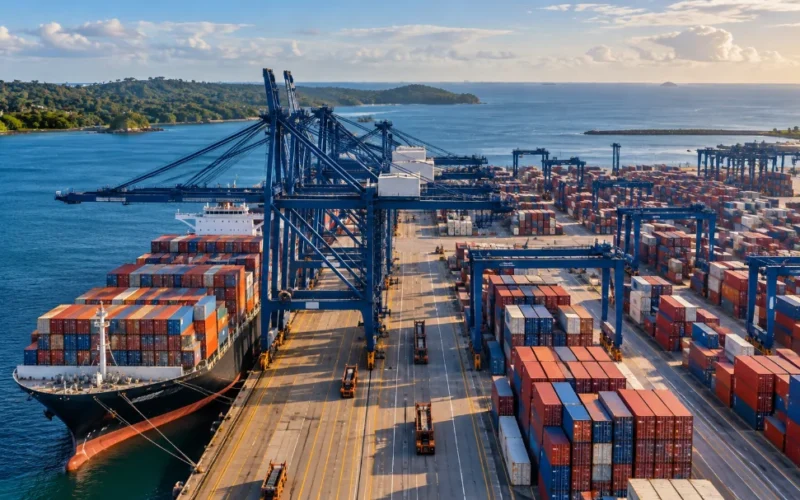
Created in 1948, the Colón Free Zone is the largest free trade zone in the western hemisphere and the second largest in the world. Its model is simple: companies import goods without paying customs duties, store or repackage them and re-export them across Latin America and the Caribbean. According to preliminary figures from the Comptroller General of the Republic, in 2025 it moved 22.615 billion dollars, 9.2% less than the 24.911 billion of 2024, in a year marked by tariffs and geopolitical tension. The zone’s administration reports higher figures under a different methodology and stresses that re-exports regained momentum in the last quarter and that in the first four months of 2026 commercial movement grew 7.2% and physical cargo 14.1%.
| Indicator | 2024 | 2025 (preliminary) | Change |
|---|---|---|---|
| Commercial movement (USD million) | 24,911 | 22,615 | -9.2% |
| Imports (USD million) | n/a | 11,674 | |
| Re-exports (USD million) | n/a | 10,940 | |
| Imports by volume (thousand tonnes) | n/a | 1,348.7 | +14% |
| New companies registered | n/a | 264 | +52% |
| Active companies | More than 2,600 registered users | ||
Value falling while volume rises points to a change in mix: more goods of lower unit value. The zone is also preparing a 280-hectare expansion to attract value-added logistics. Among the requirements to set up, Legal Solutions Panamá notes in its analysis of why to locate a company in the Colón Free Zone that the company “must undertake to hire a minimum of five Panamanian citizens”, in exchange for the “tax exemption on products imported for re-export”. The dominant sectors remain textiles, footwear, electronics, perfumery, pharmaceuticals and spirits, with customers in Colombia, Venezuela, Costa Rica, Puerto Rico and the Dominican Republic.
Panamá Pacífico: logistics, industry and services
Panamá Pacífico occupies 1,400 hectares of the former Howard air base, on the other side of the Bridge of the Americas, and is governed by Law 41 of 2004. It is at once a special economic area, an urban development and an airport. Its administering agency concentrates Immigration, Labour, Customs, the Public Registry and the Ministry of Commerce in a one-stop shop, which reduces procedures that outside the area involve half a dozen institutions.
Tax incentives
Income tax exemption for defined activities (export logistics, aviation, high technology, call centres, regional headquarters), exemption from ITBMS, customs duties and dividend tax on foreign operations.
Own labour regime
Flexibility in shifts and rest days, the option to hire up to 15% foreigners, extendable, and specific visas for workers and their families.
Infrastructure
Its own airport, logistics warehouses, business park, housing and shops within a single site, 15 minutes from the financial centre.
Anchor companies
Logistics, aeronautical, pharmaceutical and technology operators, many of them with SEM or EMMA licences inside the area.
SEM: regional headquarters of multinationals
The Multinational Headquarters regime was born with Law 41 of 2007 and turned 18 in 2025 with 186 companies; as of May 2026 the Ministry of Commerce and Industry’s list counts 192 companies and cumulative employment is around 10,000 jobs, half of them held by Panamanians. In 2025 alone 13 new headquarters joined. The SEM licence allows a multinational group to set up in Panama the headquarters that manages, administers or supports its subsidiaries in the region, with a reduced income tax rate on services provided to the group, visas of up to five years for foreign staff and ITBMS exemption on exported services.
Legal Solutions Panamá, summarising the benefits in its guide on how to set up as a Multinational Headquarters in Panama
The typical profile is a group with operations in several Latin American countries that centralises finance, human resources, technology, procurement or regional management in Panama, taking advantage of Tocumen’s connectivity and the dollar. The air connectivity analysed by Radar Panamá, with 97 direct destinations, is one of the arguments that weighs most in the decision.
EMMA: manufacturing and production services
Law 159 of August 2020 created the EMMA regime to attract to Panama activities the SEM did not cover: manufacturing, assembly, remanufacturing, product maintenance and repair, production logistics, product development and research, always provided to companies of the same group. Companies with an EMMA licence can set up in the Colón Free Zone, Panamá Pacífico, any primary customs zone or anywhere in the country where the activity is permitted. The incentives replicate the SEM model: a reduced income tax rate, customs exemptions on machinery and inputs, and visas for technical staff. It is the regime designed for nearshoring, the relocation of production close to the US market.
Which regime suits each company
| If the company… | Suitable regime | Why |
|---|---|---|
| Buys goods in Asia and distributes them in Latin America | Colón Free Zone | Customs exemption, Atlantic ports, established network of regional buyers |
| Needs a value-added warehouse near the airport and the city | Panamá Pacífico | Exempt export logistics, own airport, one-stop shop |
| Is a group with subsidiaries in several countries and wants to centralise management or shared services | SEM | Designed exactly for that; 192 companies already use it |
| Manufactures, assembles or repairs products for its own group | EMMA | Covers manufacturing and production services that SEM excludes |
| Sells to end customers in Panama | None | The regimes exclude or tax local sales; an ordinary company is advisable, as explained in Radar Panamá’s guide to opening a company |
| Only needs a company to operate outside Panama with no physical presence | None | An ordinary corporation with foreign-source income is enough, according to the guide to offshore companies |
The context: international lists and the global minimum tax
Panama’s special regimes have been reviewed in depth over the past decade by the OECD and the European Union. Panama left the FATF grey list in October 2023 and remains on the EU tax list, which it expects to leave between late 2026 and early 2027. In 2026 the country approved a 15% minimum tax for multinational groups with high consolidated revenue, aligned with the OECD’s Pillar Two. For the SEM and EMMA companies of large groups, that means the reduced Panamanian rate may be topped up with an additional tax to reach an effective 15%; for medium-sized groups below the threshold, the incentives keep operating as before. The underlying reading is that Panama has chosen to keep its regimes with real substance rather than dismantle them.
Frequently asked questions about Panama’s special regimes
What is the Colón Free Zone and how much does it move?
The largest free trade zone in the Americas, created in 1948 in Colón. In 2025 it moved 22.615 billion dollars according to preliminary figures from the Comptroller’s Office, with more than 2,600 companies dedicated to importing and re-exporting goods to Latin America and the Caribbean.
What is the difference between SEM and EMMA?
SEM (Law 41 of 2007) is for headquarters that manage or provide administrative services to the group’s subsidiaries. EMMA (Law 159 of 2020) is for manufacturing, assembly, maintenance and production logistics for the group itself. The incentives are similar; the permitted activity is different.
How many companies hold an SEM licence in Panama?
192 according to the Ministry of Commerce and Industry’s list as of May 2026, with some 10,000 cumulative jobs. In 2025, 13 new headquarters joined.
What is Panamá Pacífico?
A 1,400-hectare special economic area on the former Howard base, governed by Law 41 of 2004, with tax, customs, labour and immigration incentives, a one-stop shop and its own airport, geared to logistics, light industry, aviation and services.
Do companies in the special regimes pay taxes in Panama?
Yes, at reduced rates or with exemptions depending on the activity. SEM companies pay 5% on net income since Law 57 of 2018. Sales to the local market are taxed normally. Since 2026, large multinational groups are subject to the 15% global minimum tax.
Can an SME use these regimes?
The Colón Free Zone and Panamá Pacífico admit companies of any size that carry out the activity. SEM and EMMA require belonging to a multinational group with minimum assets or revenue and subsidiaries in other countries.
Do the special regimes grant residency to foreigners?
Yes. SEM, EMMA and Panamá Pacífico have their own visas for foreign staff and their dependants, for terms of up to five years and with the option of permanent residency in some cases.
Why did the value of the Colón Free Zone fall in 2025?
Because of the effect of tariffs and geopolitical tension on international trade, according to the Comptroller’s Office and the zone itself. Physical volume, however, grew 14%, and the first four months of 2026 showed a 7.2% recovery in value.
Which regime suits a specific company?
Legal Solutions Panamá, a law firm based in Panama City led by Kathia Rivera, with more than ten years of experience and clients from more than 55 nationalities, advises on SEM and EMMA licences, setting up in the Colón Free Zone and Panamá Pacífico, and on the associated immigration permits.
Sources
- National Institute of Statistics and Census, Comptroller General of the Republic, foreign trade of the Colón Free Zone.
- Zona Libre de Colón mueve 22.615 millones en 2025, Infobae.
- La Zona Libre de Colón consolida su dinamismo en el primer cuatrimestre de 2026, Colón Free Zone.
- El último trimestre impulsó la recuperación de la Zona Libre de Colón en 2025, La Prensa.
- SEM regime, Ministry of Commerce and Industry.
- Tras 18 años del régimen SEM, La Prensa.
- Multinacionales en Panamá alcanzan 10.000 empleos, Infobae.
- Panamá Pacífico Special Economic Area.
- Global minimum tax, Pillar Two, OECD.
- EU list of non-cooperative jurisdictions, Council of the European Union.
- Cómo establecerse como SEM en Panamá and por qué localizar una empresa en la Zona Libre de Colón, Legal Solutions Panamá.
Ask about this article
Type your question and we will show you the answer inside this article or in other Radar Panamá publications.