

Contents of this guide
The short answer
BTU per square meter is a rule of thumb. One ton of refrigeration equals 12,000 BTU per hour, and the tables that circulate online assign a figure per area to arrive at a number of tons. The problem is that area only describes the size of the box and leaves out what happens inside and around it. The US Department of Energy sizing guide notes that rules of thumb are used too often and produce excessively oversized systems, with higher cost, wasted energy and too-frequent on and off cycling. The alternative it recommends is a load calculation, and for homes it names ACCA’s Manual J method.
The Climatiza installation page describes the same approach for commercial spaces: the thermal load calculation is made with the real conditions of the site, not square meters, and according to the company it is the stage most often skipped and the one that causes the most problems. In practice, two spaces of equal area can need different capacities.
What drives the cooling load besides floor area
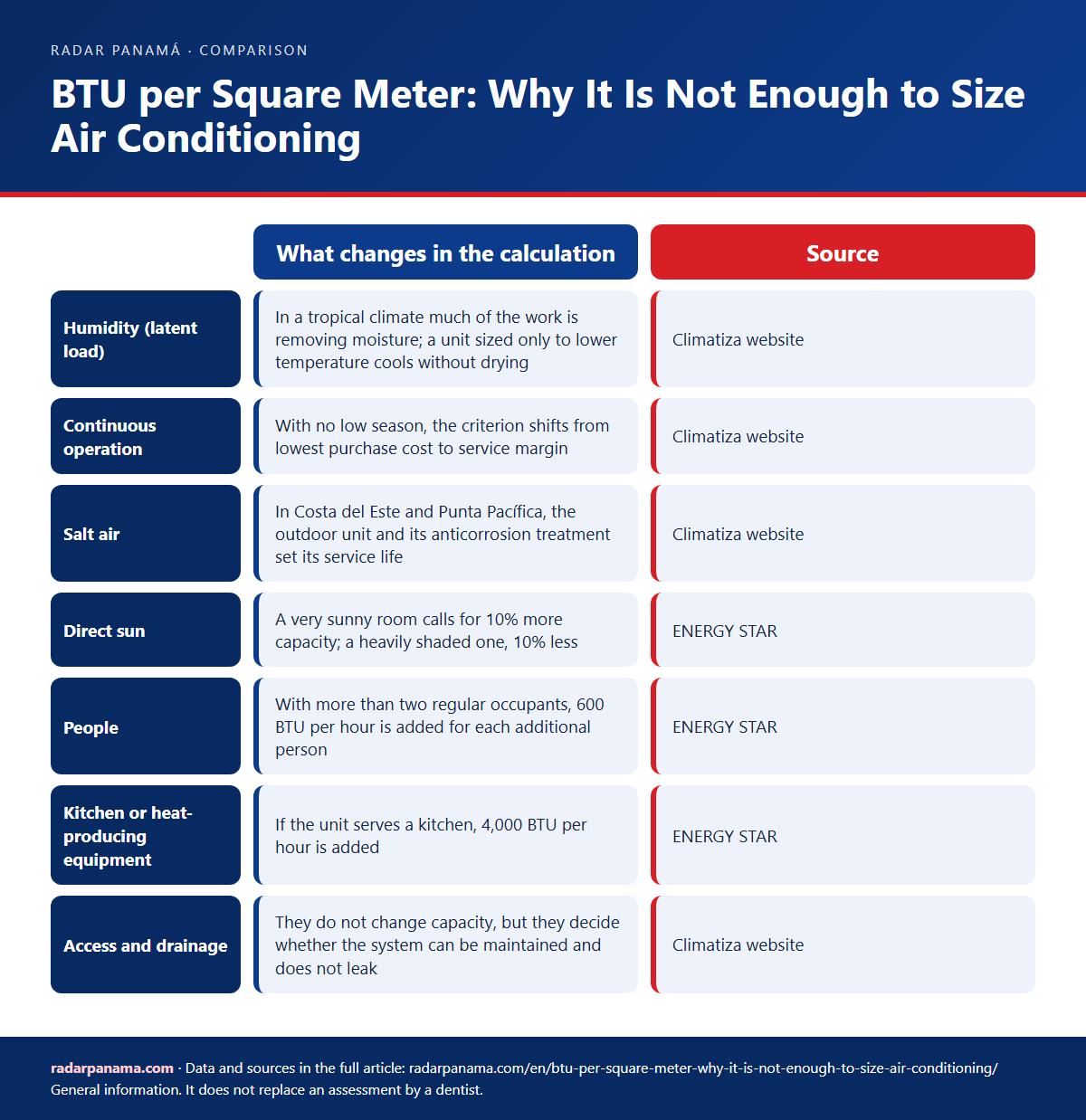
The table gathers the factors the consulted sources mention. The last column shows the origin: the Climatiza website describes Panama’s climate, and the ENERGY STAR guide for window units adjusts capacity according to what happens in the room.
| Factor | What changes in the calculation | Source |
|---|---|---|
| Humidity (latent load) | In a tropical climate much of the work is removing moisture; a unit sized only to lower temperature cools without drying | Climatiza website |
| Continuous operation | With no low season, the criterion shifts from lowest purchase cost to service margin | Climatiza website |
| Salt air | In Costa del Este and Punta Pacífica, the outdoor unit and its anticorrosion treatment set its service life | Climatiza website |
| Direct sun | A very sunny room calls for 10% more capacity; a heavily shaded one, 10% less | ENERGY STAR |
| People | With more than two regular occupants, 600 BTU per hour is added for each additional person | ENERGY STAR |
| Kitchen or heat-producing equipment | If the unit serves a kitchen, 4,000 BTU per hour is added | ENERGY STAR |
| Access and drainage | They do not change capacity, but they decide whether the system can be maintained and does not leak | Climatiza website |
The ENERGY STAR adjustments are for window units in a single room, according to the ENERGY STAR sizing guide. A commercial space uses other equipment and is calculated with a full study; the table shows which variables exist, not their values for a business.
A worked example and why it does not carry over to a commercial space
ENERGY STAR illustrates its method with a room of 14.75 feet by 10 feet, or 147.5 square feet, for which its table gives 5,000 BTU per hour. In meters, that room measures about 13.7 m², a ratio of roughly 365 BTU per hour per square meter, a Radar calculation useful only for the order of magnitude.
With the same guide’s adjustments the result changes. A 13.7 m² room like this, very sunny and with four regular occupants, starts at 5,000 BTU per hour, rises 10% for the sun to 5,500 and adds 1,200 for the two additional people: 6,700 BTU per hour. The same space, with the same dimensions, goes from 365 to about 489 BTU per hour per square meter. A jump of about one third shows why a fixed figure per square meter misleads, and the humidity of a tropical climate, outdoor air ventilation and ceiling height are still left out.
| Step | Example room | Result |
|---|---|---|
| Area | 14.75 ft by 10 ft (about 13.7 m²) | 147.5 square feet |
| Table capacity | According to ENERGY STAR | 5,000 BTU per hour |
| Strong sun adjustment | Plus 10% | 5,500 BTU per hour |
| Occupant adjustment | Two additional people at 600 each | 6,700 BTU per hour |
For central systems, the equipment selection manual from the Building America program adds another layer: the equipment must cover both the sensible load, temperature, and the latent load, humidity, and not only the total. For homes, the guide cites the ACCA recommendation that cooling capacity should not exceed the total load by more than 15%. It is a residential reference and not a standard for businesses, but it shows the order of magnitude professionals consider tolerable.
The cost of oversizing
A unit larger than the real load does not perform better. According to ENERGY STAR, an oversized air conditioner is less effective because it cools the room before it has a chance to remove the humidity, and the space ends up cold and clammy. The Department of Energy guide sums it up as higher cost, wasted energy and too-frequent on and off cycling.
The Climatiza website describes the same picture in installations it has had to maintain: oversized units that start and stop constantly, and errors that are not visible on delivery day and appear between the second and fifth year. For a business, the symptom is usually a space with an acceptable temperature but damp air, a stuffy smell and higher electricity use than expected. When an existing unit already shows symptoms, the article on an office air conditioner that stopped cooling summarizes what to check first.
What a business should ask a technical proposal to include
A serious air conditioning proposal puts in writing how the capacity was reached. The points below come from the project stages Climatiza describes and from the cited guides.
- Technical site visit. According to Climatiza, without seeing the place any proposal is an estimate over a floor plan.
- Real usage data. Expected occupancy, hours, heat-producing equipment, orientation of the space and condition of the existing installation.
- Thermal load calculation including latent load. The document should separate sensible heat from humidity, not give a single figure per area.
- Selection with a reasoned service margin. Capacity close to the calculated load, not the highest catalog step out of caution.
- Alternatives with their operating cost. Climatiza states that its proposal includes alternatives with their differences in operating cost and timeline.
- Access for maintenance. Access hatches in the ductwork, service space and drains with a real slope.
Climatiza designs and installs air conditioning systems for offices, hotels, shops and industrial facilities in Panama City, with a thermal load calculation based on the real conditions of the site. The technical proposal starts with a visit.
Each project stage is detailed on the Climatiza installation page, and how a well-calculated system is maintained afterwards is covered in the article on the air conditioning maintenance contract for businesses. Seafront buildings add a factor of their own, explained in the note on salt air and air conditioning equipment.
This text is informational and does not replace the thermal load calculation a professional makes for the specific space.
Frequently asked questions
How many BTU per square meter does a commercial space need?
No single figure works for every space. According to Climatiza, sizing is calculated with the real conditions of the site and not with square meters. As a reference, the ENERGY STAR guide gives 5,000 BTU per hour for a room of about 13.7 m², and that figure rises with sun, people and a kitchen.
How many BTU make one ton of air conditioning?
One ton of refrigeration equals 12,000 BTU per hour. Converting an area into tons with a rule-of-thumb table keeps the same underlying problem: it ignores humidity and how the space is used.
Is it bad for the air conditioner to be bigger than needed?
Yes, because it does not perform better. According to ENERGY STAR, an oversized unit cools the room before removing the humidity and leaves it cold and clammy, and the US Department of Energy adds higher cost, wasted energy and too-frequent cycling.
What is latent load?
It is the part of the unit’s work spent removing moisture from the air, as opposed to sensible load, which lowers temperature. According to Climatiza, in a tropical climate much of the system’s work is removing moisture, and a unit sized only for sensible load leaves the space cold and damp.
What should an air conditioning installation proposal include?
It should include a site visit, thermal load calculation, equipment selection, alternatives with their operating cost and timeline, and documented handover. Climatiza lists these stages on its installation page.
Related articles
- The office air conditioning stopped cooling: what to check in the first hours
- Air conditioning maintenance contract for businesses in Panama: what it should include
- Air conditioning by the sea in Panama: how salt air attacks equipment and what to do
Sources
- Climatiza, air conditioning installation in Panama: project stages, sizing criteria and frequent errors, according to the company website.
- ENERGY STAR, How to Choose the Right Sized Window AC: 147.5 square foot example, adjustments for sun, occupants and kitchen, and the effect of oversizing on humidity. Conversions to meters and to BTU per square meter are a Radar calculation.
- US Department of Energy, Proper Sizing of HVAC Systems: rules of thumb and oversizing.
- Building America, Strategy Guideline: HVAC Equipment Sizing (NREL, 2012): sensible and latent load and the ACCA 15% limit for homes.
Ask about this article
Type your question and we will show you the answer inside this article or in other Radar Panamá publications.