

Contents of this guide
The short answer
The practical rule is to start from the largest item to be stored and from whether the contents will be needed again soon. The Supreme Storage frequently asked questions page links each size to a typical use: boxes and beds in the smallest, appliances and furniture in the Small, a full move in the Medium and a large inventory in the Large. For anyone who does not yet know how much space is needed, the same page explains that choosing a branch and filling in a form is enough: the team talks through what is to be stored and calculates the space, and the reservation carries no payment or commitment.
A mini storage unit also does not require getting the size right on the first try. For businesses, the commercial solutions page says the space is flexible and the size can be adjusted, so starting small and growing later is part of the model the company describes.
The six size categories
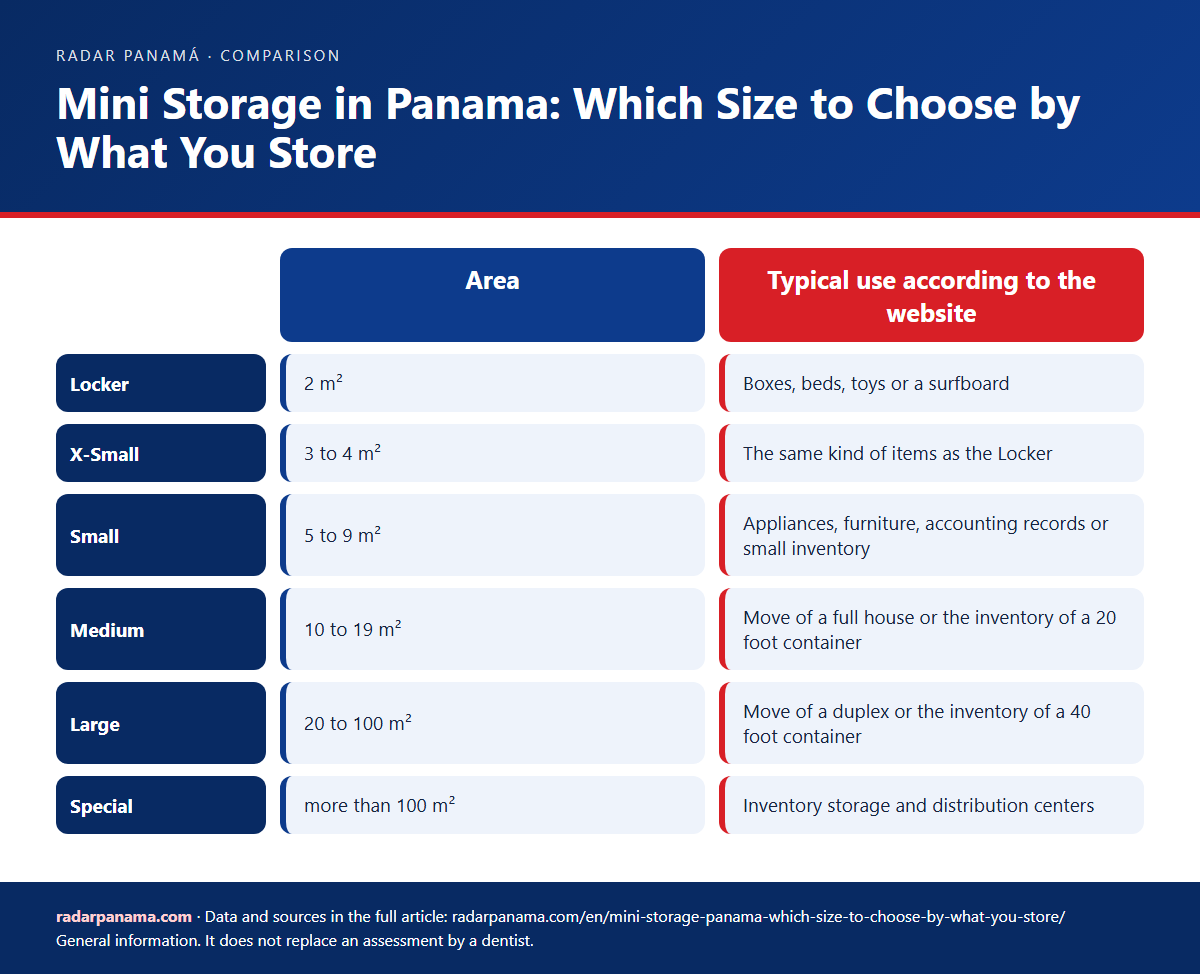
The table summarizes what the Supreme Storage website publishes for each category. The uses are the ones the company mentions, not Radar estimates.
| Category | Area | Typical use according to the website |
|---|---|---|
| Locker | 2 m² | Boxes, beds, toys or a surfboard |
| X-Small | 3 to 4 m² | The same kind of items as the Locker |
| Small | 5 to 9 m² | Appliances, furniture, accounting records or small inventory |
| Medium | 10 to 19 m² | Move of a full house or the inventory of a 20 foot container |
| Large | 20 to 100 m² | Move of a duplex or the inventory of a 40 foot container |
| Special | more than 100 m² | Inventory storage and distribution centers |
Source: Supreme Storage frequently asked questions. Rates are not included here; they are available on the company’s website.
Two details help to read the table. First, the categories overlap in use: the Locker and the X-Small hold the same items, and the practical difference is how much free room is wanted to move around and take things out again. Second, containers work as a reference: according to the data published on Wikipedia’s intermodal container entry, a 20 foot ISO container measures 6.058 by 2.438 meters outside and about 5.867 by 2.330 meters inside. Multiplied, those figures give about 13.7 m² of interior floor, a Radar calculation that fits the 10 to 19 m² range the website assigns to the Medium.
How to calculate square meters
A first estimate helps to arrive at the conversation with the advisor with a starting figure. The procedure works in steps and does not need exact measurements for every piece of furniture:
- Make the inventory. A list by category: boxes, large furniture, appliances, equipment, documents and occasional-use items.
- Separate what will be needed soon. Frequently used items are best kept near the door, which means reserving an aisle.
- Measure the three or four largest objects. The height, length and width of the sofa, bed or refrigerator set the minimum entry space and the way of stacking.
- Estimate the stacking. Uniform boxes stack; furniture does not. A low space yields less than one where height can be used.
- Add a circulation margin. Without an aisle, taking out a box from the back means moving everything else.
- Compare with the category. Check the result against the table above and confirm it with the advisor, who according to the website calculates the exact space.
| What to count | What to note | Why it matters |
|---|---|---|
| Large furniture | Height, length and width | Sets the minimum space and does not stack |
| Appliances | Dimensions of each unit | Takes floor area and barely stacks |
| Boxes | Number and approximate size | They stack and set the usable height |
| Documents | Archive boxes | Can go on shelves inside the space |
| Frequently used items | What will be taken out and how often | Determine the aisle |
Common mistakes when choosing
- Choosing by the smallest size. If the contents do not fit comfortably, taking something out means emptying half the space. With a contract starting at 1 month, according to the website, testing and adjusting costs less time than forcing the space.
- Not counting the aisle. The square meters of the inventory are fewer than the square meters needed.
- Forgetting access. Entry hours matter for anyone who takes things out often. The website lists access Monday to Friday from 7:30 a.m. to 9:00 p.m. at all four branches, with weekend hours that vary by branch.
- Storing sensitive items without protection. For wood, paper and textiles, Supreme Storage’s blog presents humidity as one of the main causes of deterioration. The website describes climate-controlled units with humidity and pest control.
- Leaving no margin if the inventory grows. If the inventory changes, the category can be reviewed again with the company.
Supreme Storage publishes on its frequently asked questions page the size categories, what fits in each one and how to reserve with no payment or commitment. An advisor calculates the exact space.
How booking works and what it includes
The Supreme Storage website describes two paths. If the size is known, the user selects “Reserva ya” (book now), the branch and the size, and fills in contact details and the estimated move-in date. If not, the user fills in the branch form and the team calculates the space. On moving day, bringing the belongings and an ID is enough, and debit card, credit card, cash, check and transfer are accepted.
On conditions, the company lists climate-controlled units with humidity and pest control and 24-hour security, plus covered parking and a large unloading area. It lends hand trucks and jack pallets at no cost. Contracts start at 1 month. The branches are in Costa del Este, Paitilla, Vía Brasil and Bella Vista, detailed on the branches page, and the personal solutions section summarizes the service for individuals.
For anyone living in an apartment, how private and common spaces work in a building is explained in the guide to horizontal property in Panama, and the weight of housing in a budget in the cost of living by city.
Frequently asked questions
What mini storage size is needed for a full house?
According to Supreme Storage, the Medium, from 10 to 19 m², corresponds to the move of a full house, and the Large, from 20 to 100 m², to that of a duplex. An advisor calculates the exact space from the contents.
What fits in a 2 m² Locker?
Supreme Storage’s website links it to boxes, beds, toys or a surfboard. Specific quantities and measurements are confirmed with the advisor.
Can the size be changed later?
For businesses, the website says the space is flexible and the size can be adjusted. For individuals, the branch explains the options.
Can a unit be reserved without knowing the size?
Yes. According to the website, a branch is chosen and a form is filled in, the team talks through what is to be stored and calculates the space, and the reservation carries no payment or commitment.
What is the minimum rental period for a mini storage unit?
Contracts start at 1 month, according to Supreme Storage. For businesses there are 6, 12 and 24 month plans.
Related articles
- Horizontal property in Panama: how a PH works, fees, assembly and owners’ rights
- Cost of living in Panama by city: food basket, rent, utilities and salaries compared
Sources
- Supreme Storage, frequently asked questions: size categories, uses, how to rent, payment methods, branches and hours.
- Supreme Storage, commercial solutions: flexible space and size adjustment.
- Supreme Storage, personal solutions and branches.
- Supreme Storage, climate-controlled units: humidity and sensitive items.
- Wikipedia, Intermodal container: ISO 20 foot container measurements; the floor area is a Radar calculation.
Ask about this article
Type your question and we will show you the answer inside this article or in other Radar Panamá publications.