
Contents of this interview
- Who is answering and why it matters
- What students ask today, and what employers ask
- The three jobs that change first in Panama
- Where AI will not reach within five years
- Where a company of thirty employees should start
- How to choose an assistant, and why to ask two
- What universities teach well and what they are missing
- Privacy, Law 81 and services outside the country
- Advice for a forty-year-old worker, and for their boss
- What a Panamanian business owner takes away
- Frequently asked questions
- Sources consulted
Who is answering and why it matters
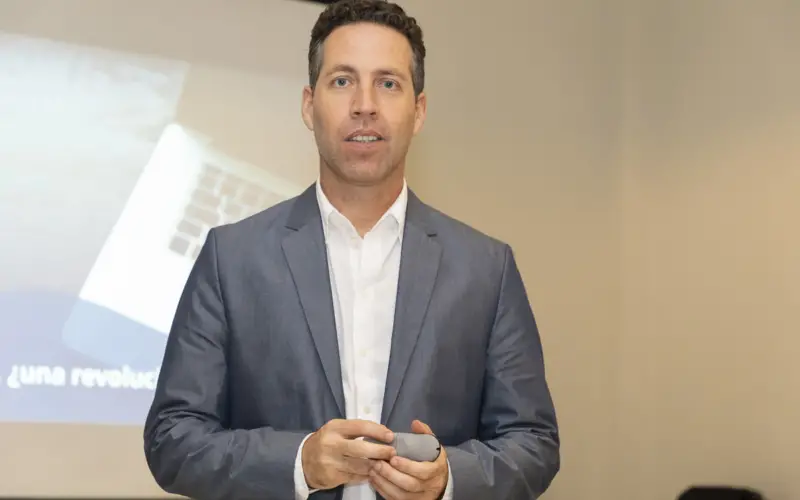
Néstor Romero is an engineer from the University of Córdoba (Spain) and holds a doctorate from the University of Málaga. He is president of the European Digital Marketing Association and vice president of the European Neuromarketing Association. In Panama he teaches artificial intelligence and digital marketing at Quality Leadership University, and he has been a visiting lecturer at the University of Louisville, the University of Málaga, the University of Chile and UNED. He has more than 20 years of digital projects in more than 30 countries and was a speaker at the LiderIA Summit, held on 23 September in the auditorium of the Torre de las Américas in Panama City.
This interview is a telephone conversation between Deilys Romero, economy and business writer at Radar Panamá, and Néstor Romero, who took the call from Panama City on 26 September, days after his talk at the LiderIA Summit. The sentences in quotation marks are verbatim from that conversation. The interviewee himself asked for a clarification that Radar Panamá records here: his answers on employment and training come from his teaching and professional experience, not from his own measurements, and he offers them as informed judgement, distinct from the data in his research.
What students ask today, and what employers ask
Néstor Romero, professor at Quality Leadership University
Employers arrive with a different concern and, according to Romero, they arrive late: they want to know which specific process to start with and, above all, what to do with their customers’ data. «The most repeated question in companies is not “what can artificial intelligence do”, but “what can I feed it without getting into trouble”», he sums up. Almost nobody asked that second question two years ago. The contrast matters for a country that, as Radar Panamá argued when asking whether Panama can be a digital hub without digital talent, needs companies and graduates to move forward together.
The three jobs that change first in Panama
Néstor Romero, professor at Quality Leadership University
The second job, he maintains, is in logistics and foreign-trade documentation, «a huge sector in this country»: document extraction and cross-checking gets automated, and what remains is exception handling, «which is where the value is». The third is marketing content and materials, where «the first draft stops being a job, and the judgement to decide what to publish and what not becomes one». The pattern repeats: the repetitive part disappears and a supervisory function appears. To size the second, Radar Panamá’s guide to what Panama exports and to whom describes the weight of foreign trade in the country’s economy.
First-line customer service
Goes away: repetitive queries in banking and retail.
Appears: the person who supervises what the machine answers and resolves what it cannot.
Logistics and foreign-trade documentation
Goes away: document extraction and cross-checking.
Appears: exception handling, where the value is.
Content and marketing
Goes away: the first draft as a job.
Appears: the judgement to decide what to publish and what not.
Where AI will not reach within five years
Néstor Romero, professor at Quality Leadership University
Romero adds a less obvious territory: any job whose value consists in taking on responsibility. «Signing a diagnosis, authorising a loan, approving a building project. The machine can prepare the decision, and in fact it prepares it better and better; what it cannot do is answer for it. As long as there is a signature with consequences behind it, there will be someone to sign.» He says it with caution, because five years in this field is a long time and predictions over that horizon tend to age badly. Several of those trades are among the sectors with their own rates in Panama’s minimum wage.
| Where AI will not reach within five years | Why, according to Romero |
|---|---|
| Installation and repair | Physical presence and immediate judgement in an unstructured environment |
| Front-of-house hospitality | Physical presence and direct contact in real time |
| Construction | Unstructured environment that demands decisions on site |
| Care work | Physical presence and immediate judgement with people |
| Jobs that sign: diagnosis, loan, building project | The machine prepares the decision but cannot answer for it |
Where a company of thirty employees should start
Néstor Romero, professor at Quality Leadership University
On whom to train, his answer is both, in that order and with different content. Management, «so that it knows what to ask for, what not to believe and where the legal risk is». Teams, «so that they know how to use it in their specific task». And he warns of what happens when only one side is trained: «If you train only the bosses, you will have enthusiasm without execution. If you train only the teams, you will have people using tools without judgement or permission, which is considerably worse.» For anyone starting from scratch, Radar Panamá’s guide to opening a company in Panama covers the preliminary steps.
- Choose a boring, measurable process. Something that repeats every week, eats up hours and does not set the company apart from anyone: quotes, frequent replies, internal reports.
- Train management first. So that it knows what to ask for, what not to believe and where the legal risk is.
- Train the teams next. So that they use the tool in their specific task, with judgement and with permission.
How to choose an assistant, and why to ask two
Néstor Romero, professor at Quality Leadership University
That rule is followed by a warning that, he says, comes from his trade: never take a single assistant’s answer as good on anything that matters. Romero says he has measured it: faced with the same question, two systems rely on almost completely different sources. «If you are evaluating something relevant, ask two and compare. The discrepancy between them will tell you more than the answer from either one.» Radar Panamá has seen that divergence in its own Radar AI studies, such as the one analysing which dental clinics AI recommends in Panama.
What universities teach well and what they are missing
Néstor Romero, professor at Quality Leadership University
What is missing, he acknowledges, is more uncomfortable. «What is missing is teaching how to verify. Students are taught to ask the machine for things and are not taught to check whether what it returns is true, which is the skill that will really set a professional apart.» Romero backs this with a finding from his research, the only measured figure in this conversation. And he points to a second gap: applied legal and ethical training, which data can be used and which cannot. «Today that is taken for granted, and it is not.»
Privacy, Law 81 and services outside the country
Néstor Romero, professor at Quality Leadership University
From the technical side, the rule he gives his clients is simple: «everything you type into a commercial assistant leaves your company and travels to a server you do not control». For that reason, health data, identity documents, customers’ financial information and anything subject to confidentiality «should not go in there without a contract that expressly covers it». And he leaves a practical question almost nobody asks: «if tomorrow a customer demands that you delete their data, can you guarantee it? If the answer is that you do not know, you already have a problem».
The framework he refers to is Law 81 of 26 March 2019, Panama’s personal data protection law, regulated by Executive Decree 285 of 2021; the authority responsible for enforcing it is the National Authority for Transparency and Access to Information (ANTAI). Romero’s question about deletion connects with the rights that law grants to data subjects, although, as he insists, the scope in each company must be determined by a specialist.
Advice for a forty-year-old worker, and for their boss
Néstor Romero, professor at Quality Leadership University
The one who should worry, he continues, is not that worker: «it is the twenty-two-year-old who handles the tool wonderfully and cannot tell a good answer from a bad one». To the boss he addresses the complementary message: the forty-year-old who has spent a decade getting to know the customers is, «with two weeks of training, the most profitable asset you have». And he closes with the clearest warning of the whole conversation: «Replacing that person with someone who masters the tool and does not know the business is the mistake that will cost the most in the coming years.»
What a Panamanian business owner takes away
Romero’s answers sketch an order of priorities for a mid-sized company in Panama. The right question is not what artificial intelligence can do, but which data can be handed over without trouble, and that runs through a contract and a legal specialist. Change arrives first in customer service, foreign-trade documentation and marketing content, and in all three what appears is supervisory work and judgement. The sensible starting point is a repetitive, measurable process, with management trained before the teams, and the assistant already included in the Microsoft or Google environment the company uses, cross-checking any relevant answer against a second system. And the veteran worker who knows the customers is worth more, with two weeks of training, than someone who masters the tool without knowing the business.
More Radar Panamá interviews: Néstor Romero answers: why AI recommends one Panamanian business and not another · Kathia Rivera answers: incorporating a company in Panama as a foreigner, without travelling and in a week
Frequently asked questions
Which jobs does artificial intelligence change first in Panama?
In Néstor Romero’s judgement, three: first-line customer service in banking and retail, documentation in logistics and foreign trade, and the production of marketing content. In all three the repetitive part disappears and a supervisory function appears: reviewing what the machine answers, handling exceptions and deciding what gets published.
Which jobs will AI not reach in the next five years?
Romero points to those that require physical presence and immediate judgement in an unstructured environment, such as installation and repair, front-of-house hospitality, construction and care work, and any job whose value lies in taking on responsibility: signing a diagnosis, authorising a loan or approving a building project. The machine prepares the decision but does not answer for it.
Where should a company of thirty employees start?
With a boring, measurable process, not the flashiest one: quotes, frequent replies or internal reports, whatever repeats every week and eats up hours. Then management must be trained, so that it knows what to ask for and where the legal risk is, followed by the teams, so that they use the tool in their specific task.
Which artificial intelligence assistant should a company choose?
The one the company is already paying for: Microsoft’s if it works in that environment, Google’s if it works in theirs. For Romero, integration with documents and email is worth more than the differences between models, which change every few months. For any relevant decision he recommends asking two systems and comparing their answers.
What are universities missing in how they teach AI?
Teaching how to verify. Romero holds that students are taught to ask the machine for things and not to check whether what it returns is true; in a study of his own, close to one in five citations attributed by a system did not come from the source. Applied legal and ethical training is also missing: which data can be used and which cannot.
Which customer data should not go into an AI assistant?
Romero warns, from the technical side, that everything typed into a commercial assistant leaves the company for a server it does not control. Health data, identity documents, customers’ financial information and anything subject to confidentiality should not go in without a contract that expressly covers it. The legal scope under Law 81 of 2019 must be checked with a specialist.
Sources consulted
- Telephone interview by Radar Panamá with Néstor Romero, 26 September. Quotations are verbatim from that conversation, translated from Spanish.
- Néstor Romero, the interviewee’s professional website.
- LiderIA Summit, programme of the event held on 23 September at the Torre de las Américas, Panama City.
- Law 81 of 26 March 2019 on personal data protection of the Republic of Panama, and Executive Decree 285 of 2021 regulating it. Enforcement authority: ANTAI.
What does artificial intelligence recommend today when asked about Panamanian businesses?
Radar Panamá measures it sector by sector in its Radar AI studies, the verification exercise Romero asks universities to teach.
Ask about this article
Type your question and we will show you the answer inside this article or in other Radar Panamá publications.