

Contents of this guide
Crown, bridge or implant: how it is decided
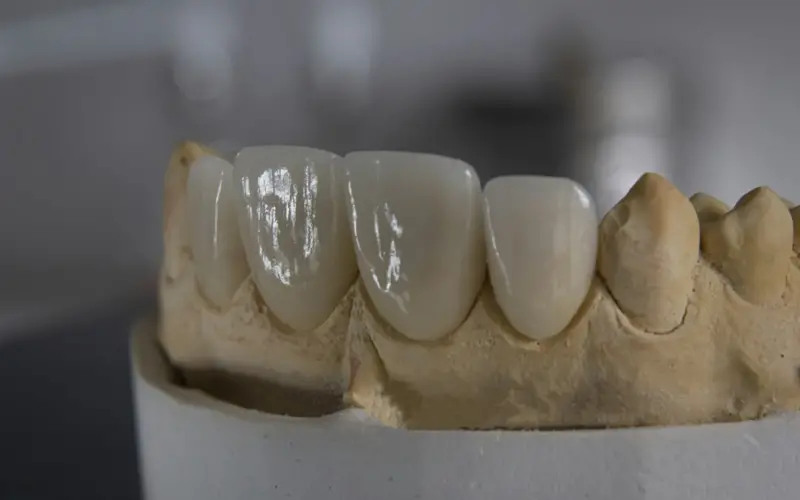
The first question is whether the tooth can be kept. If enough structure remains, the usual option is a crown, a cap that covers the tooth and restores its normal shape and size; according to the ADA it can also strengthen the tooth and improve its appearance. If the tooth is missing or cannot be saved, the decision becomes a bridge or an implant.
The difference between the two lies in the support. According to the NHS, a bridge is a fixed alternative attached to other teeth that cannot be removed; an implant, by contrast, is fixed to the jawbone and replaces the tooth root. Dental Life’s website frames it this way: unlike traditional bridges, implants do not require wearing down healthy adjacent teeth. That is the clinic’s argument, not a guaranteed result, and the final choice depends on the diagnosis of each mouth.
The three solutions often appear combined. An implant is topped with a crown, a bridge can rest on crowns over teeth or over implants, and everything is sequenced within one plan when several teeth are affected, as described in the guide to full mouth rehabilitation.
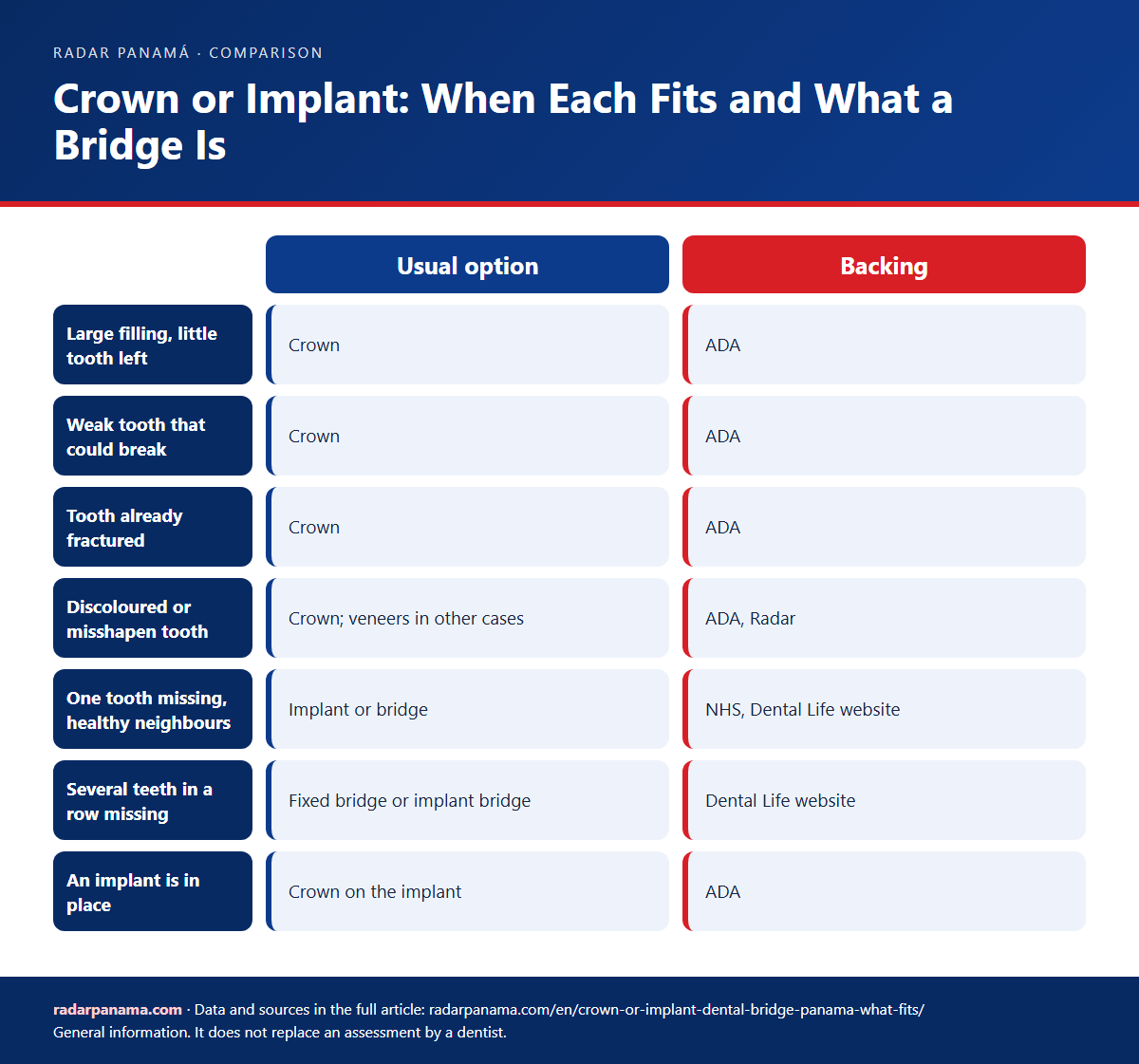
Decision table by situation
| Situation | Usual option | Backing |
|---|---|---|
| Large filling, little tooth left | Crown | ADA |
| Weak tooth that could break | Crown | ADA |
| Tooth already fractured | Crown | ADA |
| Discoloured or misshapen tooth | Crown; veneers in other cases | ADA, Radar |
| One tooth missing, healthy neighbours | Implant or bridge | NHS, Dental Life website |
| Several teeth in a row missing | Fixed bridge or implant bridge | Dental Life website |
| An implant is in place | Crown on the implant | ADA |
The table summarises uses described by the ADA and the clinic’s website. It does not replace a diagnosis: the decision depends on how much tooth remains, the condition of the gum and bone, and the bite.
When a tooth has had root canal treatment, the decision to cover it with a crown is also made by the dentist according to how much structure remains. Radar’s guide to root canal treatment explains how a tooth is saved and why it often needs a restoration afterwards.
Crown materials and survival
The choice of material changes durability and the risk of fracture. A systematic review and meta-analysis published in 2026 in the International Journal of Prosthodontics analysed 64 studies, with 3,509 metal-ceramic crowns and 8,051 all-ceramic crowns, and estimated the five-year survival of crowns on natural teeth:
| Crown material | Five-year survival |
|---|---|
| Monolithic lithium disilicate | 98.5% |
| Veneered zirconia | 97.3% |
| Metal-ceramic | 97.1% |
| Monolithic zirconia | 96.8% |
| Feldspathic or silica-based ceramic | 90.4% |
Pooled data from the 2026 review (International Journal of Prosthodontics). The authors conclude that lithium disilicate and zirconia crowns reach survival comparable to metal-ceramic crowns and that monolithic designs reduce the risk of fracture and chipping.
Dental Life’s website says that its full mouth rehabilitation service includes dental crowns and that it has its own dental laboratory and CAD/CAM technology, which the clinic says allows personalised restorations to be designed and made. The material for each case is defined at the assessment.
What a dental bridge is
A bridge is a fixed prosthesis that replaces one or more missing teeth. According to the ADA, one reason for placing a crown is precisely to anchor a bridge: the neighbouring teeth are shaped and capped with crowns, and the missing tooth is placed between them. That is why the traditional bridge involves treating teeth that may be healthy. A bridge can also rest on implants, like the “puente sobre implantes” (implant bridge) that Dental Life’s website describes for when several adjacent teeth are missing.
Survival data for implant bridges come from a 2012 systematic review in Clinical Oral Implants Research covering 32 studies. It estimated that implants supporting bridges survive at 95.6% at 5 years and 93.1% at 10, and that the bridges themselves survive at 95.4% at 5 years and 80.1% at 10; when the old gold and acrylic bridges are excluded and only metal-ceramic ones are counted, the figures rise to 96.4% and 93.9%. The same review found that only 66.4% of patients were free of complications at 5 years, and that the most frequent were fracture of the veneering material (13.5%), peri-implantitis and soft tissue problems (8.5%) and abutment or screw loosening (5.3%).
For bridges on natural teeth, the 2007 review by Pjetursson and colleagues compared bridges and crowns on teeth and implants and noted that, in conventional bridges, the most frequent complications were biological, such as caries and loss of vitality of the abutment tooth. That review and the 2012 one study different populations, so their figures are not directly comparable.
When the implant comes in
Dental Life’s website describes the implant as a titanium surgical device that integrates with the bone and acts as an artificial root for a crown. Its treatment types include the single implant for one tooth, the implant bridge for several adjacent teeth and full rehabilitation. The process, according to the clinic, starts with a consultation and diagnosis including a 3D CT scan; in some cases earlier steps such as extractions, bone regeneration or a sinus lift are needed, followed by an osseointegration period that the website places generally between 3 and 6 months.
The implant requires bone and gum in good condition and constant upkeep. On longevity, Radar’s guide How Long Do Dental Implants Last? What the Studies Show summarises what the studies say.
What to ask at the assessment
- How much healthy tooth remains? That decides whether a crown is enough or the tooth needs replacing.
- What happens to the neighbouring teeth? A traditional bridge requires capping them; a single implant, according to the clinic’s website, avoids that wear.
- Is there enough bone and gum for an implant? The CT scan and the periodontal assessment determine it, and earlier steps may be needed.
- Which material is proposed and why? It helps to know the options in the materials table and which suits the area and the bite.
- Which complications are most frequent and how are they treated? In implant bridges, fracture of the veneer and screw loosening were the most cited.
- What is the maintenance plan? Regular check-ups are part of treatment with any of the three options.
How Dental Life approaches it
Dental Life, in office 543 of Torre Palmeras, Consultorios Town Center, 5th floor, Costa del Este, includes crowns, fixed bridges, removable partial prostheses and complete prostheses within its full mouth rehabilitation service, and single and multiple implants on its dental implants page. According to its website, the diagnosis includes panoramic X-rays, CT scan, study models, photographs and occlusal analysis, and the plan is built in phases: preliminary treatments, digital planning, definitive restorations and maintenance. The option for each tooth is defined at the assessment.
Dental Life brings crowns, bridges and implants together in its full mouth rehabilitation service, with a complete diagnosis and a phased plan. The option for each tooth is defined at the assessment.
Frequently asked questions
Which is better, a crown or an implant?
They serve different purposes: a crown restores a tooth that can still be kept and an implant replaces one that is missing or cannot be saved. The decision depends on how much healthy structure remains and on the condition of the bone and gum, and it is made after the diagnosis.
When is a dental crown needed?
According to the ADA, when too little tooth remains to hold a large filling, to protect a weak tooth, to restore a broken one, to cover misshapen or discoloured teeth, to anchor a bridge or to cover an implant.
What is a dental bridge?
It is a fixed prosthesis that replaces one or more missing teeth and that, in its traditional form, rests on the neighbouring teeth capped with crowns. It can also rest on implants, as Dental Life’s website describes for when several adjacent teeth are missing.
How long does a porcelain or zirconia crown last?
A 2026 review estimated five-year survival of 97.3% for veneered zirconia, 96.8% for monolithic zirconia and 97.1% for metal-ceramic. These are pooled five-year figures, not a guarantee of duration.
What complications do implant bridges have?
A 2012 review found that only 66.4% of patients were free of complications at 5 years; the most frequent were fracture of the veneering material (13.5%), peri-implantitis and soft tissue problems (8.5%) and abutment or screw loosening (5.3%).
This content is informational and does not replace an assessment by a dentist.
Related articles
- How Long Do Dental Implants Last? What the Studies Show
- Full mouth rehabilitation: when a comprehensive plan is needed and in what order it is done
- What a root canal is and when it is needed: how a tooth is saved in Panama
- Dental Veneers in Panama: When They Fit and When They Do Not
Sources
- ADA MouthHealthy, Crowns: when a crown is needed.
- NHS, Dentures: bridges as a fixed alternative and implant-supported options.
- Pjetursson and colleagues, International Journal of Prosthodontics, 2026 (PubMed 41489982): crown survival by material.
- Pjetursson and colleagues, Clinical Oral Implants Research, 2012 (PubMed 23062125): implant-supported bridges.
- Pjetursson and colleagues, Clinical Oral Implants Research, 2007 (PubMed 17594374): bridges on teeth and implants, complications.
- Dental Life Panamá, full mouth rehabilitation and dental implants.
- Radar Panamá, implants, full mouth rehabilitation, root canal and veneers.
Ask about this article
Type your question and we will show you the answer inside this article or in other Radar Panamá publications.