

Contents of this guide
How long dental implants last: what the studies show
The most quoted figure comes from a review of 18 prospective studies of current implant systems (solid screw, roughened surface). According to its PubMed abstract, 10-year survival was 96.4% (95% confidence interval 95.2% to 97.5%). A sensitivity analysis that accounts for patients who stopped attending follow-up gave 93.2% (90.1% to 95.8%). In that second analysis, the group aged 65 or older had a survival of 91.5%, and the authors note that the risk of implant loss may double in older age groups.
Two cautions help in reading these numbers. First, the study measures how many implants are still in the mouth at 10 years, not how long they last on average. Second, these are group figures from clinical studies, and an individual result depends on the individual case.
Longer-term data exist but are scarcer. A 25-year retrospective study followed 26 patients with 75 implants in a systematic maintenance program: 95% of the implants were still functioning, against 88% of the prostheses. It is a small sample from one private practice, so it serves as guidance and not as a promise.
Dental Life Panamá states in its original article on implant lifespan that an implant “can last decades and even a lifetime” with good hygiene and follow-up (translated from Spanish). The studies cited support a high survival rate, but they do not allow a specific lifespan in years to be guaranteed.
What it depends on and what to do
Bone bonds to titanium in a process called osseointegration, and that bond can deteriorate if the surrounding tissues become inflamed. The inflammation comes in two grades. Peri-implant mucositis affects only the gum. Peri-implantitis, according to the review for the 2017 World Workshop on classification, adds progressive loss of supporting bone and can start early and advance at an accelerating pace.
It is not a marginal problem. An AAP and Academy of Osseointegration meta-analysis (102 studies, 13,030 patients) estimated a patient-level prevalence of 46% for mucositis and 21% for peri-implantitis, with incidence of 53% and 22% over 20 years. Those percentages do not equal lost implants, but they explain why maintenance is part of the treatment.
| Factor | What the evidence shows | What can be done |
|---|---|---|
| Plaque and poor hygiene | The 2017 review reports strong evidence of higher risk with poor plaque control. | Brushing, interdental cleaning and professional cleanings. |
| Missing check-ups | Across 48 studies, patients in regular maintenance had less peri-implant disease (OR 0.42) and less implant loss than irregular attendees (OR 3.76 for the irregular group). | A check-up schedule set with the specialist. |
| Previous periodontitis | A risk factor in both the 2018 and 2025 reviews. | Treat the gums before placing the implant and keep them under control. |
| Smoking | Across 107 studies, 6.35% of implants failed in smokers and 3.18% in non-smokers. Confounding factors exist. | Discuss quitting with the specialist, before and after surgery. |
| Poorly controlled diabetes | With good glycemic control, peri-implantitis risk was lower (OR 0.16) than with poor control. | Keep blood sugar controlled and tell the team. |
| Teeth grinding (bruxism) | Linked to more mechanical complications: loose screws, ceramic fractures and, less often, fracture of the implant itself. | Consider a night guard, as the clinic mentions. |
| Prosthesis hard to clean | Leftover cement, lack of keratinized gum or positions that hinder hygiene have limited evidence as factors. | Ask for a design that allows brushing and probing of the area. |
Table sources: Schwarz 2018, Carra 2023, Chrcanovic 2015, Galarraga 2025 and Vidal 2025. Risk data are observed associations, not proven cause and effect.
Two of these factors deserve nuance. In the 2017 review, smoking and diabetes were called inconclusive indicators of peri-implantitis, while the 2025 meta-analysis did identify them as risk indicators. And an earlier meta-analysis found no direct link between glycemic control and implant loss, with few patients included (Journal of the American Dental Association, 2016). The prudent reading is that both matter, and that they are weighed case by case.
Implant and crown: two parts with different lifespans
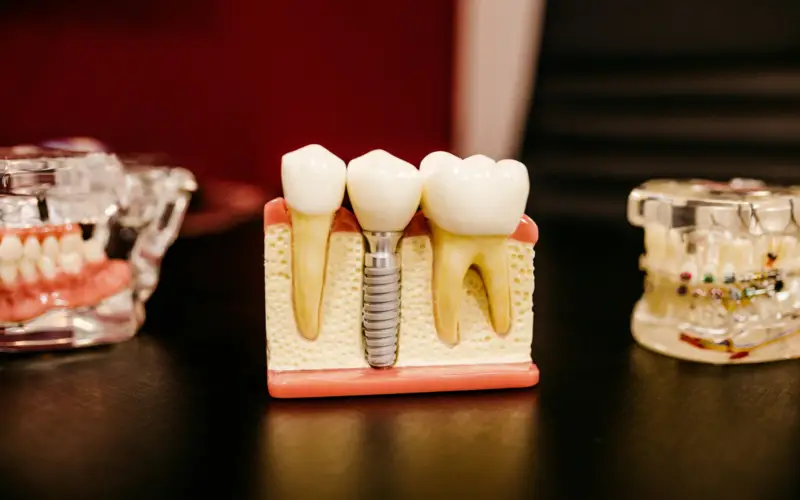
A complete implant has three components. The clinic’s implant page describes them as the titanium implant fixed to the bone, the abutment that connects it to the prosthesis, and the crown, the visible part, made of porcelain or zirconia. The ADA on MouthHealthy explains that bone grows around the implant and holds it, and that for a single tooth a custom crown is made.
The crown is exposed to chewing wear, and the data reflect it. In a review of 46 studies on single crowns (Clinical Oral Implants Research, 2012), 95.2% of implants remained at 10 years, but crown survival was 89.4%. At 5 years, cumulative technical complications were 8.8% for screw loosening, 4.1% for loss of retention and 3.5% for fracture of the veneering material. The authors conclude that survival rates are high, but that technical, biological and aesthetic complications are frequent.
Dental Life Panamá says the crown may need replacement between 10 and 15 years depending on use and care. That span is the clinic’s estimate and not a figure from the studies cited, which report survival at 5 and 10 years.
Daily care and check-ups
An implant cannot get cavities, but the gum around it does become inflamed with plaque. The European consensus on mucositis, published in the Journal of Clinical Periodontology, concludes that patient-administered plaque control, with a manual or powered toothbrush, is an effective preventive measure, and that the prosthesis must allow personal cleaning, probing and professional cleaning.
- Brush consistently. The clinic recommends brushing 2 to 3 times a day, plus floss or interdental brushes.
- Clean between the teeth and around the abutment. Healthy gums protect the supporting bone. The exact method (floss, interdental brush or irrigator) is defined by the specialist according to the type of prosthesis.
- Attend maintenance check-ups. The European Federation of Periodontology clinical guideline calls for a supportive care program with periodic assessment of the tissues. How often is set by the specialist, and the general frequency of cleanings is covered in the guide on how often to get a dental cleaning.
- Quit smoking or cut down. In the 2015 meta-analysis, implants in smokers failed more often and had more postoperative infections than in non-smokers.
- Protect against grinding. If there is clenching or grinding, the clinic mentions a night guard to protect the implant and the natural teeth.
- Do not use teeth as tools. Biting very hard objects strains the crown and the screw.
- Report warning signs. Bleeding when brushing, red or swollen gums, a bad taste or a crown that moves warrant an appointment soon, because peri-implant disease can progress at an accelerating pace.
Myths and facts
The clinic’s blog article on implant myths and realities gathers common beliefs. These are the ones supported by open sources, along with one myth the original does not cover.
| Myth | What the evidence says |
|---|---|
| Past a certain age they cannot be placed | The ADA says general health matters more than age. The Howe review did observe lower survival from age 65, a point the specialist weighs. |
| Without enough bone there is no implant | Procedures exist to gain bone, such as the sinus lift. A 2014 Cochrane review reports that, with residual height of 4 to 9 mm, short implants were an alternative and that sinus lift was associated with more complications. |
| Placing an implant hurts more than an extraction | In a study of 339 patients, straightforward placement had a recovery comparable to a simple extraction. With bone regeneration there was more swelling and more painkillers. |
| It always means months without teeth | According to the ADA, some patients receive the implant and replacement teeth in one visit, and the clinic mentions immediate loading in selected cases. |
| An implant needs no care because it cannot get cavities | Peri-implant disease affects a relevant share of patients: 21% had peri-implantitis in the 2025 meta-analysis. |
| It lasts a lifetime, guaranteed | Survival is high, but no study guarantees it for an individual. There is a 25-year follow-up in a small sample. |
Sources: ADA, Howe 2019, Cochrane, maxillary sinus augmentation, Yao 2017, Galarraga 2025 and Frisch 2020.
What to ask when choosing a clinic or specialist
The data above suggest what is worth clarifying before deciding. A list of criteria, without superlatives:
- Who will place the implant and who will make the prosthesis, with their training and specialty.
- How the case is assessed. What imaging and planning are done and how the implant position is decided.
- Gum status. If periodontitis is found, how it is treated before the implant.
- Available bone. If regeneration or a sinus lift is needed, which technique is proposed and how much time it adds.
- Materials and system. Which implant brand is used, what the crown is made of, and that everything is recorded in the patient file.
- A design that can be cleaned. That the prosthesis allows hygiene and examination.
- Maintenance plan. How often check-ups happen, what they include and who performs them.
- A written quote with phases, what is and is not included, and what happens if a complication arises.
The dental implants page of Dental Life Panamá states that diagnosis includes 3D computed tomography and digital treatment design, that it offers guided bone regeneration, sinus lift and guided surgery, and that follow-up includes periodic visits and professional cleanings. Dr. Mario Chalhoub is listed on the clinic’s profile as a specialist in periodontics and implantology, with the affiliations listed there, and the clinic also offers periodontics, the area that treats the gums that support the implant. For extensive tooth loss, Radar’s guide to full-mouth rehabilitation explains the comprehensive plan, and the clinic describes the service on its oral rehabilitation page.
The clinic is at office 543, Torre Palmeras, Consultorios Town Center, Costa del Este. Its implants page explains the treatment phases, the types of solution and the preliminary diagnosis.
Frequently asked questions
How long do dental implants last?
In a review of 18 studies published in the Journal of Dentistry, 96.4% of implants were still in place at 10 years, and 93.2% after adjusting for losses to follow-up. The crown tends to wear before the implant, and each person’s result depends on gum health, hygiene and check-ups.
What damages an implant early?
Plaque buildup that causes peri-implantitis, missed maintenance visits, untreated periodontitis, smoking, poorly controlled diabetes and teeth grinding. The 2018 and 2025 reviews describe these as associated risks, not proven causes.
How often should an implant be checked?
The specialist sets the frequency for each case. The European clinical guideline recommends a maintenance program with periodic assessment, and a meta-analysis found less peri-implant disease in people who attended regularly than in those who attended irregularly.
Can an implant be lost even after many years?
Yes, although it is not the norm. Peri-implantitis can appear over the years: a meta-analysis estimated that 22% of patients develop it over 20 years. It does not always end in implant loss, and catching it early at check-ups widens the treatment options.
How much do dental implants cost in Panama?
The cost depends on how many teeth are replaced, whether extractions, bone regeneration or a sinus lift are needed first, the type of prosthesis (single crown, bridge, overdenture or full rehabilitation) and the materials. The clinic states that the exact quote is set after the evaluation, with the treatment plan for the case.
This content is informational and does not replace an evaluation by a dentist.
Related articles
- How often to get a dental cleaning in Panama
- Full-mouth rehabilitation in Costa del Este: guide to the comprehensive plan
- What a root canal is and when it is needed
More dental health guides on Radar Panamá
- Invisalign in Panama: How It Works, Duration and Candidates
- Dental Veneers in Panama: When They Fit and When They Do Not
- Braces or Invisalign: Which One Fits the Case
- Gingivitis vs Periodontitis: Symptoms and Treatment
- Wisdom Teeth: When to Remove Them and What Recovery Looks Like
Sources
- Howe MS, Keys W, Richards D. Long-term (10-year) dental implant survival: a systematic review and sensitivity meta-analysis. J Dent 2019, vol. 84 (DOI): 96.4%, 93.2% and age 65 or older.
- Jung RE et al. Survival rate and complications of single crowns on implants (mean follow-up of 5 years). Clin Oral Implants Res 2012: implants and crowns at 5 and 10 years.
- Frisch E et al. Long-term results of implants under systematic supportive implant therapy: 25-year retrospective study. Clin Implant Dent Relat Res 2020.
- Galarraga-Vinueza ME et al. Prevalence, incidence and risk factors for peri-implant diseases: AO/AAP systematic review. J Periodontol 2025.
- Schwarz F et al. Peri-implantitis. J Periodontol 2018 (World Workshop 2017).
- Carra MC et al. Primordial and primary prevention of peri-implant diseases. J Clin Periodontol 2023.
- Herrera D et al. EFP S3 level clinical practice guideline on peri-implant diseases. J Clin Periodontol 2023 and Derks J et al. Primary prevention of peri-implantitis: managing peri-implant mucositis. J Clin Periodontol 2015.
- Chrcanovic BR et al. Smoking and dental implants: systematic review and meta-analysis. J Dent 2015.
- Vidal RA et al. Bruxism and mechanical complications in implant-supported prostheses. J Prosthodont 2025.
- Does a higher glycemic level lead to a higher rate of dental implant failure? J Am Dent Assoc 2016.
- Cochrane: Interventions for replacing missing teeth, augmentation procedures of the maxillary sinus (2014).
- Yao J et al. Patient-centered outcomes after routine implant placement, tooth extraction and periodontal surgery. Clin Oral Implants Res 2017.
- ADA MouthHealthy, Implants.
- Dental Life Panamá: dental implants, Dr. Mario Chalhoub, periodontics, oral rehabilitation, original article and myths and realities.
Ask about this article
Type your question and we will show you the answer inside this article or in other Radar Panamá publications.