

Contents of this guide
What Invisalign is and how it works
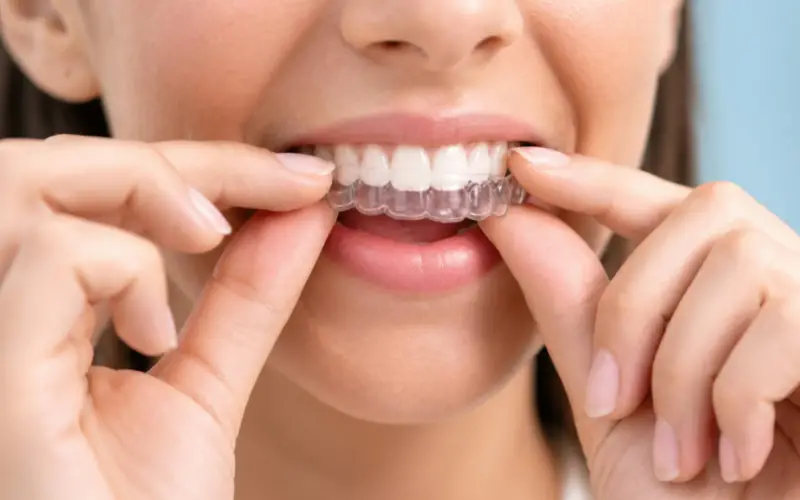
Invisalign is an orthodontic treatment that uses a series of clear plastic aligners made to fit each patient’s mouth. Each set applies gentle force and moves the teeth a little toward the position the specialist has planned. The aligners come out for eating and brushing, which is the most visible practical difference from braces, which stay fixed.
The AAO, which represents orthodontists in the United States, gives two rules of use on its clear aligner therapy page: wear them 20 to 22 hours a day, or as the orthodontist prescribes, and switch to each new set after one or two weeks. The same page notes that moving teeth is a complex biological process that needs start-to-finish supervision by an orthodontist.
At the clinic, the path described on its orthodontics and Invisalign landing page has four steps: a comprehensive assessment, a 3D plan, removable aligners and follow-up until the result is reached. The orthodontics service page adds that check-ups are generally every 4 to 8 weeks, depending on the type of treatment.
Who it suits and who it does not
The clinic says its aligners suit any age and that what matters is having healthy gums and bone. The original article on the Dental Life blog lists crowding, gaps between teeth, crossbite, open bite and overbite as treatable cases, always subject to clinical assessment.
Independent sources set limits on that list. The AAO warns that aligners may work less predictably for severe malocclusions, significant tooth rotations and large gaps, cases where braces offer more precision. A 2015 systematic review in The Angle Orthodontist of eleven studies found that aligners level the arches well and control intrusion of the front teeth, but are less effective for front-tooth extrusion and rotation. The authors themselves ask for caution in interpreting these results because of study quality and variety.
The clinic’s landing page agrees on the essentials: aligners are ideal for most corrections, and some complex cases are better solved with braces. The diagnosis decides which kind of case it is.
| Situation | What the sources say | Source |
|---|---|---|
| Crowding, gaps, crossbite or open bite | Listed as treatable cases, after assessment | Clinic blog |
| Severe malocclusion | Less predictable; braces more precise | AAO |
| Significant rotations | Less effective at rotating teeth | AAO and 2015 review |
| Large gaps | Less predictable | AAO |
| Complex cases in general | Some are better solved with braces | Clinic landing page |
| Diseased gums or bone | The disease is treated first | Clinic and periodontal academies |
How long treatment takes
Duration depends on complexity, on what needs correcting, on biological response, on how consistently the aligners are worn and on check-ups. That is how the clinic’s blog puts it, and the landing page adds that some cases are resolved in a few months and others take longer, with a clear estimate of duration given at the assessment, based on the 3D plan. The blog article on invisible orthodontics cites an average of 12 to 18 months, a figure the clinic itself qualifies by saying each case is different.
The studies show a mixed picture. A 2024 systematic review in Clinical Oral Investigations of ten studies concluded, with low-quality evidence, that in mild to moderate crowding there is no significant difference in duration between aligners and fixed appliances, and that trials in severe cases are still needed. A 2025 randomized trial in Bioinformation measured 18.2 months with aligners and 14.5 months with fixed appliances, and attributed the gap to sequential tooth movement, lapses in wear and refinements. It is a single trial, so it works as an example of the range and not as a promise of timing.
The UK National Health Service (NHS) page on braces mentions fixed braces staying on for 1 to 2 years, another order-of-magnitude reference, though it does not cover aligners.
What the cost depends on
This guide gives no figures. The clinic does not publish a list price either: its FAQ explains that cost depends on how far the teeth have moved, on the type of treatment (braces or aligners) and on how long it lasts, and that a plan with the exact price is delivered at the assessment. The logic holds, because two Invisalign patients can need treatments of very different length.
When comparing quotes between clinics, it helps to have each one clarify the same points: which cases it covers, how long the plan lasts, which check-ups are included and what happens if the plan changes. For visitors considering treatment in Panama from another country, the guide to medical tourism in Panama covers the topic.
The assessment and what to ask
According to the landing page, the assessment includes a complete evaluation of the mouth. During the visit the clinic carries out a dental and periodontal evaluation to detect gum disease, a functional bite review, clinical photographs and diagnostic records, and a digital scan. This information is used to design the 3D plan, which shows from day one how the result is projected. The services page adds that diagnosis may include X-rays and study models.
The clinic presents Dr. Samuel Ibarra as a specialist in orthodontics and laser dentistry; his profile lists traditional and aesthetic orthodontics among his specialties, with treatment for children and adults. Who will lead the case is one of the first useful questions.
- Who designs and supervises the treatment. The AAO recommends start-to-finish supervision by an orthodontist.
- Whether the case suits aligners or another technique. The clinic acknowledges that some complex cases are better solved with braces.
- How long it will take, based on the 3D plan. The estimate is given at the assessment.
- What the exact quote includes. Check-ups, refinements if the plan changes, and retainers.
- What needs treating first. Cavities or gum disease, which the clinic requires to be resolved first.
- How many hours a day and which habits. 20 to 22 hours of wear, and what to do at mealtimes.
- How retention will work. Which retainers are used and for how long.
| Question | Why it matters |
|---|---|
| Am I a candidate for aligners? | Some cases are better solved with braces |
| How long does the 3D plan estimate? | Duration depends on the case |
| What does the quote include? | The exact cost comes from the assessment |
| Is anything to be treated first? | A healthy base is required, without cavities or periodontal disease |
| Which retainers are used? | They keep the teeth from moving again |
Healthy gums before starting
The clinic sets a clear condition: before moving a single tooth, the patient must be free of cavities and gum (periodontal) disease. Its FAQ gives the reason: moving teeth in a diseased mouth can damage the bone, and a healthy base is essential for the result to last.
The Australian and New Zealand Academy of Periodontists backs this up: with active gum disease, orthodontic movement can accelerate irreversible destruction of the supporting tissues, and in most cases orthodontic treatment can go ahead after periodontal treatment. It also recommends consistent hygiene and frequent check-ups during treatment.
Because aligners are removable, they make hygiene easier. A 2023 systematic review in the Korean Journal of Orthodontics of 31 studies found better periodontal indices and less biofilm with aligners than with fixed appliances; the authors warn that most of the studies were observational and small. To keep gums in check, the guide on how often to get a dental cleaning covers frequency.
The orthodontics page of Dental Life Panamá describes the treatments the clinic offers, including clear aligners (Invisalign), and its work process.
Retainers afterward
Finishing the aligners does not close the treatment. The clinic’s blog says retainers are used, fixed or removable depending on clinical indication, and that without retention the teeth can move again (relapse). The orthodontics page lists retention as the final stage of the process.
The AAO explains on its retainers page that teeth tend to drift back toward their starting positions if nothing is done to prevent it, and recommends a full-time retainer for a few months and then nightly wear indefinitely. On another page from the same association, it states that a retainer is necessary for life, although how often it is worn may decrease. The exact schedule depends on what the specialist prescribes.
For anyone considering a broader intervention, the guide to full-mouth rehabilitation covers the comprehensive plan for the mouth.
Frequently asked questions
How much does Invisalign cost in Panama?
The exact cost comes from the clinic after the assessment, because it depends on the case. According to the Dental Life Panamá FAQ, it is influenced by how far the teeth have moved, the type of treatment (braces or aligners) and how long it lasts. That is why the clinic does not publish a list price and presents a plan with the exact price.
How long does treatment take?
It depends on each case. The clinic says some are resolved in a few months and others take longer, and that it gives an estimate based on the 3D plan at the assessment. In mild to moderate crowding, a 2024 review found no significant difference from fixed appliances, and one trial measured 18.2 months with aligners.
Does Invisalign work for very crooked teeth?
It depends on severity. Crowding is among the cases the clinic treats with aligners, but the AAO warns of less predictability in severe malocclusions, significant rotations and large gaps, and the clinic acknowledges that some complex cases are better solved with braces. The diagnosis determines the technique.
Can you eat with the aligners in?
No, they come out for eating and brushing and go back in afterward. The clinic’s blog says to remove them only to eat, to drink anything other than water and to clean the teeth. Since the recommended daily wear is 20 to 22 hours, those moments need to stay short.
What happens if they are not worn 22 hours?
Treatment moves less than planned. The clinic’s blog says the teeth do not advance according to the plan, stages may need adjusting and treatment gets longer; a 2025 trial also describes how lapses in wear add up and extend the time. The AAO states 20 to 22 hours a day or whatever the orthodontist prescribes.
This content is informational and does not replace an assessment by a dentist. For the starting point of this guide, see the original article on the Dental Life blog.
Related articles
- How often to get a dental cleaning in Panama
- Full-mouth rehabilitation in Costa del Este: a guide
- Medical tourism in Panama
More dental health guides on Radar Panamá
- Dental Veneers in Panama: When They Fit and When They Do Not
- How Long Do Dental Implants Last? What the Studies Show
- Braces or Invisalign: Which One Fits the Case
- Gingivitis vs Periodontitis: Symptoms and Treatment
- Wisdom Teeth: When to Remove Them and What Recovery Looks Like
Sources
- Dental Life Panamá, Ortodoncia e Invisalign: assessment, 3D plan, clinic FAQ.
- Dental Life Panamá, Ortodoncia en Panamá: process, check-ups and retention.
- Dental Life Panamá, Dr. Samuel Ibarra.
- Dental Life Panamá, Invisalign en Panamá: qué es, precio, duración y beneficios and Ortodoncia invisible: sonríe sin brackets con Invisalign.
- AAO, Clear Aligner Therapy: wear hours, set changes, limits and supervision.
- AAO, What Are Dental Retainers? and AAO, Protect Your Smile With Retainers.
- Rossini et al., Efficacy of clear aligners in controlling orthodontic tooth movement: a systematic review. Angle Orthodontist, 2015.
- Alhamwi et al., Duration of orthodontic treatment with clear aligners versus fixed appliances in crowding cases. Clinical Oral Investigations, 2024.
- Effect of clear aligners and fixed appliances among orthodontic patients: a comparative study. Bioinformation, 2025.
- Periodontal health status, oral microbiome, white-spot lesions and oral health related to quality of life: clear aligners versus fixed appliances. Korean Journal of Orthodontics, 2023.
- Australian and New Zealand Academy of Periodontists, Orthodontics and Periodontal Health.
- NHS, Braces.
Ask about this article
Type your question and we will show you the answer inside this article or in other Radar Panamá publications.