

Contents of this guide
Gingivitis and periodontitis: what they are
Both conditions belong to periodontal disease, which affects the tissues that hold teeth in place. The UK National Health Service (NHS) explains that gum disease is caused by a build-up of plaque on the teeth. The American Academy of Periodontology describes gingivitis as the mildest form: gums become red and swollen and bleed easily, with little discomfort. It is reversible with professional treatment and good care at home.
In periodontitis, according to the same source, plaque spreads and grows below the gum line, and the tissues and bone that support the teeth break down and are destroyed. The Academy adds that it is classified by stage and grade, from initial to severe. The European Federation of Periodontology (EFP) marks the key difference: in gingivitis there is not yet any loss of the supporting structures, while in periodontitis there is, and lost bone does not repair itself.
The World Health Organization estimates that severe periodontal diseases affect more than 1 billion people worldwide and names poor oral hygiene and tobacco use as the main risk factors. The Dental Life periodontics page cites the same figure. That clinic in Costa del Este, Panama City, offers the service and presents Dr. Mario Chalhoub as a specialist in Periodontics and Implantology.
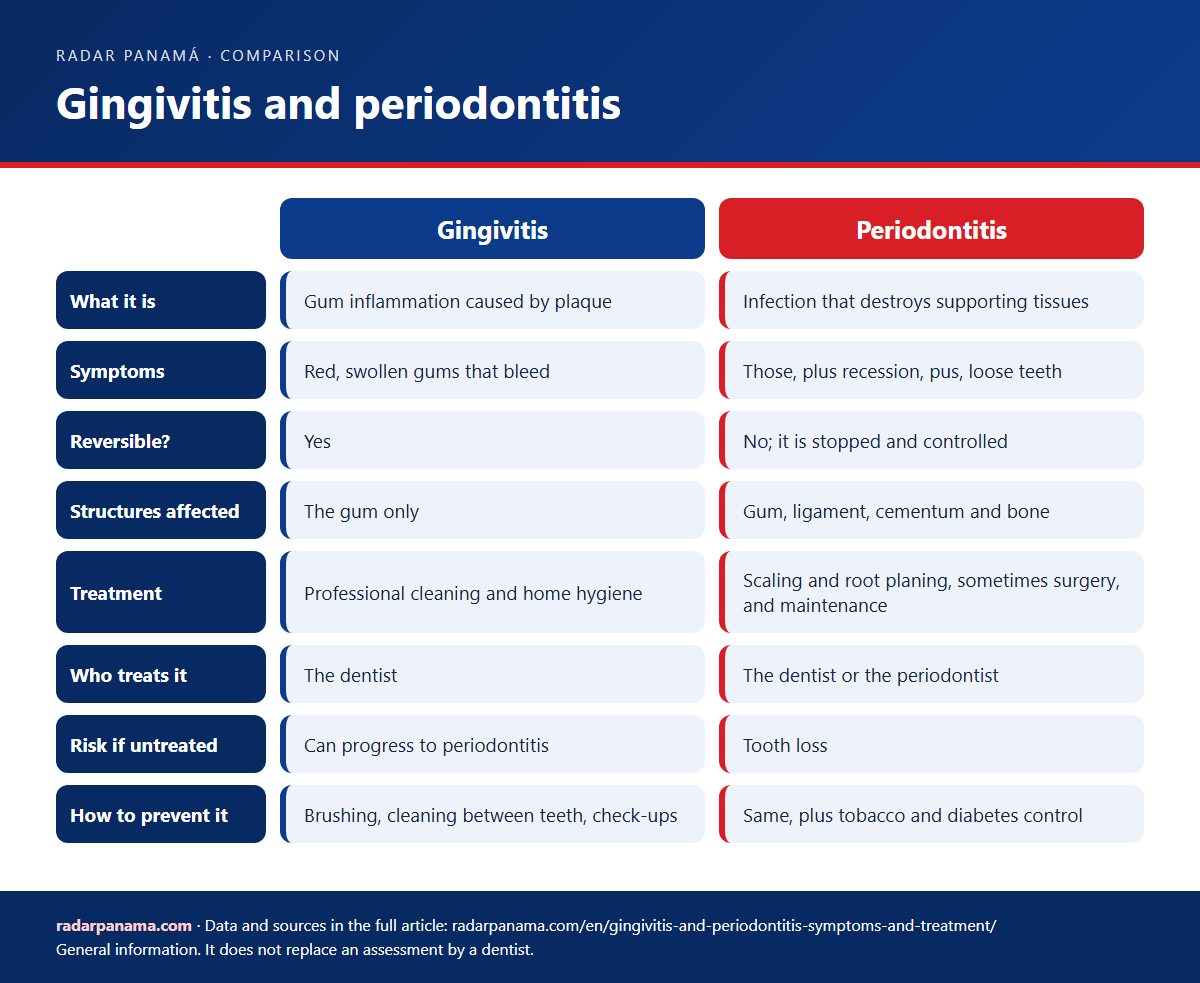
Comparison table: gingivitis vs. periodontitis
| Aspect | Gingivitis | Periodontitis |
|---|---|---|
| What it is | Gum inflammation caused by plaque | Infection that destroys supporting tissues |
| Symptoms | Red, swollen gums that bleed | Those, plus recession, pus, loose teeth |
| Reversible? | Yes | No; it is stopped and controlled |
| Structures affected | The gum only | Gum, ligament, cementum and bone |
| Treatment | Professional cleaning and home hygiene | Scaling and root planing, sometimes surgery, and maintenance |
| Who treats it | The dentist | The dentist or the periodontist |
| Risk if untreated | Can progress to periodontitis | Tooth loss |
| How to prevent it | Brushing, cleaning between teeth, check-ups | Same, plus tobacco and diabetes control |
Summary of the AAP, EFP, NIDCR and NHS sources listed below. A dentist establishes the diagnosis after examining the gums.
Warning signs and when to seek care
Gum disease can advance without pain, so small changes matter. The NHS lists bleeding when brushing, flossing or eating hard foods, and swollen, red and sore gums. The AAP adds receding gums, loose teeth, pus between the gum and tooth, persistent bad breath and changes in the way the teeth fit together. The clinic’s page also mentions teeth that look longer and gaps opening between teeth.
On when to seek care, the NHS separates two levels. Bleeding gums or painful swelling call for a non-urgent appointment with a dentist. Severe swelling or loose teeth call for an urgent appointment. The same source says the dentist makes the first assessment and may refer to a specialist when the case requires it. A periodontist is, according to the US National Institute of Dental and Craniofacial Research (NIDCR), a specialist in the diagnosis and treatment of gum disease.
- Occasional bleeding when brushing. Usually matches gingivitis and calls for a non-urgent dental check.
- Bleeding that persists or bad breath that does not go away. It means the inflammation is continuing, and a gum examination with measurement of periodontal pockets is reasonable.
- Receding gums, moving teeth or bite changes. These are signs of advanced disease, and a consultation with a periodontist makes sense.
- Pus, severe swelling or loose teeth. The NHS advises asking for an urgent appointment.
Treatment at each stage
Gingivitis. The EFP states that when a patient keeps optimal hygiene and plaque is removed regularly, gums can recover within a few days. The NHS describes advice on keeping teeth clean, interdental brushes, help to stop smoking and professional cleaning for this stage.
Periodontitis. The EFP treatment guide describes successive phases: first, reducing bacteria through hygiene instruction and managing factors such as smoking and diabetes; then professional removal of plaque and tartar, over several visits if the case is advanced; antibiotics when infection persists; and a reassessment a few weeks later with a periodontal probe. Pockets deeper than 4 mm may call for surgery, which includes scaling and root planing under local anesthesia or regenerative therapy to rebuild lost bone. The NIDCR names scaling and root planing as the deep cleaning used for gum disease.
On its periodontics page, the clinic lists deep cleaning with scaling and root planing, periodontal surgery, gum grafts, bone regeneration, periodontal maintenance and laser treatment. The specific plan depends on each patient’s diagnosis, and the exact budget is provided after the evaluation.
Maintenance. After the initial treatment, the EFP says follow-up visits are usually scheduled every three to six months, depending on severity and individual risk. The EFP is clear that periodontitis cannot be cured: it is a chronic condition with a risk of relapse, although with professional treatment it is usually possible to halt its progress completely.
What to ask at a periodontal evaluation
- Whether the diagnosis is gingivitis or periodontitis and, in the latter case, which stage.
- How deep the periodontal pockets are and how many sites bleed.
- Whether the first step is a deep cleaning or whether surgery is being considered.
- How often the maintenance visits will be.
- How smoking, diabetes or other personal factors affect the plan.
Risk factors
Tobacco. The NIDCR identifies it as the most significant risk factor and adds that it also impairs healing. According to the EFP, smokers are much more likely to develop periodontitis, and the disease progresses faster than in non-smokers.
Diabetes. The WHO says diabetes has been linked in a reciprocal way with the development and progression of periodontal disease. The EFP puts it this way: people with poorly controlled diabetes have a higher risk of periodontitis, and people with periodontitis have a higher risk of diabetes. A 2022 Cochrane review that included 35 clinical trials concluded, with moderate certainty, that treating periodontitis with subgingival instrumentation lowers glycated hemoglobin (HbA1c) by 0.43 percentage points at 3 to 4 months, compared with no treatment or usual care.
Other factors. The NIDCR mentions older age, genetic predisposition, stress, hormonal changes, a weakened immune system and some conditions such as rheumatoid arthritis, cardiovascular disease and obesity. The clinic says periodontal diseases can be related to cardiovascular disease, diabetes, respiratory problems and high-risk pregnancies, and that they can appear even without cavities, because they depend on plaque and on the state of the gums.
Tooth loss. The EFP estimates that around 70% of tooth loss in adults is caused by periodontitis. That is why treating the gums first also conditions other plans, such as implants or full-mouth rehabilitation: the clinic’s original article states that any active periodontal disease must be controlled before implants are placed.
Dental Life, in Costa del Este, offers periodontics with deep cleaning, maintenance and periodontal surgery, and presents Dr. Mario Chalhoub as a specialist in Periodontics and Implantology. The service details are on its page.
How to prevent them
The measures repeated by the NHS, the NIDCR and the clinic are the same:
- Brush at least twice a day with fluoride toothpaste.
- Clean between the teeth every day with floss or interdental brushes, because brushing alone does not reach those surfaces.
- Do not smoke, or quit; the NHS and the NIDCR list it among the basic measures.
- Attend regular check-ups that include a gum evaluation. The EFP recommends asking for a basic periodontal examination as part of the usual check-up, and the clinic mentions professional cleanings every 6 months. More detail in the guide on how often to get a dental cleaning.
- Keep diabetes under control, since it also influences gum health.
This article is informational and does not replace an evaluation by a dentist. The article it builds on is available as the original article on the Dental Life blog (in Spanish).
Frequently asked questions
Does gingivitis go away on its own?
Gingivitis is reversible, but it does not disappear just by waiting: it reverses when plaque is removed through professional cleaning and good hygiene at home. The EFP says that with optimal hygiene and regular plaque removal, gums can recover within a few days. If plaque stays for a long time, the inflammation can progress to periodontitis, although that does not always happen.
Can periodontitis be cured?
Periodontitis cannot be cured in the sense of being reversed, but with professional treatment it is usually possible to halt its progress completely. The EFP describes it as a chronic condition with a risk of relapse, so it requires regular maintenance. Lost bone does not repair itself, although regenerative techniques exist for specific cases that the specialist assesses.
Why do my gums bleed if I brush well?
Bleeding signals gum inflammation, and the most common cause is plaque left at the gum margin and between the teeth, areas that brushing does not always reach. The NHS recommends cleaning between the teeth every day with floss or interdental brushes. Other factors, such as tobacco, diabetes or hormonal changes, also play a role according to the NIDCR, and only a dental exam can tell which one is involved.
When should I see a periodontist?
The first visit is usually with a dentist, who can refer to a periodontist if periodontitis or a complex case is found. The NHS says bleeding gums call for a non-urgent appointment, and severe swelling or loose teeth call for an urgent one. Receding gums, tooth mobility and bite changes are signs of more advanced disease.
Can gum disease make you lose teeth?
Yes. Without treatment, periodontitis destroys the bone that holds teeth in place, and they can loosen and fall out. The EFP estimates that around 70% of tooth loss in adults is caused by periodontitis. Gingivitis, by contrast, does not affect the bone and is reversible.
Related articles
- How often to get a dental cleaning in Panama
- Full-mouth rehabilitation in Costa del Este: guide to the comprehensive plan
More dental health guides on Radar Panamá
- Invisalign in Panama: How It Works, Duration and Candidates
- Dental Veneers in Panama: When They Fit and When They Do Not
- How Long Do Dental Implants Last? What the Studies Show
- Braces or Invisalign: Which One Fits the Case
- Wisdom Teeth: When to Remove Them and What Recovery Looks Like
Sources
- World Health Organization, Oral health fact sheet: more than 1 billion cases of severe periodontal disease, risk factors and the link with diabetes.
- Cochrane 2022, Simpson et al., treatment of periodontitis for glycaemic control in people with diabetes.
- American Academy of Periodontology, gum disease information: gingivitis, periodontitis and warning signs.
- European Federation of Periodontology, FAQs and gum disease treatment.
- NIDCR, periodontal (gum) disease: early reversibility, scaling and root planing, risk factors.
- NHS, gum disease, causes and treatment.
- Dental Life Panamá, periodontics service, Dr. Mario Chalhoub’s page and original blog article.
Ask about this article
Type your question and we will show you the answer inside this article or in other Radar Panamá publications.