

Contents of this guide
What a professional dental cleaning is and what it includes
Bacterial plaque forms on teeth within hours and, if it is not removed, it mineralises into tartar in a few days. Tartar no longer comes off with a toothbrush: only a professional with hand or ultrasonic instruments can remove it. A full cleaning, called a prophylaxis, includes removing tartar above and below the gum, polishing the surfaces to slow new build-up, checking gums and teeth and, when needed, applying fluoride.
Dental Life, dental clinic in Costa del Este
Scaling
Removal of tartar with ultrasound and curettes, including below the gum.
Polishing
Removes surface stains and leaves a smooth surface so plaque takes longer to stick.
Check-up
Gum measurements, detection of early cavities, wear and damaged restorations.
Fluoride
Strengthens the enamel in patients at risk of cavities or sensitivity.
How often: the six-month rule and its exceptions
The twice-a-year visit is the most widespread guideline because within that period tartar is usually still scarce and early lesions are caught in time. The American Dental Association, however, recommends that the dentist set the frequency according to each patient’s risk rather than a fixed calendar. Dental Life puts it this way: “not all patients have the same needs”, and at every evaluation “we analyse the condition of the mouth individually to define the most suitable time between one cleaning and the next”.
| Profile | Suggested frequency | Why |
|---|---|---|
| Healthy gums, good hygiene, no recent cavities | Every 6 to 12 months | Low risk; a yearly check-up catches changes |
| Average adult | Every 6 months | Keeps tartar under control and catches cavities early |
| Braces | Every 3 to 4 months | Appliances trap plaque and make brushing harder |
| History of periodontitis | Every 3 to 4 months (periodontal maintenance) | Stops pockets from reactivating and further bone loss |
| Smokers, diabetes, pregnancy, dry mouth | Every 3 to 4 months | Higher risk of inflammation and cavities |
| Implants or fixed prostheses | Every 4 to 6 months | Peri-implantitis is silent and progresses fast |
Signs that a cleaning is needed ahead of schedule
- Bleeding when brushing or flossing.
- Persistent bad breath that brushing does not fix.
- A rough feeling on the teeth or visible tartar next to the gum, especially behind the lower front teeth.
- Red, swollen or receding gums.
- New sensitivity to cold.
- Stains that appear after coffee, tea, wine or tobacco.
What it prevents: from gingivitis to tooth loss
A timely cleaning stops gum inflammation before it destroys the bone that supports the teeth, catches cavities while they can still be treated with a small filling and reveals leaking restorations, wear from bruxism or lesions on the soft tissue. The evidence also links gum health to diabetes control and cardiovascular health, although the causal relationship is still under study. For someone with a painful tooth, the path is no longer a cleaning but a diagnosis, as explained in Radar Panamá’s guide to root canals; and when several teeth are missing, the comprehensive solution is described in the article on full mouth rehabilitation.
Common myths
- “Cleanings wear down the enamel.” No: the instruments remove tartar and plaque, not tooth tissue. The temporary sensitivity afterwards comes from the root being exposed once the tartar that covered it is gone.
- “If nothing hurts, I don’t need one.” Periodontitis does not hurt until its advanced stages; bleeding is the only early alarm.
- “It’s the same as whitening.” A cleaning removes tartar and surface stains; whitening lightens the colour of the tooth and is a separate cosmetic treatment.
- “Good brushing at home is enough.” A toothbrush cannot remove tartar that has already formed, nor reach below the gum.
What to do between cleanings
- Brush twice a day for two minutes with fluoride toothpaste, using a soft or electric brush.
- Floss or use interdental brushes once a day: half of each tooth’s surface lies between teeth.
- Limit sugar and acidic drinks between meals and do not smoke.
- Replace the toothbrush every three months or when the bristles splay.
- Book the next appointment before leaving the clinic; most patients who skip a cleaning do so out of forgetfulness, not by choice.
More than six months since your last cleaning?
Dental Life, a dental clinic in Costa del Este, Panama City (Torre Palmeras, Consultorios Town Center, suite 543), performs preventive dental cleanings with an individual assessment of the frequency each patient needs, and explains in its guide how often a dental cleaning is recommended in Panama.
Frequently asked questions
How often should I get a dental cleaning?
The general guideline is every six months. With braces, a history of periodontitis, smoking or diabetes, every three or four months; with healthy gums and good hygiene, the dentist may extend it to once a year.
What happens if I go several years without a dental cleaning?
Tartar builds up below the gum and raises the risk of periodontitis, loose teeth and tooth loss; many lesions progress without pain and are only found at an evaluation.
Does a dental cleaning damage the enamel?
No. Done by a professional, it removes tartar and plaque without wearing down the tooth. Sensitivity for a few days afterwards is normal and temporary.
Do I need more frequent cleanings with braces?
Yes. Appliances trap plaque in areas that are hard to brush, so cleanings every three or four months are recommended during orthodontic treatment.
How do I know I need a cleaning before the six months are up?
Bleeding when brushing, persistent bad breath, visible tartar, swollen gums or new sensitivity are signs to bring the appointment forward.
What is the difference between a cleaning and whitening?
A cleaning removes tartar, plaque and surface stains for health reasons; whitening lightens the shade of the tooth for cosmetic reasons. They can complement each other.
Does a cleaning prevent gum disease?
Yes. Removing plaque and tartar reduces inflammation and stops gingivitis, which is reversible, from progressing to periodontitis, which destroys bone irreversibly.
Sources
- ¿Cada cuánto se recomienda una limpieza dental en Panamá?, Dental Life Panamá.
- Dental cleaning, American Dental Association, MouthHealthy.
- Oral health, World Health Organization.
- Periodontal (gum) disease, United States Centers for Disease Control and Prevention.
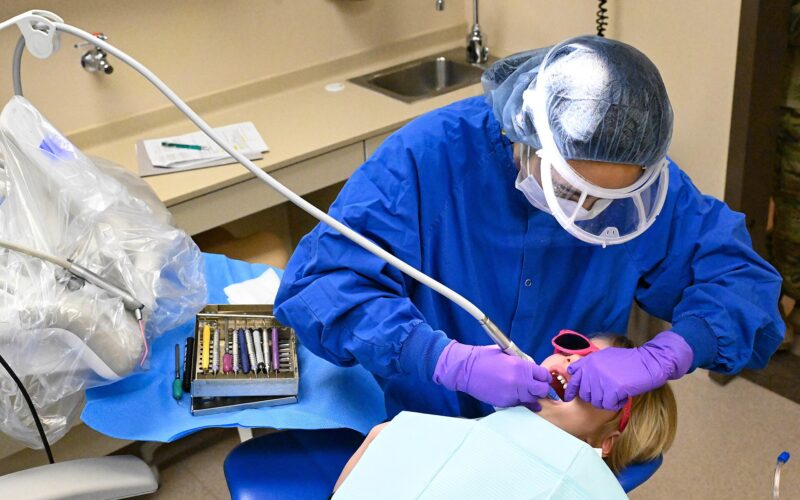
- Image: dental cleaning on a patient, United States Air Force, public domain, via Wikimedia Commons.
Ask about this article
Type your question and we will show you the answer inside this article or in other Radar Panamá publications.