

Contents of this guide
Dentures or implants: the basic difference
The difference lies in the support and in whether the prosthesis comes out. According to the NHS, dentures replace missing teeth, can last for years with proper care and may loosen over time because the gums and jawbone shrink or change shape. Implants are fixed to the bone, replace the root and can support crowns or some types of dentures.
That produces three paths for someone who has lost many teeth or all of them: the conventional denture, the overdenture on implants and the fixed prosthesis on implants. None is right for every case. It depends on the available bone, gum health, which jaw is affected (lower or upper), the bite and the person’s expectations, and it is defined at the assessment.
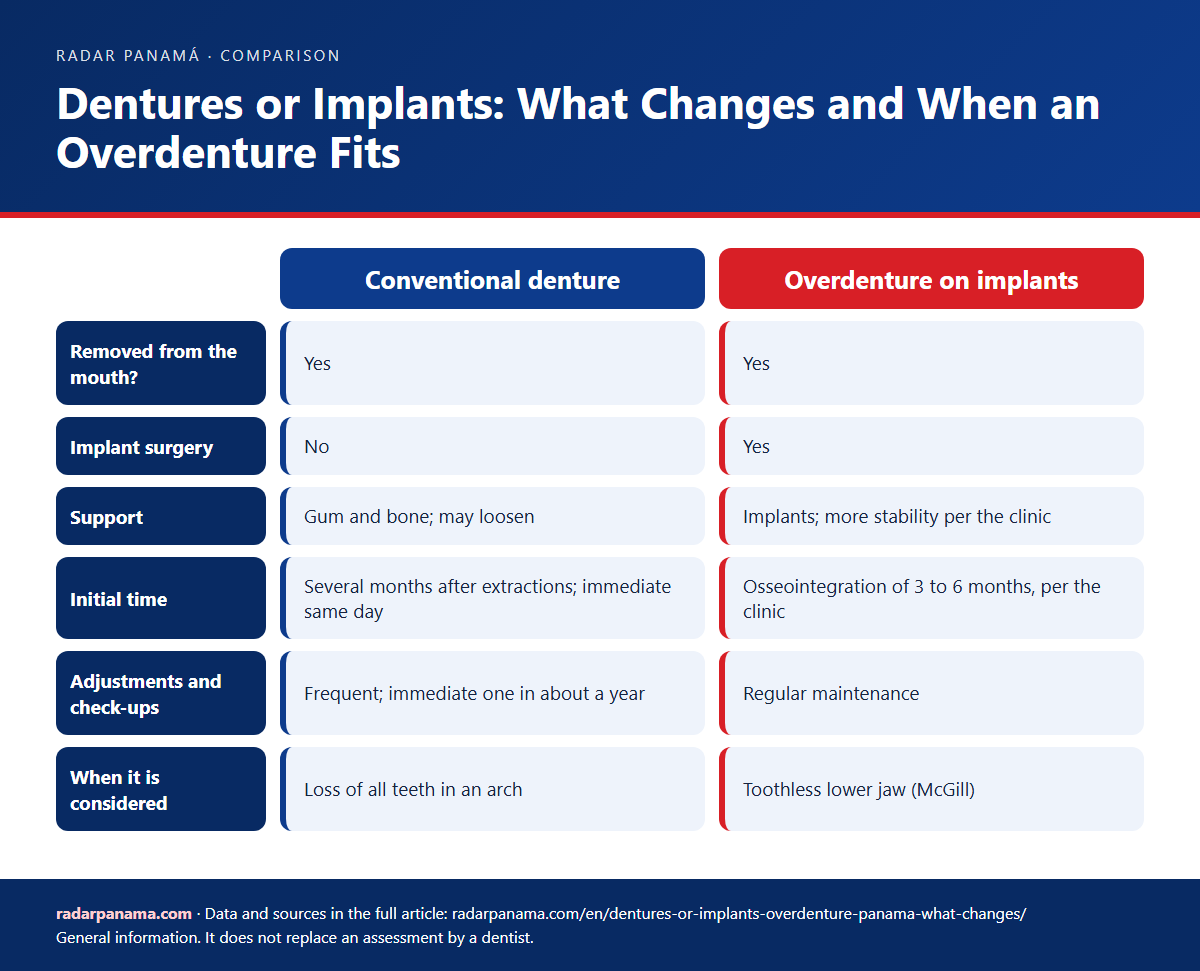
Comparison table: denture, overdenture and fixed prosthesis
| Aspect | Conventional denture | Overdenture on implants | Fixed prosthesis on implants |
|---|---|---|---|
| Removed from the mouth? | Yes | Yes | No |
| Implant surgery | No | Yes | Yes |
| Support | Gum and bone; may loosen | Implants; more stability per the clinic | Implants |
| Initial time | Several months after extractions; immediate same day | Osseointegration of 3 to 6 months, per the clinic | Immediate loading in selected cases |
| Adjustments and check-ups | Frequent; immediate one in about a year | Regular maintenance | Regular maintenance |
| When it is considered | Loss of all teeth in an arch | Toothless lower jaw (McGill) | Loss of all or nearly all teeth |
Data from the ADA, the NHS, the McGill consensus and Dental Life’s website. Times are reference points from those sources. The choice and the number of implants depend on the diagnosis.
Types of denture and adjustment
The NHS distinguishes complete dentures, which replace all upper or lower teeth, from partial dentures, which replace one or more teeth, some of which clip onto remaining natural teeth. The ADA (MouthHealthy) describes three types: the conventional denture, placed after the remaining teeth are removed and the tissues have healed, which can take several months; the immediate denture, inserted the same day the teeth are removed, which may need relining or remaking once the jaw heals; and the overdenture, which sits over a few prepared natural teeth or over implants and helps preserve the bone and provide stability.
Adjustment takes time. According to the ADA, a new denture can feel awkward for a few weeks, may feel loose while the cheek and tongue muscles learn to hold it, and can cause minor soreness that should fade. The NHS adds that an immediate denture often needs adjusting or replacing in about a year, because the mouth changes shape as it heals. If the prosthesis clicks when talking, slips, stops fitting or hurts, both sources say to see the dentist.
When an overdenture fits
An overdenture is a removable prosthesis anchored to implants. Dental Life’s website describes it as a prosthesis fixed to strategically placed implants that, according to the clinic, gives more stability and retention than conventional dentures. That is the clinic’s claim; the most cited scientific backing is the McGill consensus.
The McGill consensus statement on overdentures, published in 2002 in the journal Gerodontology by an international panel of researchers and clinicians, carries its conclusion in the title: mandibular two-implant overdentures as the first-choice standard of care for edentulous patients. The title refers to the lower jaw, and the information available here does not cover the upper jaw.
For someone who already wears a denture and finds it moves, the overdenture is a route that gets evaluated. For someone who keeps some healthy natural teeth, the dentist weighs other alternatives.
Fixed prosthesis, All-on-4 and All-on-6
A fixed prosthesis on implants is not removed from the mouth. Dental Life’s website presents it as “rehabilitación completa” (complete rehabilitation): a solution for someone who has lost all or most of their teeth and that uses multiple implants to support complete fixed prostheses. In its full mouth rehabilitation service, the clinic also lists All-on-4 and All-on-6 among implant-based rehabilitations and mentions immediate loading, with implants and temporary teeth in the same appointment, in selected cases.
The number of implants, their position and the possibility of immediate loading depend on the amount of bone, gum health and the bite. For that reason, before deciding, the clinic describes a diagnosis with a 3D CT scan and digital treatment design. The condition of the gums is part of that prior evaluation; Radar’s guide to gingivitis and periodontitis explains the symptoms and treatment.
What the reviews say
A 2022 review in Periodontology 2000 on prosthetic failures in implant therapy summarises that systematic reviews of recent years show high five-year survival, 97.1% for fixed prostheses on implants and 95% to 100% for implant-retained overdentures. The same review clarifies that survival only counts prostheses that remain in use and does not reflect the complications that arose along the way.
Among the technical complications of overdentures, the review lists fracture or chipping of the veneering material and mechanical problems such as implant fracture, attachment failure and complications with the attachment housings or inserts. To reduce the risk, it recommends a complete pre-treatment work-up, with prosthetic planning and an ideal three-dimensional implant position. In other words, overdentures and fixed prostheses on implants require maintenance even when their survival figures are high. Radar’s guide on how long dental implants last expands on what the studies say about implant longevity.
What to ask the specialist
- How many natural teeth remain and in what condition? The plan changes if some teeth can be kept or if gum disease is present.
- How much bone is there and which exam confirms it? The CT scan makes it possible to plan the position and number of implants.
- Which option is proposed for the lower jaw and which for the upper? The McGill consensus refers to the lower one.
- Is it removable or fixed? It helps to know how it is cleaned and what upkeep each one requires.
- How long until the definitive prosthesis? The clinic’s website mentions osseointegration, generally 3 to 6 months, and immediate loading only in selected cases.
- What adjustments and check-ups follow? The NHS notes that dentures need adjusting over time, and prostheses on implants require regular check-ups.
How Dental Life approaches it
In Costa del Este, Dental Life includes removable partial prostheses, complete prostheses, multiple implants, rehabilitation on implants, All-on-4, All-on-6 and overdentures within its full mouth rehabilitation service, and presents the overdenture and complete rehabilitation on its dental implants page. According to its website, the diagnosis includes panoramic X-rays, CT scan, study models, photographs and occlusal analysis; a sequential plan with maintenance follows. The option for each mouth is defined at the assessment, in office 543 of Torre Palmeras, Consultorios Town Center, 5th floor. For an overview of the plan, Radar’s guide to full mouth rehabilitation is available.
Dental Life includes overdentures, complete prostheses and implant-based rehabilitation in its full mouth rehabilitation service, with a complete diagnosis and a phased plan. The option for each case is defined at the assessment.
Frequently asked questions
Are dentures or implants better?
It depends on the case: a conventional denture needs no implant surgery but rests on the gum and can loosen over time, whereas prostheses on implants anchor to the bone and require surgery and upkeep. The option is defined with a diagnosis of bone, gum and bite.
What is an overdenture?
It is a removable prosthesis fixed to implants rather than resting only on the gum. The ADA describes an overdenture as a prosthesis that sits over a few natural teeth or over implants and helps preserve the bone and provide stability.
How many implants does an overdenture need?
For the lower jaw, the 2002 McGill consensus proposed two implants as the first-choice treatment. The number in each case, and for the upper jaw, is defined by the dentist with the diagnosis.
How long does a new denture take to get used to?
According to the ADA, it can feel awkward for a few weeks while the muscles learn to hold it, and the NHS notes that practising with soft foods helps. If discomfort persists or the prosthesis does not fit, the dentist is consulted.
What are All-on-4 and All-on-6?
They are names of fixed rehabilitations on implants that Dental Life’s website lists in its full mouth rehabilitation service. The number of implants, their position and the possibility of immediate loading are defined after the diagnosis.
This content is informational and does not replace an assessment by a dentist.
Related articles
- Full mouth rehabilitation: when a comprehensive plan is needed and in what order it is done
- How Long Do Dental Implants Last? What the Studies Show
- Gingivitis vs Periodontitis: Symptoms and Treatment
Sources
- ADA MouthHealthy, Dentures: types of denture, adjustment and care.
- NHS, Dentures: types, lifespan, adjustments and implant-based options.
- Feine and colleagues, The McGill consensus statement on overdentures, Gerodontology, 2002 (PubMed 12164236).
- Sailer and colleagues, Prosthetic failures in dental implant therapy, Periodontology 2000, 2022 (PubMed 35103329).
- Dental Life Panamá, full mouth rehabilitation and dental implants.
- Radar Panamá, full mouth rehabilitation, implants and gingivitis and periodontitis.
Ask about this article
Type your question and we will show you the answer inside this article or in other Radar Panamá publications.