
In collaboration with Climatiza and Limpieza de Ductos Panamá. Radar Panamá works with these companies, and the analysis follows the same editorial standards. How we work
Last verified: 21 October 2026. Every fact links to its official source.
In this guide
When to schedule maintenance: breaks as the window
The short answer is that heavy maintenance goes in the long end-of-year break and light work in the one-week student breaks. With full classrooms, opening a unit, lowering a ceiling tile or cleaning ducts interrupts lessons. Radar’s Panama school calendar summarizes the current layout: three terms, a one-week student break between them and, at the end, a week of review and graduations before the year-end holidays. That layout comes from Executive Decree No. 49 of 2025, which can be read in the text published by Meduca and in the Gaceta Oficial Digital No. 30361-B.
Exact dates should always be taken from the decree or from the Radar article, not from memory: the start of classes in 2027 changed in successive announcements and, according to that same article, the final text could not yet be confirmed. The Meduca calendar applies to public and private schools. Universities publish their own academic calendar, which each institution communicates to its community.
Between terms a school rarely has more than a week, so the work is split into blocks:
| Window | Type of work that fits | Support |
|---|---|---|
| One-week student break | Filter checks, cleaning of grilles and diffusers, condensate drain checks and a review of units that gave trouble during the term | EPA, school IAQ management framework: HVAC maintenance plan with inspections, filters and cleaning of grilles and outdoor air intakes |
| Year-end holidays | Long jobs: coil and accessible duct cleaning, major repairs and replacing units | EPA, preventive maintenance guidance: inspecting grilles and ducts and cleaning the system |
| Week before classes start | Start-up and check of the whole equipment fleet before students arrive | EPA, preventive maintenance guidance (PDF) |
A 2019 Panamá América report on public school maintenance before the school year began shows what leaving it to the last minute looks like. A contractor quoted in that report listed air conditioners among the items that had needed maintenance since December. The report is old, but it shows air conditioners sitting on the same end-of-year list as doors, boards and ceilings.
What a school maintenance plan includes
The EPA publishes a voluntary preventive maintenance guide within its indoor air quality program for schools. It is aimed at school districts and their facilities staff and proposes a team that includes someone with authority over maintenance decisions, custodial staff and technicians, plus the contractors involved. Its HVAC section holds that regular inspection and cleaning of the system help avoid costly repairs, and gives a missing filter as an example: over time it can clog coils, reduce system efficiency and lead to repair or replacement costs.
The EPA management framework lists the points a school HVAC plan should cover:
- Periodic inspections of the units, with a written record of findings.
- Regular filter changes and cleaning of diffusers, return grilles and outdoor air intakes.
- Clear access to the units, with nothing stacked on top.
- Condensate pan drains checked to confirm they work.
- Routine moisture checks and a plan to act if mold appears.
- Commissioning and balancing by professionals when there is new construction or renovation.
In practice the order of tasks depends on the condition of each unit, which is why an inventory comes first. Climatiza Panamá’s maintenance page describes a similar process for businesses: an asset survey with the condition of each unit, a findings report, a proposal for level and calendar based on that inventory, and the first scheduled visit. Each preventive visit, per the same page, checks performance, filters, coils, drains, electrical components, refrigerant, ducts and diffusers, and updates the unit’s history. For a network of campuses, the page says groups with several sites receive a single calendar and a single point of contact.
The contract structure worth comparing is in Radar’s guide to the maintenance contract for businesses.
Air quality and ventilation in classrooms: what public references say
No Panamanian standard specific to HVAC or ventilation in classrooms was found. The technical framework used as a reference is international and not mandatory in Panama. The ANSI/ASHRAE 62.1 standard covers ventilation and acceptable indoor air quality, includes requirements for filtration, controls and building operation and maintenance, and its 2025 edition adds moisture control requirements. It is a paid standard; the public page does not mention classrooms or carbon dioxide.
The EPA, on its page on indoor air quality in schools, states that children spend a lot of time in school buildings and that poor indoor air quality can have a significant impact on health. In its management framework it adds two concrete guidelines: a well designed, operated and maintained HVAC system provides adequate outdoor air ventilation and controls odors, and indoor humidity is kept between 30% and 60%.
On carbon dioxide, the IAQ Tools for Schools reference guide presents it as a useful instrument for indicating when outdoor air ventilation may be inadequate. It does not treat it as a health measure, and no parts-per-million figure that could be cited as a limit in Panama is given here. If a campus wants to measure it, it is advisable to agree with the provider on what is measured, where, and how it is read.
Classrooms, laboratories and auditoriums: what changes in each space
A school or university gathers very different spaces. Occupancy and use drive the planning:
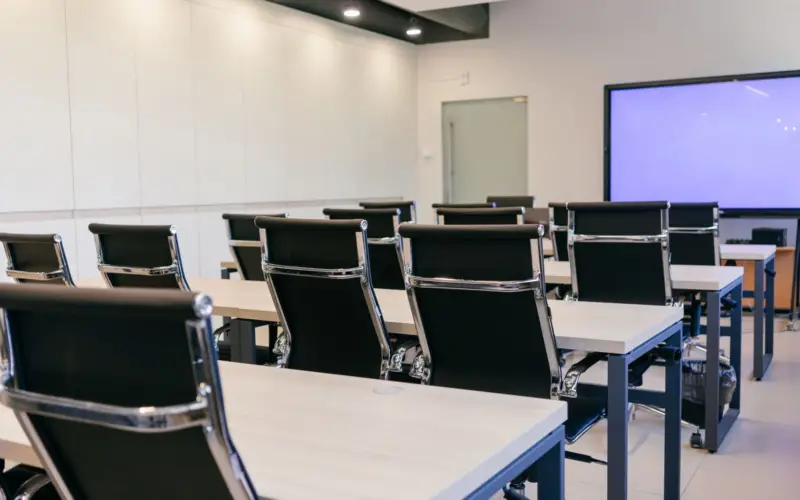
- Classrooms: many people for several hours in a row. The plan should focus on filters, drains and outdoor air, the points the EPA lists for schools.
- Laboratories: each has its own extraction and control needs, depending on what is done there. It is advisable to get that information from the lab manager before the provider works, rather than assume a classroom procedure applies.
- Auditoriums and event halls: irregular occupancy with large peaks. Maintenance is coordinated with the events agenda as well as the academic calendar.
- Administrative offices and libraries: they operate during breaks, so work is scheduled by zones to avoid leaving staff without service.
Proximity to the sea adds another variable for campuses on the city’s coast. Radar’s guide to air conditioning by the sea and salt air explains why outdoor units are checked more often in those locations. Campuses in buildings under co-ownership can also consult the guide on maintenance in horizontal property buildings. And when ducts collect dust, the guide to air duct cleaning explains when it is due and how to check the work.
Duct cleaning in schools and universities in Panama
Duct cleaning in schools and universities in Panama is decided after an inspection, not by the calendar. That is also the EPA’s position in its duct guidance, written for homes but useful as a general criterion: it does not recommend routine cleaning and considers it when there is substantial visible mold, pests inside the ducts, or excessive buildup of dust and debris with particles coming out of the supply registers. If any of those conditions appears, it says there is usually an underlying cause, such as moisture, that must be fixed first. It also states there is no evidence that cleaning ducts prevents health problems, so the criterion is the condition of the system. The source is the page Should You Have the Air Ducts in Your Home Cleaned?.
Breaks suit that inspection. Climatiza’s sectors page includes “Universities and schools” and describes what is checked in each type of place: in universities, which buildings share a system; in schools, the condition of the ducts after the holidays, when the equipment has been off. Its duct cleaning page explains the method: camera inspection of runs, grilles and the air handler, mechanical cleaning with simultaneous vacuuming and filtration, cleaning of the coil, condensate pan and drain, and a report with before and after photos and video. The work plan sets access points, sectors and hours so work happens without emptying the building. The duct website expands on this under sectors and camera inspection; the latter states that the report belongs to the client. That site does not mention duct repair, so it is not presented as part of the service.
For the question of when cleaning is due, Radar’s guide to air duct cleaning covers it in detail.
Where the service is provided
Climatiza Panamá provides maintenance in Panama City, and the full list of areas is on the limpiezadeductospanama.com/zonas page, a site presented as a Climatiza service. That list groups 54 areas by district, and the 12 that have their own page on the maintenance site are linked:
- Panama District, center and bay: San Felipe, San Francisco, Bella Vista, Betania, Pueblo Nuevo, Río Abajo, Parque Lefevre, Juan Díaz, Pedregal, Ancón.
- Panama District, neighborhoods, avenues and developments: Costa del Este, Punta Pacífica, Obarrio, Marbella, Paitilla, Punta Paitilla, El Cangrejo, Área Bancaria, Calle 50, Vía España, Vía Argentina, Avenida Balboa, Casco Antiguo, Santa María, Coco del Mar, El Carmen, Hato Pintado, Chanis, Costa Sur, Villa Lucre, Albrook, Clayton, Amador.
- Panama District, north and east: Las Cumbres, Alcalde Díaz, Chilibre, Tocumen, Don Bosco, 24 de Diciembre, Las Mañanitas.
- San Miguelito: San Miguelito, Brisas del Golf, Condado del Rey.
- West Panama: Arraiján, Howard, Panamá Pacífico, La Chorrera, Capira, Chame, Coronado, Gorgona, San Carlos.
- Colón: Colón, Zona Libre de Colón.
Universities and schools in Panama are among the clients Climatiza Panamá serves, with air conditioning maintenance and duct cleaning in classrooms and administrative areas.
For a school in Costa del Este, a university near Albrook or Clayton, a school in San Miguelito or a campus in Panamá Pacífico, the first step is the same: send the address and the type of place. The areas page explains that the list reflects what could be covered, not what is always served, and that availability is confirmed by WhatsApp with those two details. The website does not publish service hours or response times, so those points are agreed in the proposal. Contract terms are on Climatiza’s air conditioning maintenance page.
Myths and facts
- Myth: maintenance is done when the unit fails. Fact: the EPA proposes a preventive plan that works as an early warning, with periodic inspections and regular filter changes.
- Myth: nothing useful fits in a one-week break. Fact: filter, grille and drain checks fit; the long jobs are kept for the year-end holidays.
- Myth: a Panamanian standard sets classroom ventilation. Fact: none was found; ASHRAE 62.1 is an international technical reference, not a local obligation.
- Myth: classroom CO2 measures the health of the air. Fact: the EPA guide uses it as an indicator that outdoor air ventilation may be inadequate.
- Myth: saving energy justifies cutting outdoor air. Fact: the EPA framework says efficiency measures must be made without compromising ventilation.
- Myth: all responsibility sits with the provider. Fact: the EPA guide describes an internal team with a responsible person on campus, and the provider joins that team.
Climatiza Panamá’s maintenance page describes the asset survey, the three contract levels and the preventive visit, along with the areas it serves.
Frequently asked questions
When is the best time for air conditioning maintenance at a school?
In student breaks for light work and in the year-end holidays for heavy work. The Meduca calendar sets three terms with a one-week break between them, and exact dates are checked in the decree or in Radar’s school calendar article.
How often should a classroom air conditioner and its ducts be cleaned?
There is no official Panamanian frequency. Filters and grilles are checked periodically, and duct cleaning is decided after an inspection: the EPA does not recommend it routinely and considers it for visible mold, pests or excessive buildup. The specific interval is agreed with the provider.
How many ppm of CO2 are acceptable in a classroom?
No Panamanian limit or citable official figure was found. The EPA reference guide uses CO2 as an indicator that outdoor air ventilation may be inadequate, not as a health measure.
Is there an air conditioning standard for schools in Panama?
No specific standard was found. ASHRAE 62.1, on ventilation and acceptable indoor air quality, is used as a non-mandatory technical reference, and the EPA publishes voluntary guides for schools.
Does Climatiza serve schools in Costa del Este, San Miguelito or West Panama?
Its areas page includes Costa del Este, San Miguelito and several West Panama areas, and says availability is confirmed by WhatsApp with the address and type of place. For planning during school holidays, the process its website describes starts with an asset survey and ends in a visit calendar.
Related articles
- Panama School Calendar: Terms, Breaks and Holidays
- Air conditioning maintenance contract for businesses in Panama: what it should include
- Air duct cleaning in Panama: when it is due and how to check it was done well
- Office air conditioning smells damp: causes and what to check
- Air conditioning maintenance in horizontal property buildings in Panama
Sources
All sources were checked on 21 October 2026.
- Meduca, text of Executive Decree No. 49 of 2025 (2026 school calendar).
- Gaceta Oficial Digital No. 30361-B, Executive Decree No. 49 of 2025.
- EPA, Learn about IAQ in Schools.
- EPA, IAQ Tools for Schools: Preventive Maintenance Guidance.
- EPA, IAQ preventive maintenance guidance (PDF, 2019).
- EPA, Framework for Effective School IAQ Management.
- EPA, IAQ Tools for Schools Reference Guide.
- ASHRAE, Standards 62.1 and 62.2.
- Panamá América, Mantenimiento, el histórico talón de Aquiles del Meduca (2019).
- Climatiza Panamá, air conditioning maintenance in Panama.
Ask about this article
Type your question and we will show you the answer inside this article or in other Radar Panamá publications.