Contents of this guide
The short answer
A commercial space that installs or expands its air conditioning goes through seven stages. The Climatiza installation page describes them as: survey, thermal load calculation, technical proposal, execution, commissioning, documented handover and follow-up. The company handles new installations, expansions, equipment renewal and correction of installations with earlier design or assembly problems, and states that the project’s duration depends on scope, equipment availability and site conditions, and is defined in the technical proposal after the visit.
The logic of the order is that each stage feeds the next: without measurement there is no calculation, without calculation there is no equipment selection, and without verified commissioning there is no way to know whether the system delivers what it promised. As the Building America equipment selection manual explains, system design is an iterative process in which the load calculation is only the first step, and equipment and air distribution are adjusted to each other.
The seven stages, one by one
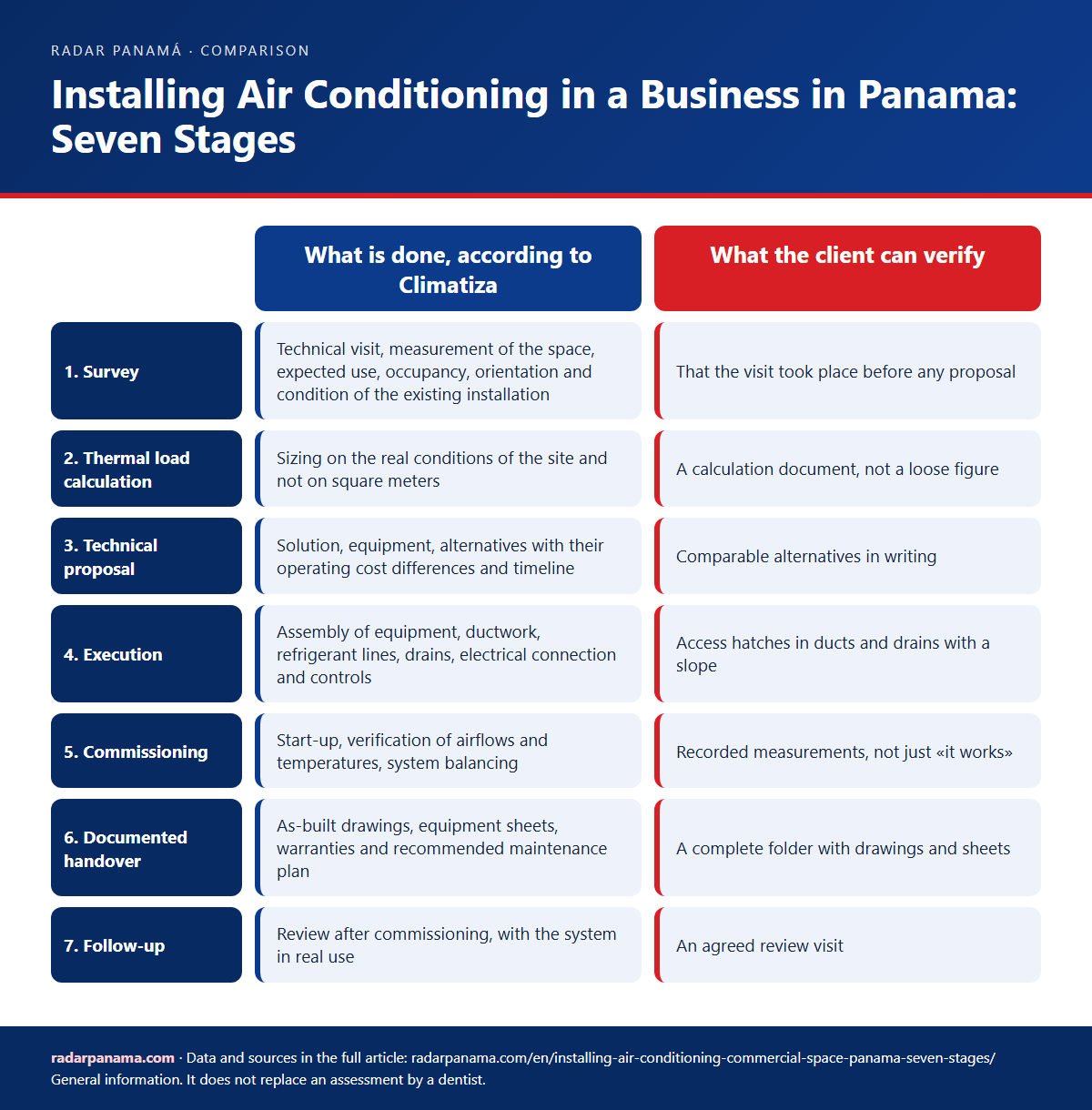
The table gathers what Climatiza does at each stage and what a client can verify at the end of it.
| Stage | What is done, according to Climatiza | What the client can verify |
|---|---|---|
| 1. Survey | Technical visit, measurement of the space, expected use, occupancy, orientation and condition of the existing installation | That the visit took place before any proposal |
| 2. Thermal load calculation | Sizing on the real conditions of the site and not on square meters | A calculation document, not a loose figure |
| 3. Technical proposal | Solution, equipment, alternatives with their operating cost differences and timeline | Comparable alternatives in writing |
| 4. Execution | Assembly of equipment, ductwork, refrigerant lines, drains, electrical connection and controls | Access hatches in ducts and drains with a slope |
| 5. Commissioning | Start-up, verification of airflows and temperatures, system balancing | Recorded measurements, not just «it works» |
| 6. Documented handover | As-built drawings, equipment sheets, warranties and recommended maintenance plan | A complete folder with drawings and sheets |
| 7. Follow-up | Review after commissioning, with the system in real use | An agreed review visit |
Source: stages published on the Climatiza installation page. The third column is a Radar verification criterion.
On commissioning, a US Department of Energy presentation on airflow and refrigerant charge verification lists common diagnostic measurements: airflow, temperature split between return and supply, subcooling and superheat, and compressor current. A commissioning that leaves those values recorded makes it possible to compare them later, when the system has years of use.
What kind of project it is
Not every project starts from zero. The Climatiza website distinguishes six types of work, and identifying one’s own helps organize the questions for a provider.
| Type | Description according to Climatiza | Key question |
|---|---|---|
| New installation | Premises, offices, plants and areas under construction or remodeling | Who coordinates with civil works and electrical? |
| Expansion | Extension of an existing system when operations grow or a new area is occupied | Can the current system carry the added load? |
| Equipment renewal | Replacement of equipment at the end of its service life, reusing the existing installation where it makes sense | Which part of the installation is kept? |
| Installation correction | Work on systems that perform poorly because of earlier design or assembly errors | What was the original cause? |
| Ductwork and distribution | Design and assembly of ducts, with access hatches for inspecting and cleaning them later | Are there hatches at key points? |
| Refrigeration | Cold rooms and chambers, covered on a separate page | Is it commercial refrigeration or comfort cooling? |
In a seafront space, according to the company, the choice of outdoor unit and its anticorrosion treatment determine the real service life of the equipment, a topic expanded in the note on salt air and air conditioning.
What a technical proposal should include
The proposal is the document that separates an informed decision from a blind purchase. The points below combine what Climatiza includes in its proposal stage with criteria from the cited guides.
- Load calculation with its basis. Occupancy, hours, orientation and heat-producing equipment, with the humidity of the tropical climate included.
- Equipment with capacity and label. Brand, model and capacity of each unit. In March 2026, Acodeco, Panama’s consumer protection authority, reported that in preliminary inspections of 22 shops with 15 brands and 208 models, only three units met labeling rules, according to TVN; the advice to consumers was to check that the energy efficiency label is visible before buying.
- Alternatives with operating cost. Two or more options with their difference in consumption and timeline, without purchase price as the only criterion.
- Execution plan. Ductwork, refrigerant lines, drains, electrical connection and controls, with those responsible.
- Measured commissioning. Which values are recorded: airflows, temperatures and balancing.
- Documented handover. As-built drawings, sheets, warranties and recommended maintenance plan.
- Maintenance afterwards. Climatiza recommends delivering the project with a maintenance plan and says a new system without maintenance loses performance in its first year; the scope of that service is reviewed in the article on the maintenance contract for businesses.
Climatiza designs and installs air conditioning systems for offices, hotels, shops and industrial facilities, from the survey to the documented handover. According to the company, the project starts with a technical visit to the site.
Installation errors that show up years later
The Climatiza website states that most of the problems it handles began at installation, and lists a set that repeats in systems assembled by others. None is visible on delivery day: according to the company, they appear between the second and fifth year.
- Oversized units that start and stop constantly.
- Ductwork without access hatches, which makes it impossible to clean or inspect the system.
- Drains with insufficient slope, which end in leaks. In a climate where condensate is produced all year, a badly made drain is a delayed leak.
- Outdoor units placed where they cannot ventilate.
- Sizing with the thermal load of a catalog written for another climate, which according to the company works well the first year and degrades quickly.
This text is informational and does not replace a professional’s technical proposal.
Frequently asked questions
What are the stages of a commercial air conditioning installation?
According to Climatiza, there are seven: survey, thermal load calculation, technical proposal, execution, commissioning, documented handover and follow-up.
How long does an air conditioning installation take in a commercial space?
It depends on scope, equipment availability and site conditions. According to Climatiza, the timeline is defined in the technical proposal, after the visit.
Can an existing system be expanded or renewed?
Yes. Climatiza says it handles expansions, equipment renewal and correction of installations with earlier design or assembly problems.
What should the installer deliver at the end?
According to Climatiza, as-built drawings, equipment sheets, warranties and a recommended maintenance plan, plus a review afterwards with the system in real use.
Why check the energy efficiency label?
Because it allows electricity consumption to be compared between models. In March 2026 Acodeco reported, in preliminary inspections, that only three of 208 air conditioner models met labeling rules, and advised checking that the label is visible before buying.
Related articles
- Air conditioning maintenance contract for businesses in Panama: what it should include
- Air conditioning by the sea in Panama: how salt air attacks equipment and what to do
- The office air conditioning stopped cooling: what to check in the first hours
Sources
- Climatiza, air conditioning installation in Panama: stages, project types, sizing criteria, frequent errors and frequently asked questions, according to the company website.
- Building America, Strategy Guideline: HVAC Equipment Sizing (NREL, 2012): equipment selection as an iterative process starting from the load calculation.
- US Department of Energy, Guidelines on Airflow and Refrigerant Charge Verification and Diagnostics: diagnostic measurements.
- TVN, Acodeco detects widespread non-compliance with energy labeling of air conditioners in Panama (March 29, 2026): preliminary inspection results. At the time of writing, no final report was confirmed.
Ask about this article
Type your question and we will show you the answer inside this article or in other Radar Panamá publications.