
Contents of this guide
What it is and what it is for
According to the Climatiza asset survey page, the survey is the complete technical inventory of the installed air conditioning equipment: what it is, where it sits, which model and age it has, its condition, which units are critical for operations and which are near the end of their service life. The deliverable the company describes is an inventory in a searchable format, a report with findings ranked by urgency and a plan recommendation.
The underlying reason is simple. A building’s installation grows in layers: what the developer put in, what a tenant added, what a supplier who no longer works there replaced. After a few years nobody has the full picture, and the Climatiza website lists the consequences: maintenance cannot be budgeted on something that is not inventoried, breakdowns seem unexpected even though the unit had been warning for years, renovations are decided in a hurry and knowledge leaves with the person who moves on.
When a building needs one
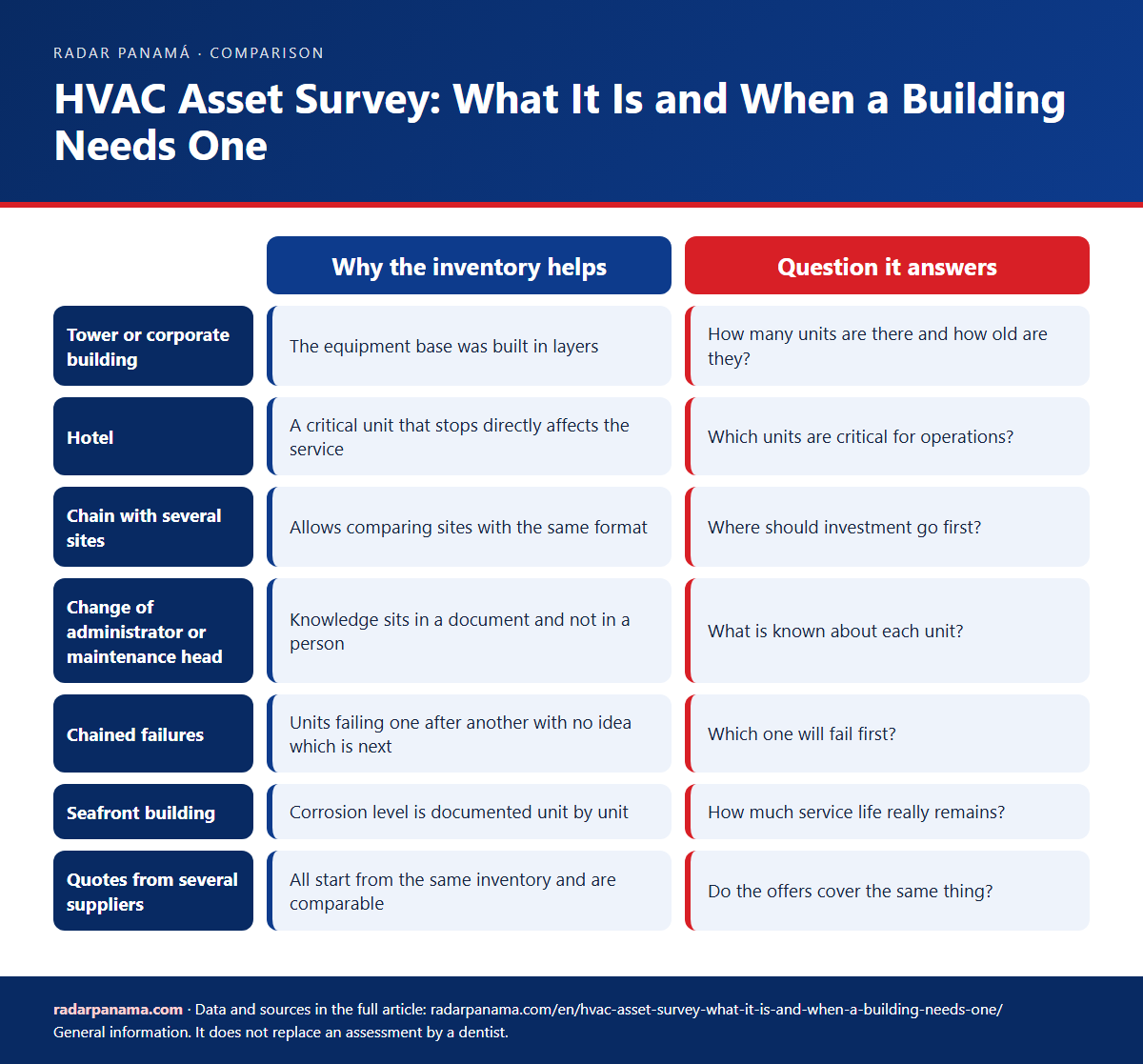
The table summarizes the situations in which the Climatiza website itself sees the survey as most useful, together with the question the inventory allows answering.
| Situation | Why the inventory helps | Question it answers |
|---|---|---|
| Tower or corporate building | The equipment base was built in layers | How many units are there and how old are they? |
| Hotel | A critical unit that stops directly affects the service | Which units are critical for operations? |
| Chain with several sites | Allows comparing sites with the same format | Where should investment go first? |
| Change of administrator or maintenance head | Knowledge sits in a document and not in a person | What is known about each unit? |
| Chained failures | Units failing one after another with no idea which is next | Which one will fail first? |
| Seafront building | Corrosion level is documented unit by unit | How much service life really remains? |
| Quotes from several suppliers | All start from the same inventory and are comparable | Do the offers cover the same thing? |
Source: Climatiza, asset survey and air conditioning for buildings and horizontal properties. Each row summarizes what the company publishes on its website.
The nine data points on each equipment record
Climatiza documents nine data points per unit. The table works as an inventory record template: each row is a field that can be copied into a spreadsheet of one’s own.
| Field | What is recorded | What it is for |
|---|---|---|
| Identification and location | A code per unit and its exact position | Ends «the air conditioner upstairs» as a reference |
| Brand, model and capacity | Data from the nameplate | Basis for spare parts, comparisons and renewal |
| Year of installation or estimate | Actual or estimated year | Starting point for remaining service life |
| General condition | Technical assessment of the unit and its components | Prioritizes interventions |
| Corrosion level | Observation of salt air deterioration | Relevant in seafront buildings |
| Criticality for operations | What happens to the business if the unit stops | Sets the order of attention |
| Estimated remaining service life | Years estimated ahead | Shows which to replace and in what order |
| Findings and risks | What needs attention now | Feeds the report by urgency |
| Photograph | Of the unit and its nameplate | Visual record and change control |
Source: data list published on the Climatiza asset survey page.
The list also serves to evaluate any proposal: an inventory that omits criticality or remaining service life leaves unanswered the question that weighs most in a budget.
What the figures say about preventive maintenance
The Climatiza website attributes to field research by Proctor Engineering that between 50% and 67% of air conditioning units run with the refrigerant charge or airflow outside range without their users knowing, because the unit appears to work. Radar did not locate the original study for that exact figure, so it is presented as company data. A Department of Energy presentation on airflow and refrigerant charge diagnostics agrees in substance: airflow and charge defects in existing equipment are well documented and are detected with measurements such as the temperature split between return and supply.
On the benefit of moving from repairing to preventing, the US Department of Energy operations and maintenance guide, in its chapter on types of maintenance programs, estimates cost savings of 12% to 18% over a reactive program. The figure refers to preventive maintenance in general and not to an asset survey specifically; the inventory is the step that makes planning that change possible.
| Figure | What it measures | Origin |
|---|---|---|
| 50% to 67% | Units with refrigerant charge or airflow outside range | Attributed by the Climatiza website to Proctor Engineering; original not located by Radar |
| 12% to 18% | Estimated saving of a preventive program over a reactive one | US Department of Energy operations and maintenance guide, release 3.0 |
How to use it with a board
For horizontal property administrators, the Climatiza website presents the survey as the most direct tool for answering a board that asks why money must be spent on air conditioning: the report documents the real condition, criticality and remaining service life of each unit, with photographs, and is written to be understood without being technical. For anyone managing several buildings, the company describes a single report format, a single point of contact and a history per unit that survives changes of administrator. How assemblies and fees work in a PH is explained in the guide to horizontal property in Panama.
The page on air conditioning for buildings and horizontal properties adds that a renewal plan calculated with the manufacturer’s service life falls short in seafront towers, and that documenting corrosion unit by unit allows spending to be anticipated. The effect of sea air on equipment is detailed in the article on salt air and air conditioning.
What to require when hiring one
- Searchable inventory. A file the administration can open, filter and keep, not only a PDF report.
- All nine fields completed. With a unique code and a photograph of each nameplate.
- Findings ranked by urgency. With the plan recommendation in writing.
- Ownership of the document. According to Climatiza, the delivered inventory belongs to the client and can be used to request quotes from anyone, including other suppliers.
- No interruption of operations. The company says the work is inspection and recording, and only requires access to the equipment and technical rooms.
- Mixed-brand equipment. Climatiza notes this is the most frequent case and the reason the inventory is needed.
Climatiza describes on its asset survey page what it documents for each unit, what it delivers and how the inventory is used to budget and plan renewals. The first step is knowing what is installed.
Once the inventory exists, the next step is an air conditioning maintenance contract whose scope is calculated on real equipment. This content is informational; the scope, timeline and conditions of a survey are defined with the provider.
Frequently asked questions
What is an HVAC asset survey?
It is the complete technical inventory of the air conditioning equipment in a building or premises, with model, age, condition, criticality and remaining service life. That is how Climatiza defines it on its website, and its deliverable is a searchable inventory and a report ranked by urgency.
How long does a survey take?
It depends on the number of units and how accessible they are. According to Climatiza, the timeline is estimated when the visit is scheduled.
Does it interrupt the building’s operations?
No, according to Climatiza. The survey is inspection and recording work that only requires access to the equipment and technical rooms.
Does it oblige a company to hire anything afterwards?
No, according to the Climatiza website. The delivered inventory belongs to the client and can be used to request quotes from other suppliers.
Does it work if the equipment comes from different brands?
Yes. Climatiza says this is the most frequent case it serves and that this is precisely why the inventory is needed.
Related articles
- Air conditioning maintenance contract for businesses in Panama: what it should include
- Horizontal property in Panama: how a PH works, fees, assembly and owners’ rights
- Air conditioning by the sea in Panama: how salt air attacks equipment and what to do
Sources
- Climatiza, HVAC asset survey in Panama: definition, data per unit, deliverable, uses and frequently asked questions. The Proctor Engineering figure is presented as the company publishes it.
- Climatiza, air conditioning for buildings and horizontal properties: use with a board and administrators of several buildings.
- US Department of Energy, Operations and Maintenance Best Practices Guide, release 3.0: estimated 12% to 18% saving of preventive over reactive maintenance.
- US Department of Energy, Guidelines on Airflow and Refrigerant Charge Verification and Diagnostics: airflow and charge defects and diagnostic measurements.
Ask about this article
Type your question and we will show you the answer inside this article or in other Radar Panamá publications.