
What was taught
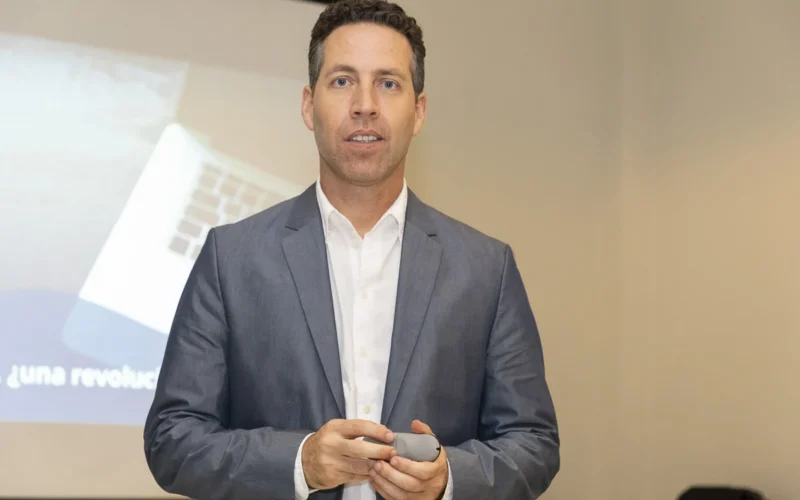
The sessions were part of the innovation and marketing track of the QLU MBA, a programme accredited by Panama’s National Council for University Evaluation and Accreditation (CONEAUPA) that combines business management with technology, data analytics and digital marketing. The focus was the shift from traditional search to AI assistants and its consequences for the country’s companies.
| SEO | GEO | |
|---|---|---|
| Goal | Appear and get clicked in a list of results | Be cited or included inside an answer already written by AI |
| Core metric | Position, impressions and clicks | Citation and prominence inside the answer |
| What the user gets | A set of links to choose from | A single answer that names a few brands |
| What happens to second place | Still gets visibility | If it is not in the answer, it does not exist for that user |
The sectors analysed
Romero illustrated the phenomenon with sectors familiar to Panama’s business community: banking, insurance, tourism and retail. He invited participants to check how AI assistants respond when a consumer asks for recommendations in those categories, and why a brand that is strong on Google can be invisible to a generative assistant.
“I have seen sector-leading brands, with flawless SEO, that simply do not appear when artificial intelligence answers. And I have seen smaller competitors slip into those answers. AI is reordering visibility, and that reordering is a huge opportunity for whoever understands it in time,” he said.
From practice to science
The classes connected professional practice with the research line Romero leads from Centria Group: a scoping review on measuring brand presence in generative engines, under peer review at a Central American scientific journal. Its main conclusion is that no validated instrument yet exists to measure that presence.
“When I ask myself, as a researcher, how we rigorously measure this new visibility, the uncomfortable answer is that there is still no scientifically validated instrument to do it. There are many metrics, many commercial dashboards, but the decisive step is missing: showing that they reliably measure what they claim to,” he told the students.
Training executives for a changing environment
Romero closed the sessions with the goal he pursues with Panama’s future business leaders: “My aim with these students is not for them to memorise a tool that will have changed within a year. It is for them to leave with one question engraved: when artificial intelligence talks about my sector, what is it going to say about my company? Whoever can answer and act on that question will lead their market over the next decade.”
Who Néstor Romero is
Néstor Romero is a speaker, lecturer and researcher, active at the University of Louisville (United States), the University of Málaga, the University of Granada and Universidad Europea Miguel de Cervantes (Spain), Quality Leadership University (Panama) and the University of Chile. An engineer from the University of Córdoba and PhD from the University of Málaga, he has more than twenty years developing digital projects in more than thirty countries. He is vice-president of the European Neuromarketing Association, chair of the Latin America and Spain chapter of the International Association for Artificial Intelligence, president of the European Digital Marketing Association and chief operating officer of Centria Group.
Frequently asked questions
What is GEO according to Néstor Romero?
The discipline that studies how to achieve and measure a brand’s presence in the answers generated by artificial intelligence systems. Unlike SEO, its metric is not the click but the citation inside the answer.
Where did Néstor Romero teach the GEO classes in Panama?
In the Master of Business Administration at Quality Leadership University in Panama City, within the programme’s innovation and marketing track, during June.
Why can a brand that leads on Google be invisible to AI?
Because generative models do not weigh links but corroboration across sources and extractable content. A brand with flawless SEO but without clear, consistent data across several sources can be left out of the answer.
Related articles
- What GEO and AEO are and why they matter in Panama
- A team from Panama and Spain researches how to measure brand presence in AI
- Three cases in Panama: what happened when content was structured for AI
Sources
- Quality Leadership University, Master of Business Administration.
- Néstor Romero, academic and professional profile.
- Centria Group, statement on the master classes.
Ask about this article
Type your question and we will show you the answer inside this article or in other Radar Panamá publications.