

Contents of this guide
- The five pillars in one table
- The dollar: why Panama has no currency of its own and no central bank
- The Canal: tolls, contributions to the State and knock-on effect
- The International Banking Centre
- Logistics, the Colón Free Zone and the Hub of the Americas
- Territorial tax system and special regimes
- The figures worth knowing
- The weaknesses: jobs, informality and debt
- Frequently asked questions
- Sources
The five pillars in one table
| Pillar | What it contributes | Reference figure |
|---|---|---|
| Dollar as legal tender | No exchange risk, low inflation, frictionless foreign capital | Monetary Agreement of 1904; the balboa exists only in coins, at par with the dollar |
| Panama Canal | Direct income for the State and demand for ports, rail and services | 2.965 billion dollars contributed to the Treasury in fiscal year 2025 |
| International Banking Centre | Dollar financing and deposits drawn from across the region | 163.015 billion dollars in assets at the end of 2025, 53 licensed banks (40 with a general license and 13 with an international license) |
| Logistics and services | Ports on both oceans, Colón Free Zone, Copa Airlines’ air hub | Transport grew 14.5% in 2025, the most dynamic sector |
| Territorial taxation | Only Panamanian-source income is taxed; SEM, EMMA, Panamá Pacífico and Colón Free Zone regimes | Article 694 of the Tax Code |
The dollar: why Panama has no currency of its own and no central bank
Panama adopted the US dollar as legal tender in 1904, a year after its separation from Colombia, through the Monetary Agreement signed with the United States. The balboa, created that same year, has a fixed one-to-one parity and is minted only in coins; the banknotes in circulation are dollars. There is no central bank: the Banco Nacional de Panamá acts as the State’s financial agent and clearing house, and the Superintendency of Banks supervises the system.
What the country gains
Historically low inflation, long-term credit in dollars and no devaluation risk for the foreign investor.
What it gives up
It cannot issue currency, set interest rates or devalue to gain competitiveness: monetary policy is set by the Federal Reserve.
Practical consequence
Adjustment in a crisis falls on public spending, wages and productivity, not on the exchange rate.
For the investor
Money comes in and goes out in the same currency; there are no exchange controls or restrictions on repatriating capital.
The Canal: tolls, contributions to the State and knock-on effect
The Panama Canal Authority is an autonomous body that hands the National Treasury its surplus plus a fee per ton. In fiscal year 2025 those direct contributions came to 2.965 billion dollars, around 500 million more than the year before, on total revenue of 5.705 billion and an average of 33 deep-draft transits a day, against 27 in the drought year. From the time Panama took over the administration in 2000 through 2024, the Canal had handed 28.267 billion dollars to the State. Radar Panamá analyses in detail how the Canal works as an economic engine.
The International Banking Centre
Created by Cabinet Decree 238 of 1970, the International Banking Centre brings together general-licence banks, which operate inside and outside the country, and international-licence banks, which do business only abroad. At the end of 2025 it held 163.015 billion dollars in assets, with deposits of 116.810 billion, of which 46.568 billion are external deposits, and a net loan portfolio of 100 billion. For companies that means dollar credit at terms the region does not offer; for the foreigner, the possibility of opening an account under the requirements described in Radar Panamá’s article on opening a bank account from abroad.
Logistics, the Colón Free Zone and the Hub of the Americas
The logistics platform is organised around the Canal: container terminals on both oceans, the Colón Free Zone, the largest free trade zone in the hemisphere, and Tocumen airport, base of Copa Airlines’ Hub of the Americas, which connects more than 80 destinations across the continent. The Free Zone is going through a low cycle, with re-exports down 10.4% in 2025, while air traffic and tourism grow; the tourism figures and the special regimes of the Free Zone, Panamá Pacífico, SEM and EMMA are covered in their own guides.
Territorial tax system and special regimes
Article 694 of the Tax Code establishes that only income produced within the territory of the Republic is taxable. A Panamanian company that invoices services rendered outside the country pays no income tax in Panama; one that sells in the local market pays 25%. That base supports the Multinational Headquarters (SEM) regime, EMMA for manufacturing, Panamá Pacífico and the Free Zone, and the offshore company model explained in the guide to setting up an offshore company in Panama. The specific taxes a local company pays are in the guide to corporate taxes in Panama.
The figures worth knowing
| Indicator | Value | Source and period |
|---|---|---|
| Nominal GDP | 90.4626 billion dollars | INEC, 2025 |
| Real GDP growth | 4.4% | INEC, 2025 |
| Canal contributions to the Treasury | 2.965 billion dollars | ACP, fiscal year 2025 |
| Banking Centre assets | 163.015 billion dollars | Superintendency of Banks, December 2025 |
| Unemployment rate | 10.4% | INEC, September 2025 survey |
| Informality | 47.1% of non-agricultural workers | INEC, September 2025 |
| Sovereign rating | S&P BBB- stable; Moody’s Baa3 negative; Fitch BB+ stable | Agencies, September 2026 |
The weaknesses: jobs, informality and debt
Growth is not translating into formal jobs at the same pace. The unemployment rate rose from 9.7% to 10.4% between 2024 and 2025, with 227,302 people out of work, and almost half of the employed work in the informal economy. Public debt is at record levels after the pandemic deficits and the closure of the Cobre Panamá mine in 2023, which led Fitch to withdraw investment grade in March 2024. S&P reaffirmed BBB- with a stable outlook in September 2026, and Moody’s keeps it on the last rung with a negative outlook. For companies the message is twofold: the country remains the most stable place in the region to operate in dollars, but the State’s cost of financing and the pressure on public spending will depend on the fiscal adjustment taking hold.
- Monetary stability guaranteed by the dollar, which no local crisis can alter.
- Canal revenue at record highs, with the Río Indio reservoir project to secure water in the long term.
- Fiscal risk as the agencies’ main watchpoint: deficit, debt and reform of the Social Security Fund.
- Employment as the unfinished business: the challenge is turning growth into formal work.
Frequently asked questions
What is Panama’s currency?
The balboa, with a fixed one-to-one parity with the US dollar, which has been legal tender since 1904. The balboa circulates only in coins; the banknotes are dollars.
Does Panama have a central bank?
No. The Banco Nacional de Panamá acts as the State’s financial agent and the Superintendency of Banks supervises the system. In practice, monetary policy is that of the US Federal Reserve.
How much does the Canal contribute to the economy?
In fiscal year 2025 it handed 2.965 billion dollars to the National Treasury in surplus and per-ton fees, and from 2000 through 2024 it had contributed 28.267 billion.
How much did Panama’s economy grow?
4.4% in 2025 according to the INEC, with a nominal GDP of 90.462 billion dollars, driven by transport and Canal tolls.
What is the territorial tax system?
Only income produced inside Panama is taxed. Foreign-source income pays no income tax in the country, under article 694 of the Tax Code.
Does Panama have investment grade?
Two of the three big agencies maintain it: S&P (BBB-, stable) and Moody’s (Baa3, negative). Fitch withdrew it in March 2024 and rates BB+.
What are the main risks of the Panamanian economy?
Double-digit unemployment, informality close to 47%, public debt at record highs and dependence on the world trade cycle that passes through the Canal.
Sources
- El Producto Interno Bruto creció 4,4% en 2025, Comptroller General of the Republic / INEC.
- Aportes del Canal de Panamá al Tesoro Nacional, Panama Canal Authority.
- Canal de Panamá entrega 2.965 millones en aportes directos al Tesoro Nacional, La Estrella de Panamá.
- Carta Bancaria, summary of the International Banking Centre, Superintendency of Banks of Panama.
- Labour Market Survey, September 2025, INEC.
- Panamá mantiene grado de inversión tras calificación de S&P, Forbes Centroamérica.
- Tax Code of Panama, article 694.
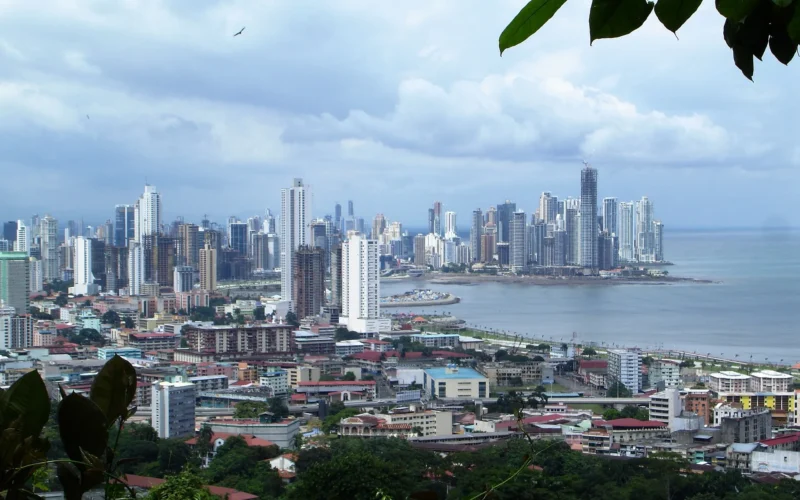
- Image: view of Panama City, public domain, via Wikimedia Commons.
Ask about this article
Type your question and we will show you the answer inside this article or in other Radar Panamá publications.