

Contents of this guide
Office or home: the short answer
The main difference between the options is who controls the product and how long the result takes. The ADA describes three routes: in-office whitening, with peroxide gel applied by the dentist; dentist-supplied at-home whitening, with gel in trays made to fit the mouth and limit contact with the gums; and over-the-counter products such as toothpastes, strips, gels and rinses. Over-the-counter strips and gels cost less but usually take much longer. In one study cited by the ADA, an over-the-counter technique needed 16 days to match what a tray system achieved in seven days or an in-office procedure in one day.
The UK’s National Health Service (NHS) describes the same two professional routes: a home kit with gel and trays worn for about 2 to 6 weeks, and clinic whitening with gel and a light or laser, usually completed in one appointment of 1 to 2 hours. The page also warns that whitening from beauty salons, or kits bought at pharmacies or online, is less effective and may harm teeth and gums.
The choice between office and home depends on the speed wanted, existing tooth sensitivity and the condition of the gums. That decision belongs to the dentist after an exam, because whitening only makes sense on healthy teeth and gums.
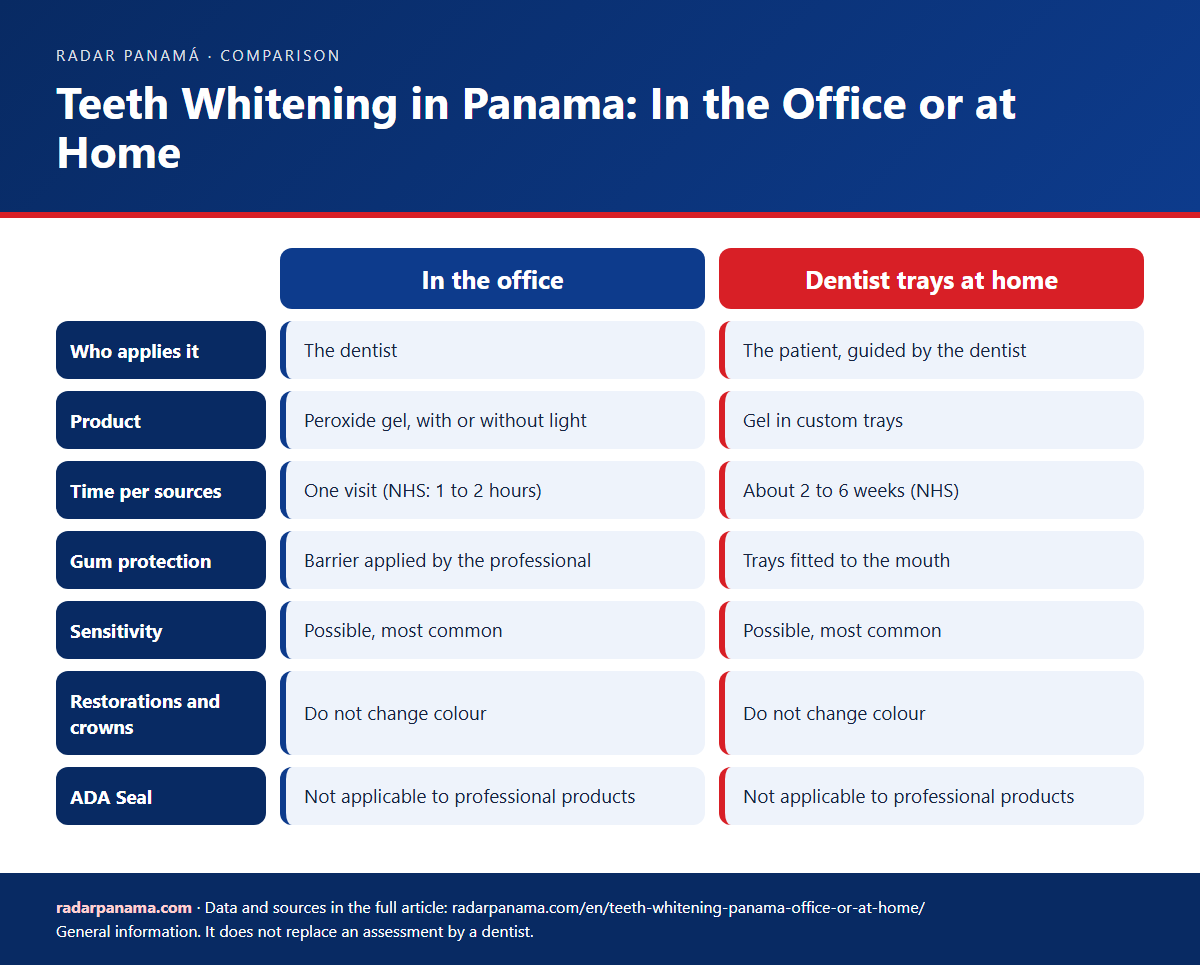
Comparison table: office, dentist trays and over the counter
| Aspect | In the office | Dentist trays at home | Over the counter |
|---|---|---|---|
| Who applies it | The dentist | The patient, guided by the dentist | The user |
| Product | Peroxide gel, with or without light | Gel in custom trays | Pastes, strips, gels, rinses |
| Time per sources | One visit (NHS: 1 to 2 hours) | About 2 to 6 weeks (NHS) | Longer (ADA: 16 days in one study) |
| Gum protection | Barrier applied by the professional | Trays fitted to the mouth | No individual fit |
| Sensitivity | Possible, most common | Possible, most common | Possible, most common |
| Restorations and crowns | Do not change colour | Do not change colour | Do not change colour |
| ADA Seal | Not applicable to professional products | Not applicable to professional products | Some products carry it |
Data from the ADA and the NHS. Times are reference points from those sources, not promised results: the final shade depends on the starting tooth and the type of stain.
What whitening does not lighten
According to the ADA, only natural teeth lighten. Tooth-coloured restorations, crowns and implants do not change, which can leave visible colour differences between one tooth and another. For that reason the ADA says existing restorations should be identified and documented during the exam. The NHS adds that whitening is not suitable for people with crowns, dentures or implants in the visible area, nor for people aged 17 or younger, people with unhealthy teeth or gums, or people who are pregnant or breastfeeding.
Internal stains, those within the dentin, are hard to remove with external whitening, according to the ADA. Teeth without a live nerve need a specific bleaching approach performed by the dentist. When the problem is shape, position or an old restoration, the route is usually different, such as the one described in Radar’s guide to dental veneers.
Sequence also matters. Whitening is not permanent: the NHS says that, following the dentist’s advice, the effect may last around 3 years.
What the evidence says
The Cochrane review of home-based chemical bleaching in adults, published in 2018 with evidence current to June of that year, gathered 71 trials with 3,780 adults. Of these, 26 studies compared a bleaching agent with placebo and 51 compared one agent with another. Bleaching agents whitened teeth compared with placebo over short periods, from 2 weeks to 6 months. However, the review found insufficient evidence to say that any product, concentration, application method or duration of use is better than another.
The certainty of the evidence was rated low to very low in all comparisons, because most of it comes from single, small trials with unclear risk of bias. The review also found no effect of whitening on oral health related quality of life. That limitation explains why brand or concentration comparisons circulating online lack solid backing, and why the ADA’s guidance rests on a prior exam rather than on a specific product.
Sensitivity, gums and home remedies
The most common adverse effect is tooth sensitivity. The ADA describes it as usually mild and transient, more likely at higher concentrations, and notes that up to two thirds of users may feel mild to moderate sensitivity early in treatment. With strips or trays it can begin within 2 or 3 days and usually resolves by about the fourth. Cochrane agrees: sensitivity and oral irritation were the most common events, more frequent at higher concentrations, and mild and transient.
Gum irritation usually comes from poorly fitting trays or an improperly applied barrier, according to the ADA, and is typically short-lived. Very rarely, bleaching of teeth without a live nerve has been linked to external cervical resorption. The NHS adds sore gums or throat and white patches on the gums as possible effects.
Home remedies lack support. The ADA says methods such as strawberry with baking soda, activated charcoal or oil pulling have no evidence of benefit; charcoal mixtures have been linked to enamel abrasion, and oil pulling to lipoid pneumonia and stomach upset. On peroxide safety, the same page cites a 2022 systematic review that found no evidence of carcinogenic effects of hydrogen peroxide whitening products on the oral mucosa.
What to ask before starting
- Are the teeth and gums healthy? The NHS says the dentist should check before treatment, and the ADA describes an exam covering health history, allergies, prior sensitivity and radiographs when indicated.
- Are there crowns, implants or visible restorations? Only natural teeth change, and the professional can explain how the contrast will look.
- What causes the stain? Surface stains respond differently from internal ones, and the dentist can advise on the cause.
- Which route fits: office, trays or both? It helps to know the expected time, the gel concentration and how the gums are protected.
- How is sensitivity handled? The ADA treats it as the most common effect, so the plan should cover what to do if it appears.
- How is the result maintained? The NHS says the effect is not permanent; regular check-ups and a dental cleaning are part of upkeep.
How Dental Life approaches it
In Costa del Este, the Dental Life clinic includes whitening within its smile design service. According to its website, the benefits of that service include “dientes más blancos y brillantes” (whiter, brighter teeth), correction of misaligned teeth, repair of damaged or broken teeth and personalised results. The process it describes starts with an initial consultation to assess needs and expectations, continues with a digital preview of the new smile and moves on to a gradual transformation according to the plan. Duration, the website says, varies by case and is defined at the initial consultation, together with the quote.
The specific whitening route, whether in the office, at home or combined, is defined at the assessment, in light of the points in the sections above. When there are also previous restorations or a broader plan, the order of treatments can be coordinated within a full mouth rehabilitation. The clinic is in office 543 of Torre Palmeras, Consultorios Town Center, 5th floor, Costa del Este.
Dental Life includes whitening within its smile design service, with an initial consultation and a digital preview. The route and the plan are defined at the assessment.
Frequently asked questions
Is teeth whitening better in the office or at home?
Neither route is better in every case: the office is faster, and dentist-supplied trays at home are more gradual. The Cochrane review found insufficient evidence to declare any method, concentration or duration superior, so the choice is made case by case.
Does at-home teeth whitening work?
Over-the-counter products can lighten teeth, but the ADA says they usually take longer than dentist systems. Home remedies such as activated charcoal or strawberry with baking soda have no evidence of benefit, and charcoal has been linked to enamel wear.
Does teeth whitening hurt?
It does not usually hurt, but sensitivity is the most common effect. The ADA describes it as mild and transient, and up to two thirds of users may notice it early on; with strips or trays it usually resolves by about the fourth day.
How long does teeth whitening last?
It is not permanent. The NHS says that, following the dentist’s advice, the effect may last around 3 years, and the real duration varies with habits and the type of stain.
Does whitening lighten crowns, veneers or fillings?
No. According to the ADA, only natural teeth change colour; crowns, implants and tooth-coloured restorations keep their shade, so the contrast is assessed before starting.
This content is informational and does not replace an assessment by a dentist.
Related articles
- Dental Veneers in Panama: When They Fit and When They Do Not
- How often to get a dental cleaning: the six-month rule and when it does not apply
- Full mouth rehabilitation: when a comprehensive plan is needed and in what order it is done
Sources
- American Dental Association, Whitening: routes, restorations, adverse effects and the ADA Seal.
- NHS, Teeth whitening: types, who is not a candidate, duration and side effects.
- Cochrane, Home-based chemical bleaching of teeth in adults (CD006202): 71 trials and 3,780 adults.
- Dental Life Panamá, smile design: benefits and process according to the clinic’s website.
- Radar Panamá, dental cleaning, dental veneers and full mouth rehabilitation.
Ask about this article
Type your question and we will show you the answer inside this article or in other Radar Panamá publications.