
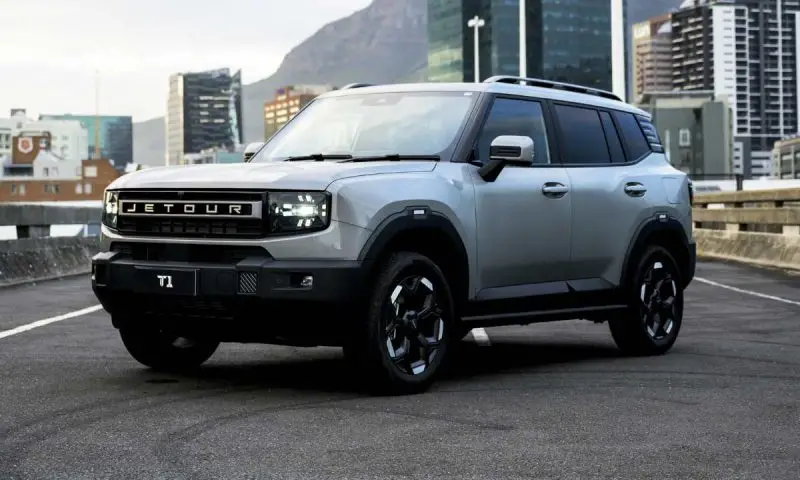
Jetour T1 price in Panama by version
| Version | Price (ITBMS included) | Engine | Drive | Central screen |
|---|---|---|---|---|
| T1 Comfort | 32,000 dollars | 1.5 turbo, 181 hp | Front | 12.8″ |
| T1 Sport 2.0T XWD | 38,000 dollars | 2.0 turbo, 251 hp | All-wheel (XWD) | 15.6″ |
| T1 Plug-in Hybrid (PHEV) | 38,000 dollars | 1.5 turbo + 2 electric, 342 hp | Front | 15.6″ |
Launch prices in March 2025 were 30,000 dollars (Comfort) and 36,000 (top 2.0 version), according to Deagencia. These are offer prices: confirm the current value and financing with the dealer.
Jetour T1 technical sheet: engine, power and transmission
The Jetour T1 offers three powertrains: a 1.5 turbo with 181 hp, a 2.0 turbo with 251 hp and a 342 hp plug-in hybrid system. The petrol engines are direct injection and deliver peak power at 5,500 rpm.
| Item | T1 Comfort | T1 Sport 2.0T XWD | T1 Plug-in Hybrid |
|---|---|---|---|
| Engine | 1.5 turbo, 4 cylinders | 2.0 turbo, 4 cylinders (1,998 cc) | 1.5 turbo + 2 electric motors |
| Power | 181 hp | 251 hp at 5,500 rpm | 342 hp combined |
| Torque | 290 Nm | 390 Nm between 1,750 and 4,000 rpm | 525 Nm combined |
| Transmission | 7-speed dual clutch (7DCT) | 8-speed automatic | Dedicated hybrid (1-DHT) |
| Drive | Front | Intelligent all-wheel (XWD) | Front |
| Wheels | 18″ | 19″ | 19″ |
| Fuel tank | 70 L | 70 L | — |
| Approx. kerb weight | 1,619 kg | 1,811 kg | — |
The 2.0 turbo is the same engine as the Jetour T2, but in the T1 it is paired with a conventional eight-speed automatic instead of a dual clutch. The official sheet for Panama does not publish fuel consumption figures. Sources: Petromotors (Sport and figures by version), Deagencia (wheels, weights and Comfort transmission) and Autoblog Uruguay (hybrid powertrain).
Jetour T1 plug-in hybrid: battery, electric range and power
The plug-in hybrid version of the Jetour T1 claims 150 km in 100% electric mode (NEDC cycle) thanks to a 26.7 kWh battery, and is the most powerful in the range with 342 hp. It is the option for anyone who mostly drives urban routes and can charge at home or at work.
| Item | T1 Plug-in Hybrid |
|---|---|
| System | 1.5 turbo (141 hp / 215 Nm) + 2 electric motors (201 hp / 310 Nm) |
| Combined power and torque | 342 hp / 525 Nm |
| Battery | 26.7 kWh, LFP chemistry (lithium iron phosphate) |
| Electric range | 150 km (NEDC) · 117 km (WLTC) |
| Claimed total combined range | Up to 1,300 km (NEDC) |
| Drive | Front |
| Battery warranty | 8 years or 150,000 km |
The cycle used changes the figure a lot. NEDC is the most optimistic; WLTC, closer to real use, lowers the electric range to 117 km. In a test drive in Chile, The Clinic estimated between 65 and 80 electric km in real conditions. Even so, it comfortably covers a typical daily commute in Panama City without using petrol.
LFP chemistry is the most used today in vehicle batteries for its thermal stability and its lifespan over charge cycles. Sources: Autoblog Uruguay, Jetour Uruguay and Petromotors.
Jetour T1 4×4: XWD traction and off-road drive modes
The Sport 2.0T version is the only Jetour T1 with all-wheel drive (XWD) in Panama, and adds features that are unusual in a compact SUV: centre differential lock, electronic limited-slip differential and water depth detection when wading.
| Feature | What it brings in practice |
|---|---|
| XWD all-wheel drive | Splits power between both axles in rain, dirt or slopes |
| Centre differential lock | Keeps traction when a wheel loses grip |
| Electronic limited-slip differential | Stops the unsupported wheel spinning freely |
| Hill descent control (HDC) and hill start assist (HAC) | Descends and starts on steep slopes without driver intervention |
| Wading detection | Indicates water depth when crossing a puddle or a river |
| Independent suspension (McPherson front, multi-link rear) | More comfort on uneven pavement |
The Sport offers eight drive modes: Sport, Economy, Standard, Snow, Mud, Sand, Rock and an intelligent X Smart mode. The Comfort version keeps the Sport, Economy and Standard modes, designed for city and highway. Petromotors’ marketing summarises the range as “7 drive modes”.
In Panama, this equipment translates into dirt roads to farms, beaches with sand access or the climb to Boquete in the rainy season. Source: T1 Sport technical sheet at Petromotors.
Jetour T1 dimensions and boot capacity
The Jetour T1 is 4,705 mm long, 1,967 mm wide and 1,843 mm tall, with a 2,800 mm wheelbase and a 574-litre boot. All three versions share the same body.
| Measurement | Jetour T1 |
|---|---|
| Length | 4,705 mm |
| Width | 1,967 mm |
| Height | 1,843 mm |
| Wheelbase | 2,800 mm |
| Boot | 574 L (expandable by folding the 60:40 second row) |
| Seats | 5 |
| Spare tyre | Included |
Its width and height place it above the segment average: it is about 10 cm wider and about 15 cm taller than a RAV4 or a CX-5. That shows in shoulder room and in the raised driving position, although it also demands more attention when parking in tight spaces. Sources: Petromotors and Deagencia (boot).
Jetour T1 safety: 5 stars ASEAN NCAP and ADAS assistance
The Jetour T1 earned five stars in ASEAN NCAP with 87.67 points, under the 2021-2025 protocol, and all versions sold in Panama carry six airbags. Autonomous emergency braking (AEB) is available in the Sport and Hybrid versions.
| Area assessed by ASEAN NCAP | Points scored | Maximum possible |
|---|---|---|
| Adult occupant protection | 38.09 | 40 |
| Child occupant protection | 16.18 | 20 |
| Safety assist | 17.14 | 20 |
| Motorcyclist safety | 16.25 | 20 |
| Total | 87.67 | 100 |
The unit assessed was the 2.0 turbo version for the Asian market, according to the ASEAN NCAP report. It is a useful reference for the vehicle’s structure, but not a test of the exact configuration sold in Panama.
Safety equipment of the T1 Sport according to the Petromotors sheet:
- Braking and stability: ABS, EBD, brake assist, stability and traction control, rollover control and cornering brake control.
- ADAS assistance: autonomous emergency braking (AEB), adaptive cruise, forward and rear collision warning, blind spot detection, lane departure warning and lane keeping assist, and intelligent high beams.
- Visibility and parking: 540° HD camera with dynamic guidelines and front and rear sensors.
- Protection: six airbags, ISOFIX anchors, tyre pressure monitoring and electronic immobiliser.
The Comfort version includes six airbags, stability control, blind spot detection, lane change warning and hill descent control, according to Deagencia; it does not include autonomous braking.
Jetour T1 technology and interior: 15.6″ screen and Sony audio
The Sport and Hybrid versions fit a 15.6-inch central screen, a 10.25-inch digital instrument cluster and a 9-speaker Sony audio system. The Comfort uses a 12.8-inch screen and six speakers.
| Equipment | T1 Comfort | T1 Sport and Hybrid |
|---|---|---|
| Central screen | 12.8″ | 15.6″ |
| Digital instrument cluster | 10.25″ | 10.25″ |
| Apple CarPlay and Android Auto | Yes | Yes |
| Audio | 6 speakers | 9 Sony speakers |
| Wireless charger | Yes | Yes |
| Seats | Leather, electric adjustment, front ventilation and heating | Leather, electric adjustment with memory, ventilation and heating |
| Roof | Panoramic with electric opening | Panoramic with sunroof |
| Tailgate | Electric | Automatic |
| Start | Button | Button and remote start |
Both levels have climate control with rear vents, ambient lighting, front and rear USB ports and LED exterior lights. The Sport adds side steps, rain sensor and power-folding mirrors. Sources: Petromotors (Sport) and Deagencia (Comfort).
Jetour T1 vs RAV4, CX-5 and Tucson: how it compares
Against the benchmark compact SUVs in Panama, the T1 Sport stands out for power, size and the price of its 4×4 version with autonomous braking, while its rivals keep the advantage in reliability record and resale value.
| Item | Jetour T1 Sport XWD | Toyota RAV4 | Mazda CX-5 (2027) | Hyundai Tucson |
|---|---|---|---|---|
| Maximum power | 251 hp | 236 hp (Hybrid AWD) | 177 hp | 154 hp |
| 4×4 version with autonomous braking | 38,000 dollars | 44,995 dollars (Hybrid AWD) | 39,250 dollars (Signature AWD) | No equivalent version |
| Width / height | 1,967 / 1,843 mm | 1,855 / 1,695 mm | 1,860 / 1,695 mm | 1,865 / 1,665 mm |
| Boot | 574 L | 580 L | — | 539 L |
| Airbags | 6 | 7 | 7 | 6 |
The RAV4 offers a slightly larger boot, self-charging hybrid versions and Toyota’s service network; the CX-5 adds seven airbags. The T1, on sale in Panama since 2025, is still building its resale record. Data and sources for each rival in FAQ Box’s full Jetour T1 vs RAV4, CX-5 and Tucson comparison. Prices with ITBMS.
Jetour T1 warranty and international recognition
All versions of the Jetour T1 have a 7-year or 200,000 km warranty, and the hybrid’s battery 8 years or 150,000 km. So publishes the official distributor, Petromotors.
Which Jetour T1 version is worth buying?
The choice depends on use: Comfort for the city at the lowest price, Sport for anyone who leaves the tarmac and Hybrid for anyone who drives mostly in the city and can charge.
| If you are looking for… | Recommended version | Why |
|---|---|---|
| The lowest entry price | T1 Comfort (32,000 dollars) | Same size and warranty, 181 hp and good comfort equipment |
| Beach, farm or mountain trips | T1 Sport 2.0T XWD (38,000 dollars) | All-wheel drive, differential lock, off-road modes and autonomous braking |
| Saving fuel in the city | T1 Plug-in Hybrid (38,000 dollars) | 150 electric km (NEDC), 342 hp and a battery with an 8-year warranty |
Between Sport and Hybrid, at the same price, the key question is whether you need all-wheel drive. If not, and you have somewhere to charge, the hybrid cuts daily petrol spending. If off-road use is frequent, the Sport is the only version with 4×4.
The T1 will be on display at the Panama Motor Show 2026, from 2 to 4 and from 7 to 11 October, at the Panama Convention Center in Amador.
Frequently asked questions about the Jetour T1
How much does the Jetour T1 cost in Panama?
From 32,000 dollars for the Comfort version and 38,000 for the Sport XWD and Plug-in Hybrid versions, ITBMS included, according to Petromotors’ September 2026 offer prices.
How much horsepower does the Jetour T1 have?
The T1 Comfort has 181 hp (1.5 turbo engine), the T1 Sport 251 hp (2.0 turbo engine) and the T1 Plug-in Hybrid 342 hp combined.
Is the Jetour T1 a 4×4?
Only the Sport 2.0T version. It has intelligent all-wheel drive (XWD), centre differential lock and modes for snow, mud, sand and rock. The Comfort and the Hybrid are front-wheel drive.
How many kilometres does the Jetour T1 hybrid travel in electric mode?
150 km under the NEDC cycle and 117 km under the WLTC cycle, with a 26.7 kWh battery. In real use, press tests estimate between 65 and 80 km.
How safe is the Jetour T1?
It earned five stars in ASEAN NCAP with 87.67 points. In Panama all versions carry six airbags, and the Sport and the Hybrid add autonomous emergency braking.
What warranty does the Jetour T1 have?
7 years or 200,000 km on all versions. The hybrid version’s battery has 8 years or 150,000 km.
What is the boot capacity of the Jetour T1?
574 litres, expandable by folding the second row of seats (60:40).
Related articles
- Guide to buying a Chinese car in Panama: warranty, parts, workshops and resale
- Plug-in hybrids in Panama: what they are, how they charge and who sells them
- What Jetour is and why it wins awards on four continents
Sources
- Petromotors, Jetour T1: versions, prices and technical sheet (consulted 30 September 2026).
- FAQ Box, Jetour T1 vs RAV4, CX-5 and Tucson.
- Deagencia, Jetour T1 in Panama (15 March 2025, updated 14 September 2026).
- Autoblog Uruguay, launch of the Jetour T1 PHEV.
- Jetour Uruguay, T1 PHEV.
- The Clinic, behind the wheel of the Jetour T1 PHEV.
- ASEAN NCAP, Jetour T1 result.
- Top Gear Philippines, T1 i-DM review.
- G5noticias, Autocosmos 2026 recommended cars (10 January 2026).
Ask about this article
Type your question and we will show you the answer inside this article or in other Radar Panamá publications.