
Contents of this guide
Braces or Invisalign: the short answer
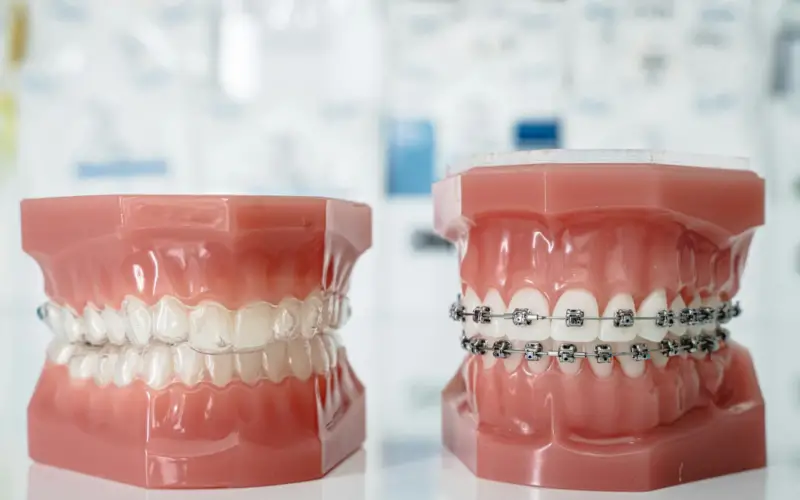
Neither is better in absolute terms. The AAO sums it up this way: there is no single right way to do orthodontics, one appliance is not inherently better than another, and the choice depends on the treatment goals and on each patient’s lifestyle. Braces, metal or ceramic, are bonded to the teeth and a wire guides the movement. Aligners are a series of clear trays that come out for eating and brushing.
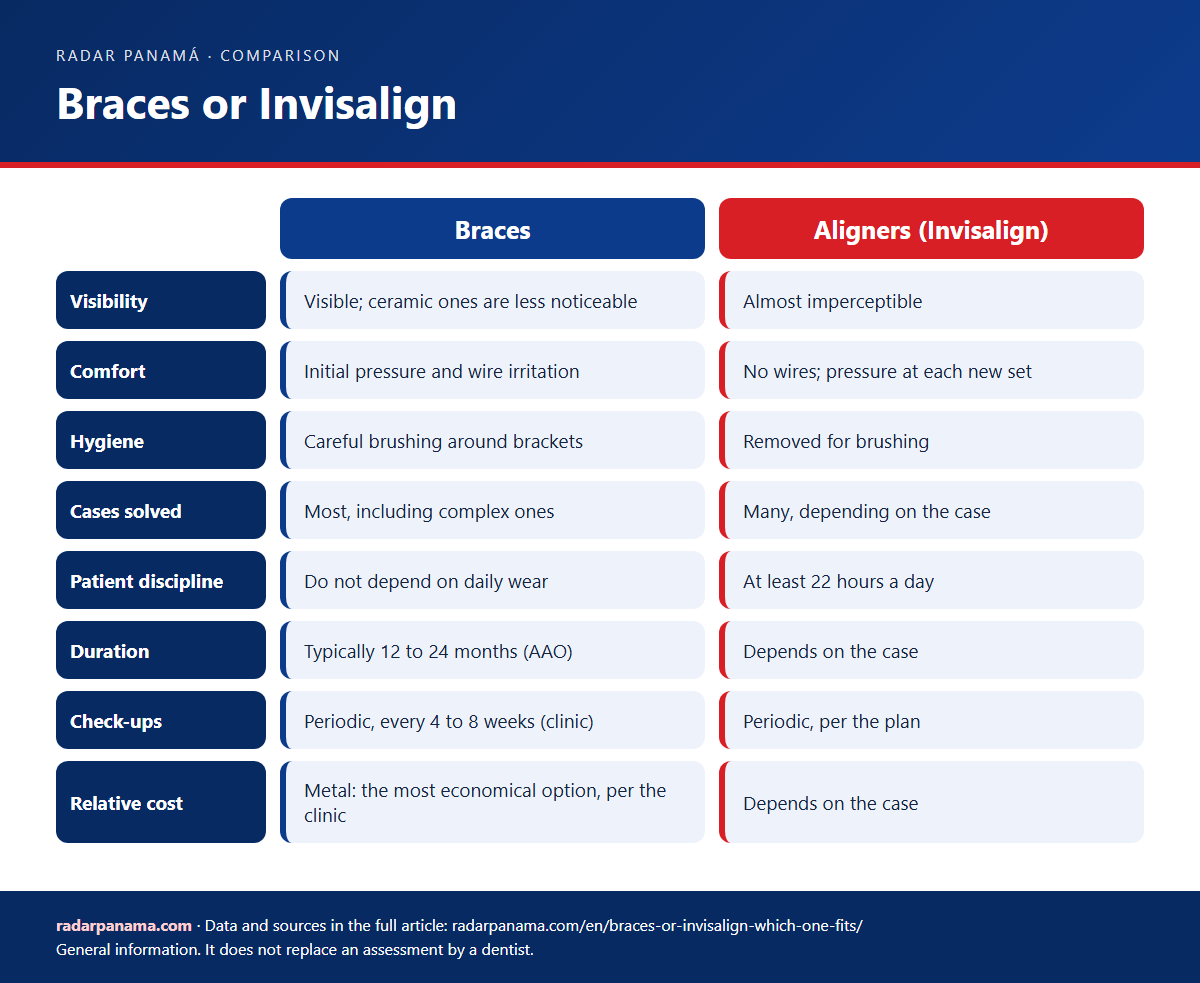
The table gathers the differences that weigh most in the decision. The cells summarize what the AAO, the Dental Life orthodontics page and its original blog article say; each point is detailed in the sections below.
| Aspect | Braces | Aligners (Invisalign) |
|---|---|---|
| Visibility | Visible; ceramic ones are less noticeable | Almost imperceptible |
| Comfort | Initial pressure and wire irritation | No wires; pressure at each new set |
| Hygiene | Careful brushing around brackets | Removed for brushing |
| Cases solved | Most, including complex ones | Many, depending on the case |
| Patient discipline | Do not depend on daily wear | At least 22 hours a day |
| Duration | Typically 12 to 24 months (AAO) | Depends on the case |
| Check-ups | Periodic, every 4 to 8 weeks (clinic) | Periodic, per the plan |
| Relative cost | Metal: the most economical option, per the clinic | Depends on the case |
Summary based on the AAO and on information published by Dental Life. Actual timelines and check-up schedules are set by the specialist for each case.
When each one fits
The AAO describes braces as an option that “can treat most orthodontic problems” and aligners as effective for many, with suitability depending on the case. Its page on aligners lists crowding, gaps, overbite, underbite, open bite and crossbite, and adds that aligners are “not right for everyone” and that some cases are treated more predictably with braces.
The systematic review by Ke, Zhu and Zhu (BMC Oral Health, 2019), covering 8 studies, found that both appliance types correct malocclusion. Aligners stood out in segmented tooth movement and in less chair time, while braces were superior for occlusal contacts, torque control and transverse expansion. A more recent review in the European Journal of Orthodontics (2025), with 15 trials and 1,084 patients, found no significant differences in quality or duration in non-extraction cases, but better quality with fixed appliances in extraction cases, thanks to better control of tooth movement.
- Braces tend to fit when the case is complex, when extractions are expected or when the treatment should not depend on daily wear. The clinic’s original article describes them as an option that does not rely on patient discipline.
- Aligners tend to fit when discretion matters, when the case is mild to moderate and when the patient can keep up the wear time. On its landing page the clinic says aligners suit most corrections and that some complex cases are better solved with braces.
- Age. The clinic states that orthodontics suits any age as long as gums and bone are healthy. For teenagers, its original article considers braces potentially more appropriate, since they do not require the consistency aligners demand.
Who decides: the diagnosis
According to the AAO, an orthodontist is the professional qualified to determine whether braces or aligners are the better option. The starting point is the diagnosis, and a tailored plan follows. The Dental Life orthodontics page describes that process: a clinical exam, X-rays, photographs and study models, then a plan in which the available options are presented with their pros and cons.
The clinic’s orthodontics and Invisalign landing page adds a prerequisite: before any tooth is moved, the patient is checked for cavities and gum disease, because moving teeth in a diseased mouth can damage the bone. At the clinic, orthodontics is handled by Dr. Samuel Ibarra, whom the clinic’s profile presents as a specialist in orthodontics and laser dentistry. When gum health and the rest of the mouth need separate attention, the guide to full mouth rehabilitation explains how a comprehensive plan is built.
Faster, more painful, costlier: what the evidence says
Duration. The AAO says most people wear braces for 12 to 24 months, with variation by complexity. Comparisons between appliances are not uniform: Ke and colleagues calculated that, without extractions, aligners took about 6 months less, while the 2025 EJO review found no significant differences in those cases. For a patient, the prudent reading is that time depends more on the case than on the type of appliance.
Pain and discomfort. Both treatments create pressure in the first days. A systematic review with meta-analysis (Li and colleagues, BMC Oral Health, 2023) of 12 studies found less pain with aligners only on the third and fourth day after starting, with no clear differences at other points, and rated the certainty of the pain evidence as very low. For quality of life, aligners showed an edge at one month and six months, which evened out over time. In its landing page the clinic explains that mild pressure in the first days of each aligner set or adjustment is normal.
Hygiene. With braces, the AAO recommends a soft-bristled toothbrush, fluoride toothpaste and tools such as water flossers or interdental brushes for hard-to-reach areas, and advises avoiding hard and sticky foods. With aligners, teeth must be clean before the trays go back in, and the AAO advises against drinking sugary drinks with them in place, to prevent staining and decay. Professional cleanings remain part of the routine; their frequency is covered in the guide on how often to get a dental cleaning.
Cost. Neither the AAO nor the reviews cited give comparable figures, and this article does not include any. The clinic explains on its landing page that cost depends on how far the teeth have moved, the type of treatment (braces or aligners) and how long it lasts, and that it provides the exact quote after the assessment. Its orthodontics page describes metal braces as the most economical option.
The Dental Life orthodontics page describes metal braces, ceramic braces and clear aligners, and the process from diagnosis to retention.
What to ask at the assessment
An assessment exists to decide with data. These questions help keep the recommendation clear and let each option be weighed against the diagnosis:
- What bite problem is present and how complex it is. That determines whether both appliances are viable or one is clearly more predictable.
- Whether extractions or other procedures are expected. The 2025 EJO evidence shows this factor weighs on the choice.
- What duration estimate applies to each option and what it depends on. The clinic says it gives an estimate with the 3D plan.
- How many hours of daily wear the aligner requires and what happens if they are not met. The AAO speaks of at least 22 hours; the clinic’s original article mentions 20 to 22, so the figure for this specific plan is worth asking for.
- How often the check-ups are and how many visits to expect. The clinic says they are usually every 4 to 8 weeks.
- How healthy the gums are and whether any cavities are pending that must be handled before starting.
- The exact budget for each option, what it includes and how it is paid. The clinic says it provides it after the assessment.
- How retention will work once treatment ends, since retainers are part of the treatment.
This content is informational and does not replace an assessment by a dentist or orthodontist.
Frequently asked questions
Which is faster, braces or Invisalign?
It depends on the case, not the appliance. The AAO says most people wear braces for 12 to 24 months, and the systematic reviews cited disagree: one found treatments about 6 months shorter with aligners in non-extraction cases, and a 2025 review found no significant differences. The orthodontist estimates the duration after the diagnosis.
Does Invisalign work for complex cases?
Sometimes, depending on the case. The AAO says aligners are not right for everyone and that some cases are treated more predictably with braces. A 2025 review in the European Journal of Orthodontics found better quality with fixed appliances in extraction cases. The clinic notes that some complex cases are better solved with braces.
Which one hurts more?
Both cause pressure in the first days. A 2023 meta-analysis found less pain with aligners only on the third and fourth day, with very low certainty of evidence, and no clear differences afterward. The clinic says mild pressure after each adjustment or new aligner set is normal.
Which one is cheaper in Panama?
According to the Dental Life orthodontics page, metal braces are the most economical option. The final cost depends on how far the teeth have moved, the type of treatment and its duration, and the clinic provides the exact quote after the assessment.
Do the gums need to be healthy before starting?
Yes. According to the clinic’s landing page, before any tooth is moved the patient is checked for cavities and gum disease, because moving teeth in a diseased mouth can damage the bone. That applies to both braces and aligners.
Related articles
- How often to get a dental cleaning in Panama
- Full mouth rehabilitation in Costa del Este: a guide to a comprehensive plan
More information is available on Dental Life’s orthodontics and Invisalign landing page and on the profile of Dr. Samuel Ibarra. The original article on the Dental Life blog is also available (in Spanish).
More dental health guides on Radar Panamá
- Invisalign in Panama: How It Works, Duration and Candidates
- Dental Veneers in Panama: When They Fit and When They Do Not
- How Long Do Dental Implants Last? What the Studies Show
- Gingivitis vs Periodontitis: Symptoms and Treatment
- Wisdom Teeth: When to Remove Them and What Recovery Looks Like
Sources
- AAO, Aligners vs. Braces: A Comparison: no appliance is inherently better; decision based on goals and lifestyle.
- AAO, Aligners: wear of at least 22 hours a day, treatable cases and the orthodontist’s role.
- AAO, Braces: typical duration of 12 to 24 months, hygiene and foods.
- Ke Y, Zhu Y, Zhu M. A comparison of treatment effectiveness between clear aligner and fixed appliance therapies. BMC Oral Health, 2019.
- Quality and stability of orthodontic treatment outcomes with clear aligners versus fixed appliances: a systematic review and meta-analysis. European Journal of Orthodontics, 2025.
- Li et al. Comparison of pain intensity and impacts on oral health-related quality of life between orthodontic patients treated with clear aligners and fixed appliances: a systematic review and meta-analysis. BMC Oral Health, 2023.
- Dental Life, Orthodontics, orthodontics and Invisalign landing page, original article Brackets vs Invisalign and profile of Dr. Samuel Ibarra.
Ask about this article
Type your question and we will show you the answer inside this article or in other Radar Panamá publications.