

Contents of this guide
When wisdom teeth must come out and when watching is enough
Wisdom teeth, or third molars, are the last teeth to come in. When there is not enough room they stay trapped or come in only partly, and that is where problems start. The reasons for removal listed by the American Dental Association (MouthHealthy) include pain or infection, cysts or tumors, damage to neighboring teeth, gum disease and decay that cannot be restored. When there are signs of disease, removal is the usual recommendation.
A tooth with no symptoms and no disease is a different case. The 2020 Cochrane review on this question analyzed only 2 studies, with 493 participants in total, and rated the certainty of the evidence as very low. Its conclusion: there is not enough data to decide whether these teeth should be removed or kept. One study suggested that keeping them might be linked, in the long term, to a higher risk of periodontitis in the neighboring second molar, though the evidence is very uncertain. If the teeth are kept, the authors consider regular clinical check-ups advisable.
In practice, the decision is made between the dentist or surgeon and the patient, based on the position of the tooth, the person’s history and preferences. The wisdom teeth page of Dental Life follows the same logic: remove when there are signs of disease and decide case by case when there are no symptoms.
Signs that justify an evaluation
None of these signs confirms on its own that surgery is needed, but each one deserves an exam with an X-ray:
- Persistent pain at the back of the jaw, especially when chewing or opening the mouth, sometimes spreading toward the ear.
- Swollen, red or bleeding gum around a tooth that came in partly. Cleveland Clinic calls this inflammation pericoronitis: the flap of gum over the tooth traps bacteria and food. Its acute forms include severe pain, fever, facial swelling, pus and trouble swallowing.
- A persistent bad taste or bad breath in the area.
- Decay or difficulty cleaning on the wisdom tooth or the tooth next to it.
- Jaw stiffness or trouble opening the mouth.
- Shifting or crowding of the teeth. The clinic lists it in its original article on signs for removal; the X-ray shows whether the wisdom tooth is the cause.
Pain in that area can also have another source, such as deep decay that needs a root canal. Telling them apart is part of the evaluation.
The panoramic X-ray and what it decides
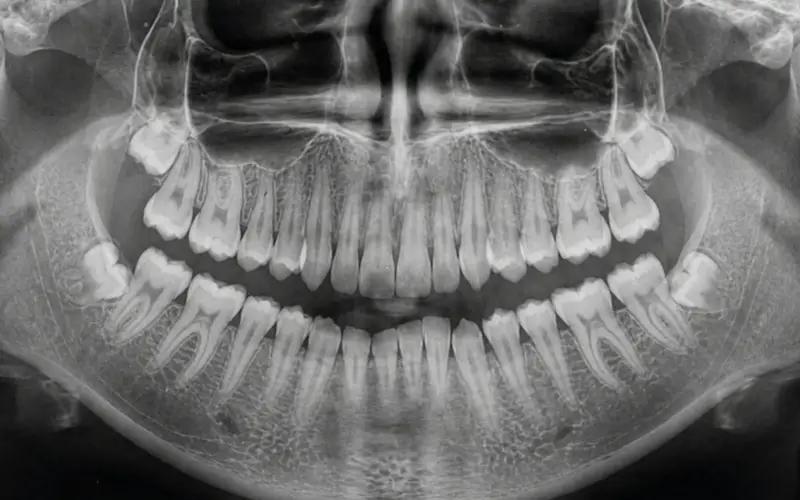
The ADA states that the dentist examines the mouth and takes an X-ray before deciding. The clinic uses the panoramic image to assess the position and development of the teeth, detect cysts, infections or damage to adjacent teeth and plan the extraction, and says it has digital radiology equipment (according to the clinic). The image provides, among other things, this information:
| What the image shows | Why it matters for the decision |
|---|---|
| Position of the tooth | A tilted tooth, or one trapped against its neighbor, changes the risk and the technique. |
| Condition of the neighboring tooth | Shows decay or damage in the second molar. |
| Cysts or lesions | One of the reasons for removal cited by the ADA. |
| Nearby bone structures | The clinic uses it to plan the extraction and reduce risks. |
| Available space | Indicates whether the tooth can come in fully or will stay trapped. |
Reading the X-ray is up to the professional who evaluates each case.
What the procedure is like
According to the UK NHS, removal is done with an injected local anesthetic. If the case is complex or the patient is anxious, sedation can be added or general anesthesia used. If gum covers the tooth, the surgeon cuts it, widens the socket and takes the tooth out whole or in pieces, then closes the area with dissolvable stitches. The NHS says the surgery often takes just a few minutes and should take no more than 40.
The clinic describes the same outline in its guide to before, during and after surgery: a panoramic X-ray, a review of medical history, a talk about sedation, and preparation at home with a ride back, soft foods and prescribed medication. Its article on pain states that nothing hurts during the procedure because the area is numbed, though pressure or movement may be felt. The clinic also mentions sedation protocols and minimally invasive techniques (according to the clinic).
The duration of each surgery is defined at the evaluation, depending on the case.
Recovery day by day
Timelines vary with the complexity of the case. The NHS says pain, swelling and bruising can last up to 2 weeks, improving after 1 or 2 days, and that many people return to normal activities the next day. The clinic places peak swelling between 48 and 72 hours and mild to moderate pain at 2 to 3 days. The table combines both sources, and the surgeon adjusts the timing for each patient.
| When | What usually happens | Eating | Activity and hygiene |
|---|---|---|---|
| First hours | Light bleeding, controlled by biting on sterile gauze for about 30 to 45 minutes (clinic). | Cold or lukewarm liquids. | Rest, local cold, no spitting or straws, no smoking. |
| Days 1 to 3 | Peak swelling between 48 and 72 hours; mild to moderate discomfort. | Liquids and very soft foods: plain yogurt, warm broth, gelatin. | No intense exercise; no brushing the area or hard rinsing on day one; afterward gentle warm salt-water rinses. |
| Days 4 to 7 | Swelling goes down gradually; non-dissolvable stitches, if any, are removed. | Purees, creamy soups, scrambled eggs, pasta, flaked fish. | Gradual return to routine; office work after 2 to 3 days, per the clinic. |
| Week 2 onward | Leftover soreness and bruising fade; the NHS notes up to 2 weeks. | Solid foods reintroduced gradually, chewing carefully. | Exercise and sports once the surgeon allows it. |
Sources: the NHS recovery guide and the clinic’s articles on recovery and aftercare. The surgeon may change these instructions.
The guides agree on avoiding hard or hot foods and alcohol, not smoking, not drinking through a straw, and keeping the mouth clean without brushing the wound. The clinic is not consistent on how long to apply cold (the first 24 hours in one article, the first 48 in another), an example of why the surgeon’s own written instructions matter. Routine care also helps the general state of the mouth, including a regular dental cleaning.
Dry socket and warning signs
Dry socket (alveolar osteitis) happens when the clot that protects the tooth socket does not form or comes loose before healing. Cleveland Clinic puts it at roughly 2 to 5 percent of tooth extractions, more often after wisdom teeth. It usually appears in the first 3 days, and if there are no symptoms by day 5 the risk is low. Severe pain that spreads to the jaw or ear, a bad taste and bad breath are its usual signs.
The risk factors that source lists include smoking (it triples the risk), poor oral hygiene, using a straw, vigorous rinsing and estrogen-containing contraceptives. Prevention follows from that: no smoking, no straws, gentle rinsing, soft foods and following the post-operative instructions.
According to the NHS and the clinic’s articles, these are signs to call the surgeon or the clinic without waiting for the follow-up visit:
- Bleeding that does not stop or is heavy.
- Severe pain that does not improve with the prescribed painkillers, or that prevents sleep.
- Swelling that grows after the third day.
- Fever, discharge in the area or a persistent bad taste.
- Trouble swallowing or breathing.
- Prolonged numbness or tingling in the lip or tongue. The NHS lists it as a risk of nerve damage, usually temporary.
What to ask at the evaluation
- Is removal needed now, or can the tooth be monitored? It helps to ask for the specific reason shown on the X-ray.
- What risks apply to this case? This includes closeness to nerves, the condition of neighboring teeth and the chance of dry socket.
- Which anesthesia or sedation will be used, and does it require a companion and a ride home?
- How many teeth come out in the same session, and how long will the surgery last?
- What medication and aftercare are given in writing? With schedules, cold, eating and hygiene.
- When is the follow-up visit, and which number to call for a warning sign?
- What is the quote? According to its FAQ, the clinic gives the exact quote after the evaluation. Cost depends on factors such as the position of the teeth, the number of teeth and the type of anesthesia.
For people traveling to Panama for treatment, the guide to medical tourism in Panama gives the general context, and the one on the health system explains the difference between public and private care.
Dental Life Panamá describes on its service page the evaluation with a panoramic X-ray and wisdom teeth removal. According to the clinic, its specialists are certified and have advanced training in oral surgery.
Where Dental Life is
The team presented on the clinic’s website includes Dr. Giorgio Colucci, an oral and maxillofacial surgeon, described as an expert in maxillofacial surgery and complex surgical procedures. The contact details on the website are:
- Address: Office 543, Torre Palmeras, Consultorios Town Center, 5th floor, Costa del Este, Panama City.
- Hours: Monday to Friday from 8:00 a.m. to 6:00 p.m. and Saturday from 8:00 a.m. to 1:00 p.m.
- Phones: (+507) 388-7150 and (+507) 6130-4046.
- Email: sonrie@dentallifepanama.com.
More detail is in the original article on the Dental Life blog (in Spanish) and on the clinic’s website.
Frequently asked questions
Is it mandatory to have wisdom teeth removed?
No. If they cause no symptoms or disease, the 2020 Cochrane review found not enough evidence to recommend routine removal. They are taken out when there is pain, infection, decay, damage to neighboring teeth or cysts, and teeth that are kept are checked at regular intervals.
At what age do wisdom teeth come in?
Usually between 17 and 25, according to the clinic’s page; the ADA (MouthHealthy) mentions ages 17 to 21. Often there is not enough room, and the teeth stay trapped or come in only partly.
What happens if I do not remove them?
If they are healthy and symptom free, they can be kept with regular check-ups. If they stay partly covered by gum they can cause pericoronitis, decay or damage to the neighboring tooth, and the dentist usually recommends removal then.
How many days does the swelling last?
According to the clinic, swelling peaks between 48 and 72 hours after surgery and then goes down. The NHS says pain, swelling and bruising can last up to 2 weeks, improving after 1 or 2 days.
When can I eat normally?
After surgery, soft foods are the rule for the first days. The clinic’s guide expects firmer foods between days 4 and 7 and solids gradually from week 2, and the surgeon adjusts those timelines.
This content is informational and does not replace an evaluation by a dentist or oral surgeon.
Related articles
- What a root canal is and when it is needed
- How often to get a dental cleaning
- Medical tourism in Panama
- Panama’s health system: CSS, MINSA and private
More dental health guides on Radar Panamá
- Invisalign in Panama: How It Works, Duration and Candidates
- Dental Veneers in Panama: When They Fit and When They Do Not
- How Long Do Dental Implants Last? What the Studies Show
- Braces or Invisalign: Which One Fits the Case
- Gingivitis vs Periodontitis: Symptoms and Treatment
Sources
- Cochrane, Surgical removal versus retention for the management of asymptomatic disease-free impacted wisdom teeth (2020).
- NHS, Wisdom tooth removal, what happens during removal and recovery.
- ADA MouthHealthy, Wisdom teeth.
- Cleveland Clinic, Pericoronitis and Dry socket.
- Dental Life Panamá, wisdom teeth: clinic information (Spanish).
- Dental Life blog (Spanish): signs for removal, recovery, what to expect, pain and aftercare.
Ask about this article
Type your question and we will show you the answer inside this article or in other Radar Panamá publications.